

Solís's Expedition: Discovery of the Río de la Plata
In this entry · 17 sections
Expedition · 1515. Juan Díaz de Solís.
Varela dates departure from Sanlúcar to 8 October 1515 with two caravels and one nao, after a ship was lost and replaced during preparations. He reconstructs the route via the Canaries, Cape Verde and the Brazilian coast from Enciso’s Suma. [B129]
In February 1516 the fleet entered the Mar Dulce, today’s River Plate. Varela recounts the intention to capture people and the attack in which Solís and his companions died. The account of what happened to the bodies is attributed to the transmitted narrative rather than treated as independently verified. [B129] [B129]
The study describes withdrawal, loading of brazilwood and loss of another ship. The two remaining caravels reached Seville in September 1516. Naming Francisco de Torres among the specialists is insufficient to make him the documented leader of the return. [B129] [B129]
Context
The news of the South Sea reinforced the search for a maritime passage through America. Survey of the southern Atlantic coast was meant to allow connection with Asian routes. [B17]
Stages
- October 8, 1515, Sanlúcar: Departure of the fleet. [B129]
- 1515–1516, Brazilian coast: Reconnaissance voyage southward. [B129]
- 1516, River Plate: Entry into the estuary without finding the sought ocean passage. [B129]
- 1516, Estuary coast: Solís and several companions died on landing. No exact point is fixed for Solís's landing and death. [B129]
- September 1516, Return to Spain: The survivors gave an account of what had been covered. [B129]
Events of this expedition
Route data
- 3 ships according to the tradition.
- He sought a passage to the South Sea and found the great estuary, which he called Mar Dulce.
- Among the castaways of Santa Catarina was Aleixo García, who later reached the lands of the Incas.
Outcome
No exit to the Pacific was found through the estuary. [B129]
Varela describes the return of two caravels to Seville in September 1516 and connects the search for the passage with Magellan’s later enterprise. [B129]
Limits of the evidence
The departure of 1515 is distinguished from Solís's arrival and death in 1516. [B129] [B129]
The location of the episode and the identification of the groups involved vary; sensationalist accounts from the chronicles are not repeated as verified facts. [B129]
Expedition facts
| Date | 1515 |
|---|---|
| Leader | Juan Díaz de Solís |
| Departure | Sanlúcar de Barrameda |
| Destination | — |
| Period | 1515–1516 |
Organisation
Three vessels left Sanlúcar on 8 October 1515. The expedition continued along the Brazilian coast southward to a great estuary, called the Mar Dulce (Freshwater Sea). [B129]
Objectives
- To find a maritime connection to the Pacific [B129]
- To survey the South American Atlantic coast [B129]
Encounters and societies
The accounts of Solís's death were transmitted from the perspective of survivors and European chroniclers. The estuary was a space of Indigenous circulation and settlement, not an enclave discovered without inhabitants. [B129]
Recorded vessels
- Three vessels; unverified names are avoided [B129]
People and societies
- Juan Díaz de Solís: Chief pilot and head of the campaign [B129] [B129]
- Francisco de Torres: Specialist named by Varela; the passage does not assign him individual command of the return [B129]
- Estuary populations: Populations mentioned in the landing account; no single ethnic identification is imposed [B129]
Related people
Related cartography
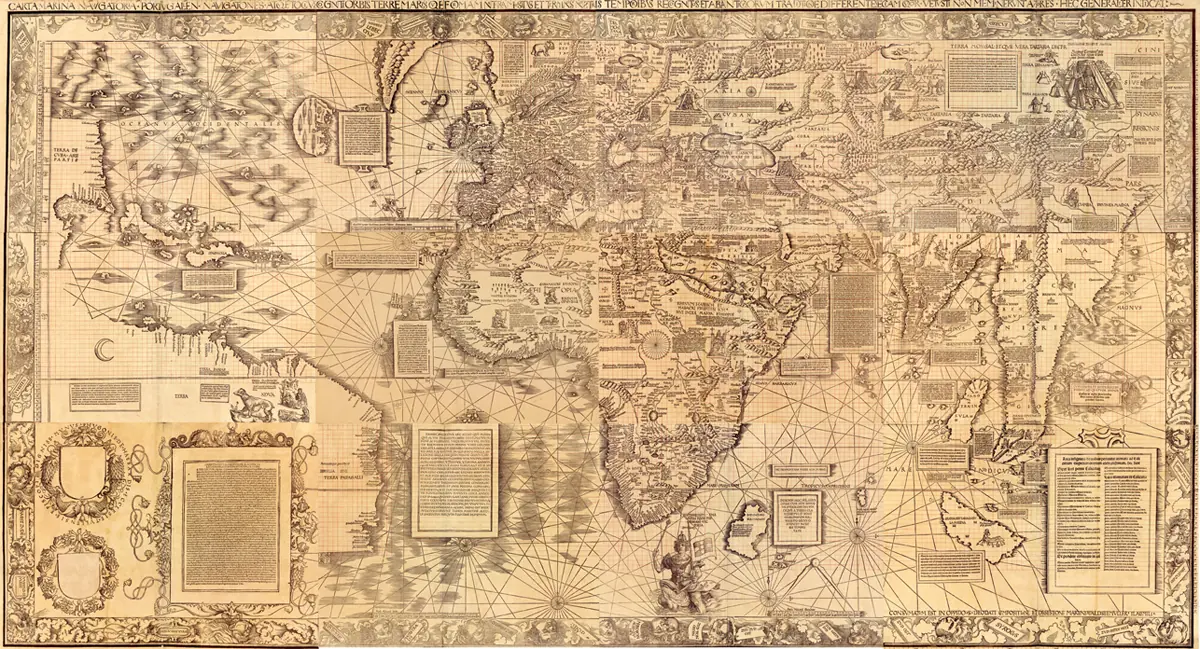
Carta marina navigatoria · 1516. The images and texts combine nautical information and the author's interpretations. It does not record the voyage of Solís or Magellan.
Miller Atlas: world map · 1519. The world map is shown, not all the atlas's sheets. Its composition and decoration also express a political vision of Portuguese dominion.
Nautical planisphere of Lopo Homem · Original of 1554; the museum displays a facsimile. The Galileo Museum distinguishes the original from the facsimile displayed. The record allows consultation of the work; no license is attributed here to its photographs.
Americae sive quartae orbis partis nova et exactissima descriptio · 1562. The copy in the image is reproduced from Wikimedia Commons; the institutional record allows comparison with another copy of the same work. It is not a reconstruction of all the routes.
Americae sive novi orbis, nova descriptio · 1570. The depictions of the far south and the interior territories contain incomplete information and hypotheses of the period.
Descriptionis Ptolemaicae augmentum: set of plates · Atlas of 1597; record of a 1964 facsimile; montage of reproductions with no precise date. The linked record describes a 1964 facsimile with an introduction by R. A. Skelton. The image is a montage of plates, not a single historical sheet. To cite a specific region its plate and edition must be located.
Art and memory
Other expeditions with shared protagonists
Sources and references
- [B189] Juan Díaz de Solís and the southern surveys. Armada, Ministry of Defense. n.d.; edition date not established. Original record
- [B1] General and Natural History of the Indies: second part, first volume. Gonzalo Fernández de Oviedo; edition by José Amador de los Ríos. Work of the 16th century; linked volume edited in 1852. Original record
- [B163] Navegación Virtual Díaz de Solís. Institute of Naval History and Culture. s. f.; recurso institucional. Original record
- [B129] Juan Díaz de Solís, Diccionario Biográfico Español. Real Academia de la Historia. n.d.; edition date not established. Original record
- [B17] Francisco Pizarro González, Diccionario Biográfico Español. Héctor López Martínez · Real Academia de la Historia. n.d.; edition date not established. Original record
- Juan Díaz de Solís and the southern surveys. Armada, Ministry of Defense. Institutional resource with broad chronology. It is used for Solís's departure and itinerary, not to accept without checking all its claims of priority.
Documents and call numbers
- PATRONATO,29,R.5 · Account of Solís's voyage
General bibliography guides further reading; it is not a pinpoint reference for every claim. Page, chapter and archival references are identified at the relevant passages.
Send comments to the author
Found an error or have information to contribute? Write privately to the author.