

Inquiry and relief of Juan Aguado
In this entry · 16 sections
Expedition · 1495. Juan Aguado.
The royal letter of 9 April 1495, transcribed by Las Casas, presents Juan Aguado as a royal household officer and envoy. The chronicler describes his dispatch with four ships. Fernández Morente dates departure from Spain to 5 August. [B24]¶ [B24]¶ [B292]
Las Casas places arrival at La Isabela in October 1495 and recounts the conflict over Aguado’s powers. When narrating the hurricane that damaged the ships, he explicitly expresses a memory doubt which must be retained. [B24]¶ [B24]
The chronicler dates the return with Columbus from 10 March to arrival at Cádiz on 11 June 1496. Pérez de Tudela explains the complaints and Columbus’s need to justify himself to the monarchs. [B24]¶ [B8]
Context
Complaints from settlers and clergy who had returned to Castile led the Monarchs to send a royal pantryman with powers of inquiry, together with the relief the colony needed. [B24]
Stages
- August 5, 1495, Sevilla: Departure from Spain on 5 August, according to Fernández Morente. The Seville map position is an attribution not established by this passage. [B292]
Development
Aguado reached La Isabela in autumn 1495 and collected testimony on the Columbuses' conduct. A hurricane destroyed part of the ships anchored in the port before the return. [B24]¶ [B24]
Route data
- 4 ships with supplies and a royal envoy with inquiry functions.
- Aguado collected testimony on the Columbuses' government.
- From the ships lost in the hurricane the India was built, in which Columbus returned.
Outcome
The inquiry weakened the Admiral's position and anticipated the Crown's later intervention in the government of the Indies; Columbus returned to Castile in 1496 to defend his conduct. [B8] [B24]
Limits of the evidence
The date and number of ships come from the documentary study of the second voyage included in the critical catalog; the content of the inquiry is known mainly from later accounts. [B292] [B24]
Expedition facts
| Date | 1495 |
|---|---|
| Leader | Juan Aguado |
| Departure | Sevilla |
| Destination | Antilles |
| Period | August 5, 1495 |
Organisation
Fernández Morente dates departure from Spain to 5 August 1495; the consulted passage does not specify Seville as the port. The fleet was bound for Hispaniola. [B292]
Objectives
- Fleet of four ships with supplies and a royal envoy charged with reporting on the Columbian government. [B24]
Recorded vessels
- Fernández Morente, p. 124, describes four caravels; a nominal crew list is not completed here. [B292]
People and societies
- Juan Aguado: Participant in or head of the enterprise; see the clarifications and sources in the record [B24]
Related people
Related cartography
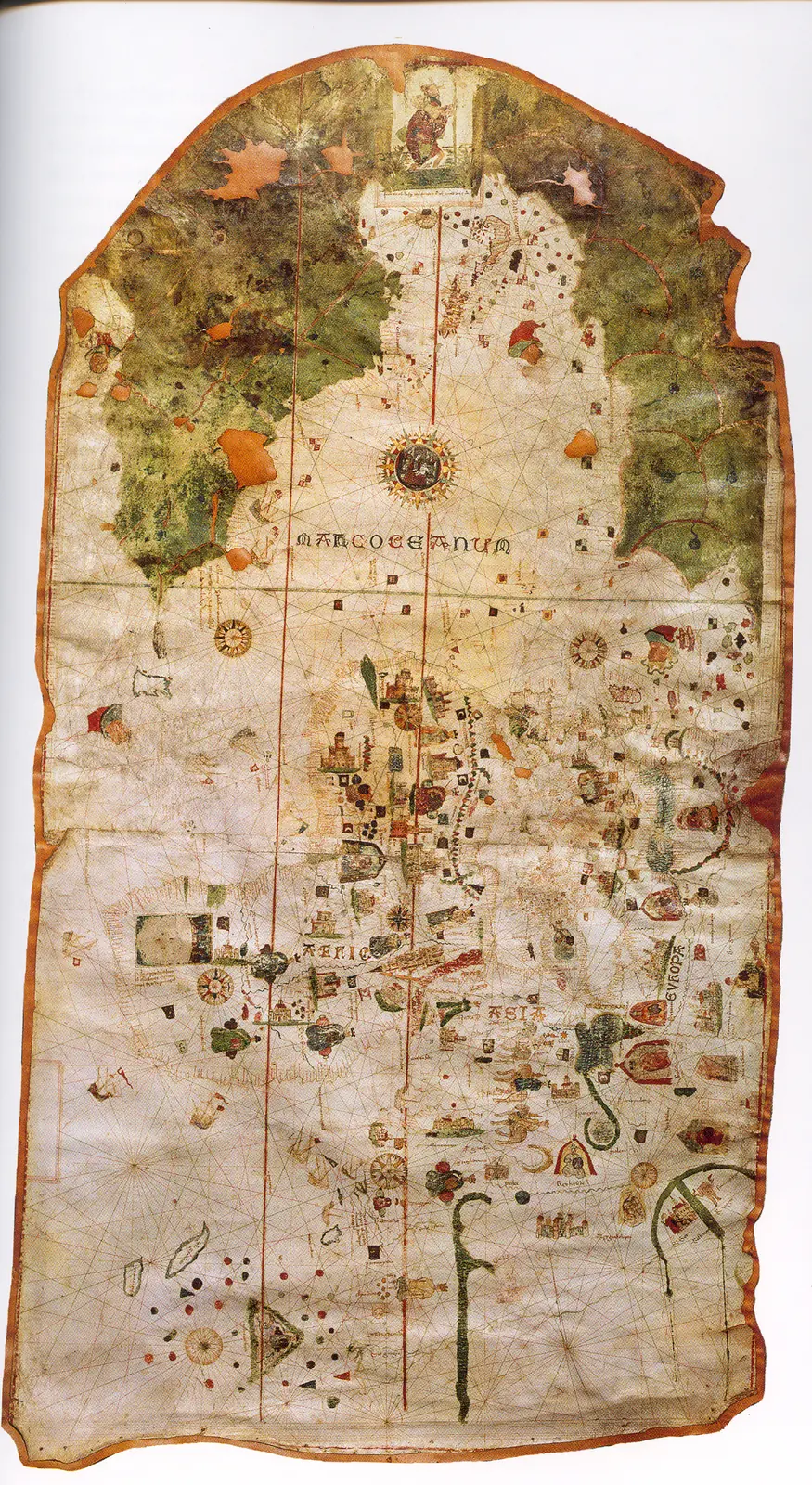
Juan de la Cosa's chart · 1500. It is not a map of the route of Columbus's first voyage. The image reproduces the chart preserved in the Naval Museum, MNM 257.
Art and memory
- Hurricane during Columbus's second voyage · 1613, German edition
Sources and references
- [B24] Historia de las Indias, volumen 2 de 5. Bartolomé de las Casas. Work written between 1527 and 1561; edition of 1875. Original record
- [B292] Juan Bermúdez: descubridor de las Islas Bermudas. Guadalupe Fernández Morente. 2011, pp. 117–132. Original record
- [B8] Cristóbal Colón, Diccionario Biográfico Español. Juan Pérez de Tudela y Bueso · Real Academia de la Historia. n.d.; edition date not established. Original record
- History of the Indies, annotated edition. Bartolomé de las Casas; ed. José Miguel Martínez Torrejón · Miguel de Cervantes Virtual Library, 2006. It narrates the relief expeditions sent to Hispaniola in 1494–1495 and the arrival of Diego Columbus in 1509. Las Casas used Columbian documentation now lost, but writes from a theological and polemical perspective that should be cross-checked.
- Instruction of the Catholic Monarchs for Columbus's voyage, 1493. General Archive of the Indies, INDIFERENTE,418,L.1,F.1V-4R · PARES. Instructions for the second voyage: fitting-out, government and conduct after arrival. It explains the framework of the later relief expeditions but is not a record of their departures.
General bibliography guides further reading; it is not a pinpoint reference for every claim. Page, chapter and archival references are identified at the relevant passages.
Send comments to the author
Found an error or have information to contribute? Write privately to the author.