

Bartolomé de las Casas
In this entry · 14 sections
- Seville and Salamanca
- Encomendero in Hispaniola and Cuba
- Procurator of the Indians
- From Guatemala to the New Laws
- The Valladolid controversy and the last years
- Slavery and historical judgment
- Documentary comparison of a specific episode
- Offices
- Disputed dates and open questions
- Participation
- Maps
- Mentioned in other entries
- Sources
- Linked sources
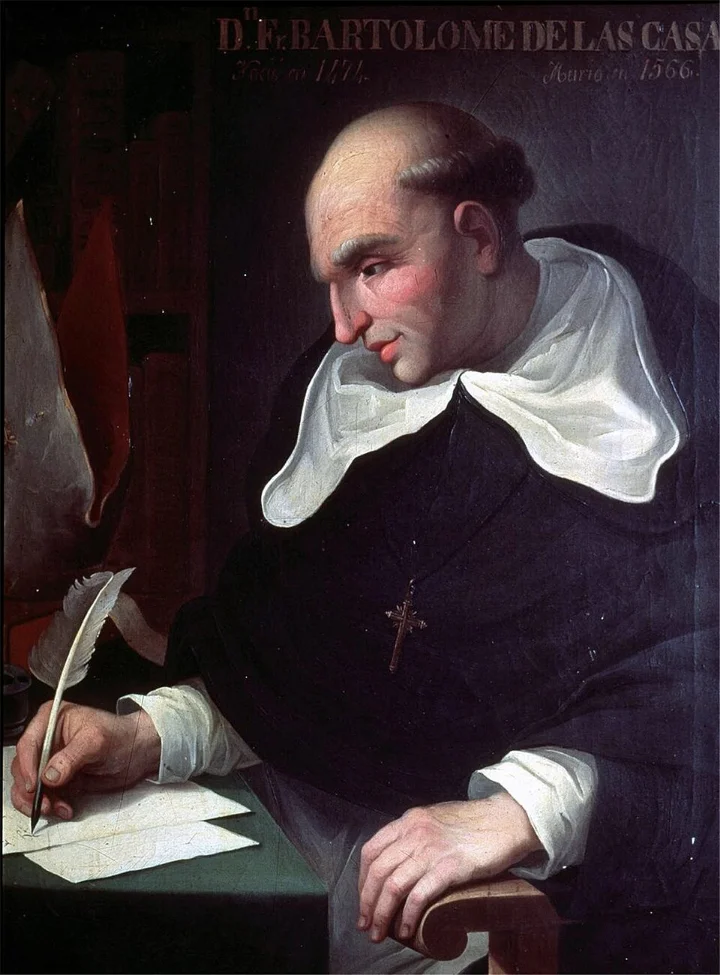
Unidentified artist · Sixteenth century (record dating).
A cleric and former encomendero who relinquished his encomienda and advocated for Indigenous people before the Crown. He entered the Dominican novitiate in 1522 and developed an extensive body of writing on colonisation and evangelisation. [B274] [B274]
Birth: Seville, around 1484 according to the RAH heading [B274]. Death: Madrid, 1566 according to the 1875 editors; the RAH heading gives 1565 [B2]¶ [B274].
Seville and Salamanca
A Sevillian and son of Pedro de las Casas, he received an education whose course is incompletely established. Castañeda records his study of Latin and considers a university career unproven; attendance at Salamanca is therefore not presented as certain. He describes departure with Ovando on 13 February 1502 and arrival at Santo Domingo on 15 April, return to Spain in 1506 and a stay in Rome in 1507. [B274]
Encomendero in Hispaniola and Cuba
In Hispaniola he was a settler and farmer. Castañeda links his relationship with the Dominicans to Montesino’s sermon and his priestly ordination, without dating the latter in that passage. He places his move to Cuba in early 1513, receipt of an encomienda and subsequent decision to relinquish it to defend Indigenous people. His different assignments in Hispaniola and Cuba are distinguished, and a precise chronology of every religious order received is not presented as fully documented. [B274]
Procurator of the Indians
He returned to Spain in 1515 intending to denounce conditions in the Indies. According to Castañeda, a planned audience with Ferdinand did not occur before the king’s death. He prepared memorials and collaborated on reform projects before Adrian and Cisneros. The contract to settle the Paria coast was signed on 19 May 1520 and the farmers departed in December. After the Cumaná enterprise failed, he entered the Dominican novitiate in 1522 and professed in late 1523. [B274]
From Guatemala to the New Laws
The Verapaz evangelisation enterprise of 1537–1539 relied on preaching and negotiations to avoid prior military conquest. Back in Spain from 1540, he advocated reform of government in the Indies. The 1542 New Laws incorporated part of that reforming current, although Las Casas considered continued encomiendas inadequate. Appointed bishop of Chiapas in 1543 and consecrated in Seville in 1544, he faced strong opposition over his Confesonario’s restitution requirements. He returned permanently to Spain in 1547 and relinquished the see. [B274]
The Valladolid controversy and the last years
The 1550–1551 Valladolid controversy confronted his arguments with Sepúlveda’s, with a summary by Domingo de Soto and subsequent objections and replies. Castañeda also examines the treatises printed in Seville in 1552–1553 and the works of his final years in Atocha. His judgments about the Brevísima or imperial policy are attributed to the historian rather than treated as a unanimous historiographical view. [B274]
Slavery and historical judgment
In Historia de las Indias he acknowledges proposing the admission of enslaved Africans to free Indigenous people, adding that he later understood the injustice of their enslavement. This passage documents his retraction without fixing a precise date for the change or attributing a uniform lifelong defence of liberty to him. His retrospective account should be compared with petitions and actions at each stage. [B33]
Documentary comparison of a specific episode
On page 87, David Orique examines the Cumaná project, the departure in December 1520 and its failure in 1521. This study provides a comparison for that specific venture within a broader biography. [B301]
Offices
Chronology
A life, step by step. Follow the dates and open each milestone or image to explore its sources.
- 1502
Sixteenth century (record dating) About this image
Portrait of Bartolomé de las Casas · Sixteenth century (record dating). Context portrait; it does not depict this event. Representation attributed to this person in the provenance record. It is not treated as evidence of physical appearance or as a record of their expeditions. The date of the work is distinguished from its digitisation date.Departure with Ovando and arrival in Santo Domingo. [B274]
Explore this year - 1506–1507
Return to Spain and stay in Rome. [B274]
Explore this year - 1513–1515
Cuba, relinquishing the encomienda and return to Spain. [B274]
Explore this year - 1520–1523
Cumaná enterprise and Dominican profession. [B274]
Explore this year - 1537–1539
Verapaz project. [B274]
Explore this year - 1542–1547
New Laws, bishopric and return to Spain. [B274]
Explore this year - 1550–1553
Controversy and treatises. [B274]
Explore this year - 1566
Death according to the 1875 editors; the RAH heading gives 1565. [B2]
Explore this year
Disputed dates and open questions
- The RAH heading and the 1875 editors disagree about the year of death. [B2]¶ [B274]
- His retraction of the African-slavery proposal is documented in his retrospective narrative. [B33]
Participation
- Las Casas's Settlement Expedition to Cumaná (1520): Promoter of the farming and evangelisation project
Maps
Mentioned in other entries
- Beginning of the conquest of Cuba
- Promulgation of the New Laws
- Valladolid controversy, 1550–1551
- A Brief Account of the Destruction of the Indies
- Treatises, controversies and other works of Las Casas
- Voyages of Christopher Columbus: Las Casas's summary of the logbook
- History of the Indies, annotated edition
- A Brief Account of the Destruction of the Indies
Show all links (16)
- Historia de las Indias, volumen 2 de 5
- Historia de las Indias, volumen 3 de 5
- Historia de las Indias, volumen 5 de 5
- The Letters of Amerigo Vespucci, and Other Documents Illustrative of His Career
- A Brief Account of the Destruction of the Indies
- El sermón
- 1511: Montesinos's sermon
- 1514: The great Darién fleet
Una mención permite investigar una relación; no implica participación en la expedición ni acredita por sí sola el pasaje citado.
Sources
- Bartolomé de las Casas, Paulino Castañeda Delgado
- Historia de las Indias, Bartolomé de las Casas · Miguel de Cervantes Virtual Library
- Un muy breve relato de una vida muy larga: Bartolomé de Las Casas (1484–1566), David Orique
- Historia de las Indias, volumen 4 de 5, Bartolomé de las Casas
- Historia de las Indias, volumen 1 de 5, Bartolomé de las Casas
Send comments to the author
Found an error or have information to contribute? Write privately to the author.