

Oñate's Entry into New Mexico (1598)
In this entry · 15 sections
Episode · 1598. Juan de Oñate.
Gutiérrez Lorenzo dates Oñate’s authorisation to 1595 and actual departure to 1598, after inspections and disputes. His caravan included families, soldiers, religious, Tlaxcalan Indigenous people and enslaved Africans, as well as livestock and supplies. [B198]
The study distinguishes the 30 April ceremony beside the Rio Grande from establishment of San Juan de los Caballeros in August 1598 alongside existing Pueblo communities. The Spanish possession claim is not equated with a prior absence of inhabitants. [B198] [B219]
Acoma’s resistance, the colonial attack and subsequent punishments form part of the entry’s outcome. The biography, NPS history and Mangum study are compared; their figures are not merged into a certain count. [B198] [B218]¶ [B209]
Context
Explorations of northern New Spain and mining expectations preceded the capitulation granted to Oñate. Colonization advanced over territories with long occupation, agriculture, towns and institutions of their own. [B198]
Stages
- 1598, Northern New Spain: Advance of the expedition toward the Río Grande. [B198]
- 1598, Vicinity of San Juan / Ohkay Owingeh: Initial establishment beside a Pueblo town. [B198]
- 1598–1599, Acoma: Confrontation and later colonial attack with grave consequences for its inhabitants. [B218]¶ [B209]
- Later years, New Mexico: Continuity of the governorship and survey campaigns. [B198]
Events of this expedition
Route data
- Overland expedition with carts, livestock, settlers, soldiers and families.
- It took place under the settlement Ordinances of 1573.
- After the attack on Acoma, Oñate was tried and convicted years later for his abuses.
Outcome
A sustained colonial presence began in the region, with strong conflicts. [B198] [B218]
The NPS institutional history records Acoma’s continuity and resistance to Spanish rule; the expedition account is not limited to new colonial foundations. [B218]
Limits of the evidence
Oñate’s authorisation dates to 1595 and the colonising entry to 1598. The old identifier is retained to preserve links. [B198]
Victim numbers differ among the cited reconstructions; they are not turned into a single census. [B218]¶ [B198]
Expedition facts
| Date | 1598 |
|---|---|
| Leader | Juan de Oñate |
| Departure | Not specified in this entry |
| Destination | — |
| Period | 1598–1599; governorship and later campaigns |
Organisation
Soldiers, settlers, families, clergy, livestock and supplies traveled. It was an overland expedition, not a fleet; no vessels or naval routes are assigned to it. [B198]
Objectives
- To establish a governorship and colonial settlements [B198]
- To seek resources and organize missions [B198]
- To survey territories north of New Spain [B198]
Encounters and societies
The NPS describes Acoma’s resistance, destruction of part of the pueblo and sentences imposed on survivors. Mangum’s study records the punishments and their documentary reference; that reconstruction is distinguished from reading the original trial record. [B218]¶ [B209]
People and societies
- Juan de Oñate: Governor and head of the entry [B198]
- Soldiers, families and clergy: They made up the colonizing enterprise [B198]
- Pueblo communities, including Acoma: Political actors and defenders of their territories [B218]
Related people
Related cartography
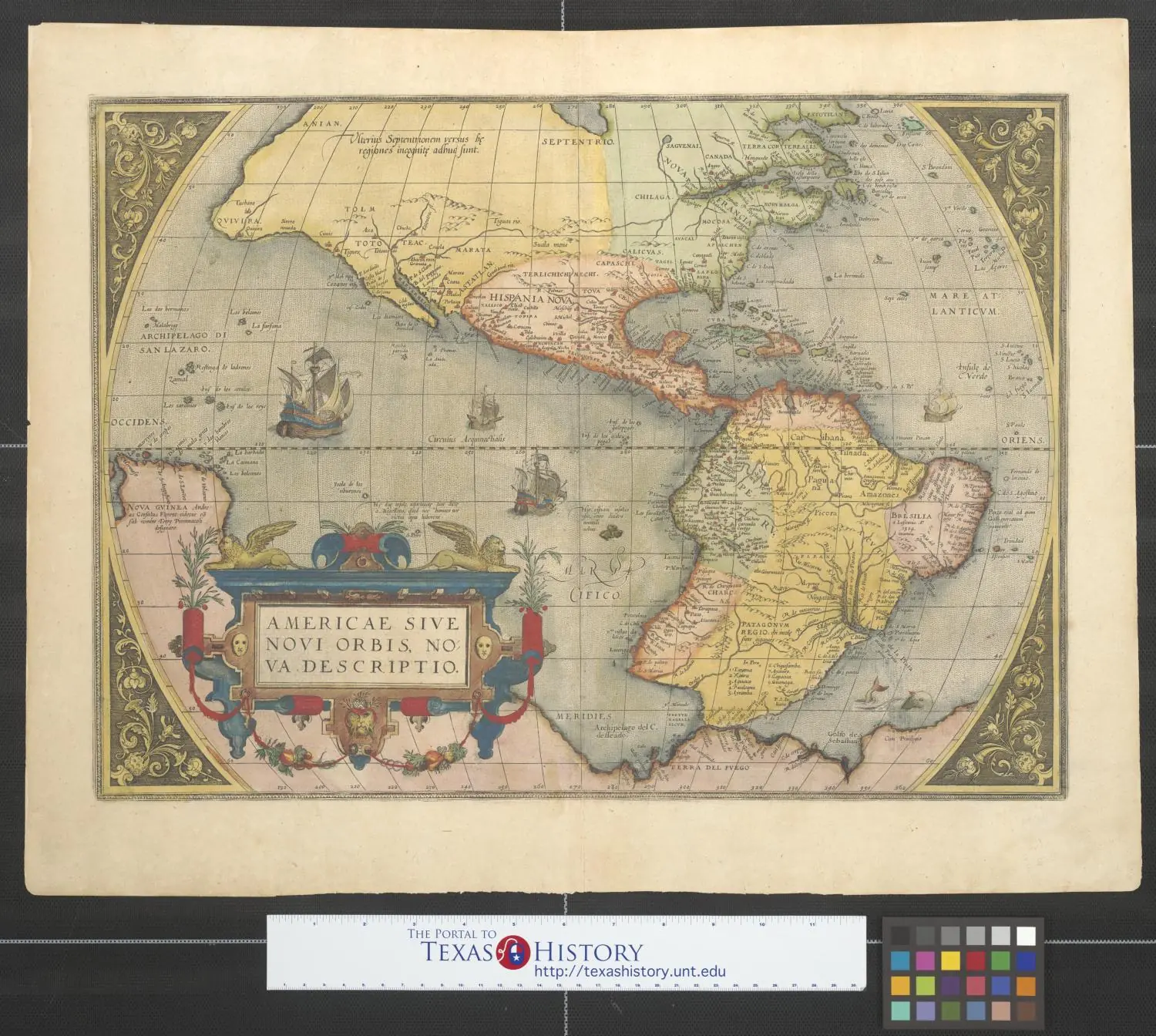
Americae sive novi orbis, nova descriptio · 1570. The depictions of the far south and the interior territories contain incomplete information and hypotheses of the period.
Descriptionis Ptolemaicae augmentum: set of plates · Atlas of 1597; record of a 1964 facsimile; montage of reproductions with no precise date. The linked record describes a 1964 facsimile with an introduction by R. A. Skelton. The image is a montage of plates, not a single historical sheet. To cite a specific region its plate and edition must be located.
Granata Nova et California · 1597. It represents California as a peninsula, with unreliable names and distances for the northern coast. Copy from the Bibliothèque nationale de France; it is not the plate of the 1964 facsimile in the other Wytfliet record.
Sources and references
- [B154] Archaeology and Legend: historical memory of Acoma. Pueblo of Acoma. Contemporary institutional memory of processes begun in 1598. Original record
- [B218] Acoma Pueblo: Ancient City in the Sky. U.S. National Park Service. n.d.; edition date not established. Original record
- [B198] Juan de Oñate Salazar. María del Pilar Gutiérrez Lorenzo. Undated electronic edition; consulted on 2 November 2026. Original record
- [B219] Camino Real in New Mexico, AD 1598–1881: National Register documentation. National Park Service. n.d.; edition date not established. Original record
- [B209] In the Land of Frozen Fires: A History of Occupation in El Malpais Country. Neil C. Mangum. 1990; edición HTML conservada en NPS History. Original record
- Archaeology and Legend: historical memory of Acoma. Pueblo of Acoma. The Pueblo of Acoma's institutional perspective on Oñate's colonization, begun in 1598, and its consequences.
- Acoma Pueblo: Ancient City in the Sky. U.S. National Park Service. Synthesis of colonial contact and the violence of 1598–1599; casualty figures vary among reconstructions.
Documents and call numbers
- MEXICO,235 · Account of Oñate's expedition
General bibliography guides further reading; it is not a pinpoint reference for every claim. Page, chapter and archival references are identified at the relevant passages.
Further reading and comparison
- Peace of Vervins · 1598
Send comments to the author
Found an error or have information to contribute? Write privately to the author.