

Fleet of Jorge de Espira and Nicolás Federmann
In this entry · 16 sections
Expedition · 1534. Jorge de Espira and Nicolás Federmann.
Empresas Polar distinguishes the October embarkation at Seville, several attempts to depart and Espira’s sailing on 8 December 1534. Not all ships left together. [B188]
The vessels sailed in staggered fashion after the preparations in Seville and Sanlúcar, made stopovers and reached the Caribbean in 1534–1535. [B188] [B179]
The host gave way to inland campaigns from Coro, amid violence, losses and conflicts of command. [B179]
Context
The succession to the government of Venezuela and the interests of the Welsers drove a new fleet recruited in Spain. [B179]
Stages
- October–December 1534, Seville and Sanlúcar de Barrameda: Preparations and embarkation in Seville precede departures from Sanlúcar. [B188]
Development
The vessels sailed in staggered fashion after the preparations in Seville and Sanlúcar, made stopovers and reached the Caribbean in 1534–1535. [B188] [B179]
Route data
- Enterprise organized under the concession to the Welsers of Augsburg.
- Espira, Federmann and Hutten led different groups of the same fleet.
- They sought the wealth of the interior; the entry caused violence and heavy losses.
Outcome
The host gave way to inland campaigns from Coro, amid violence, losses and conflicts of command. [B179]
Limits of the evidence
One enterprise with several commanders and staggered departures is recorded; Espira, Federmann and Hutten are not counted as three independent departures of the same fleet. [B188]
Expedition facts
| Date | 1534 |
|---|---|
| Leader | Jorge de Espira and Nicolás Federmann |
| Departure | Seville and Sanlúcar de Barrameda |
| Destination | Caribbean and the mainland (Tierra Firme) |
| Period | October–December 1534 |
Organisation
Empresas Polar distinguishes the October embarkation at Seville, several attempts to depart and Espira’s sailing on 8 December 1534. Not all ships left together. [B188]
Objectives
- Enterprise of settlement and conquest organized under the Welser concession. [B179]
Recorded vessels
- The chronology identifies the flagship Santa Trinidad and staggered departures; it does not provide a complete fleet roster here. [B188]
People and societies
- Jorge de Espira: Governor of Venezuela appointed in September 1534 [B179]
- Nicolás Federmann: Commander of the flagship in the Empresas Polar chronology [B188]
- Felipe de Hutten: Participant in preparations and the inland campaign [B179]
Related people
Related cartography
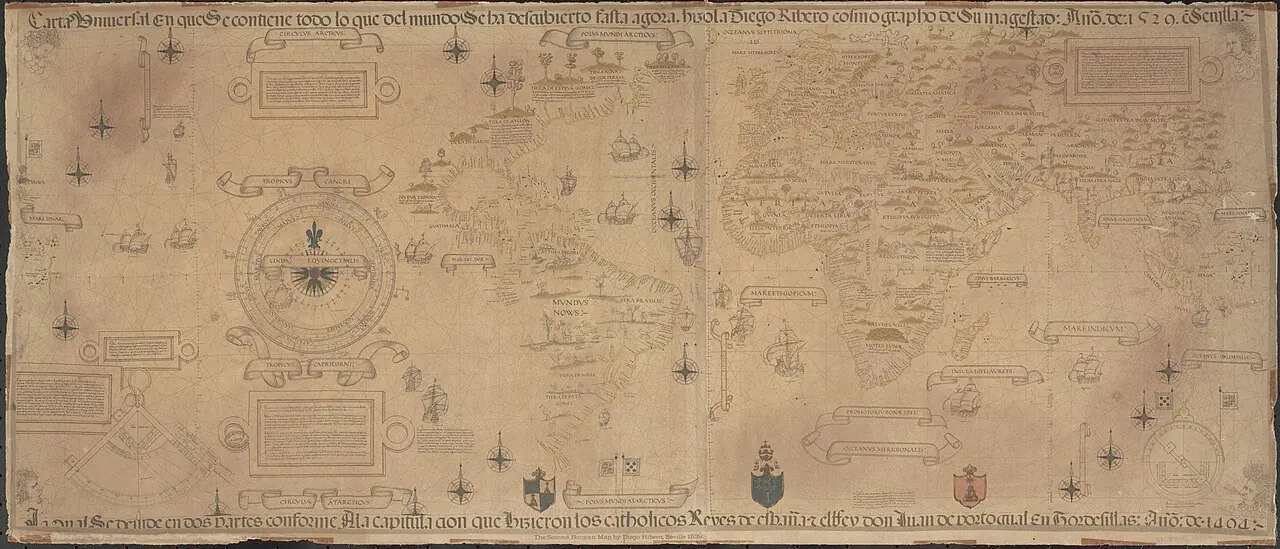
Universal chart of Diego Ribero: reproduction · Model of 1529; 2019 reproduction based on a 19th-century facsimile. The linked copy is a 2019 reproduction, not the original of 1529. The chain of reproduction is expressly kept.
Art and memory
- Portrait of Felipe de Hutten · Sixteenth century (record dating)
Sources and references
- [B188] Jorge de Espira's fleet: preparations and departure of 1534. Empresas Polar Foundation, Chronology of Venezuelan history. n.d.; edition date not established. Original record
- [B179] Jorge Hohermuth. Manuel Lucena Salmoral. Undated electronic edition; consulted on 2 November 2026. Original record
- Jorge de Espira's fleet: preparations and departure of 1534. Empresas Polar Foundation, Chronology of Venezuelan history. It distinguishes the embarkation at Seville from the staggered departures to sea; Espira and Federmann belong to a single enterprise.
General bibliography guides further reading; it is not a pinpoint reference for every claim. Page, chapter and archival references are identified at the relevant passages.
Send comments to the author
Found an error or have information to contribute? Write privately to the author.