

Reinforcement of Bartholomew Columbus on Hispaniola
In this entry · 17 sections
Expedition · 1494. Bartolomé Colón.
The monarchs appointed Bartolomé Columbus captain of three caravels on 14 April 1494, after receiving news and requests for supplies through Antonio de Torres. Varela places departure between late April and early May. [B65]
The small fleet reached La Isabela on 24 June, according to Varela, while Christopher Columbus explored Cuba and Jamaica. The study describes opposition by Margarit and Boyl to the authority Bartolomé attempted to exercise. [B65]
Varela dates Christopher’s appointment of Bartolomé as adelantado to 15 October 1494 and notes the conflict with the royal prerogative. The campaigns and establishment of Santo Domingo belong to Bartolomé’s subsequent government, beyond the reinforcement voyage. [B65] [B65]
Context
Antonio de Torres's return in March 1494 brought to the Court news of disease, scarcity and conflicts at La Isabela, and a request for new supplies. [B237] [B65]
Stages
- Spring 1494, Cádiz: Departure of the expedition from Spain. [B65]
Development
Bartholomew Columbus, the admiral's brother, crossed the Atlantic with three ships and reached La Isabela in the summer of 1494, while Christopher Columbus was exploring Cuba and Jamaica. He later took up the post of adelantado. [B65]
Route data
- 3 ships with provisions and people for the colony.
- It arrived while Christopher Columbus was exploring Cuba and Jamaica.
- Bartholomew later led the move to the south that preceded Santo Domingo.
Outcome
The reinforcement sustained the colony and gave Bartholomew a central role in governing the island, including the campaigns against the Taíno caciques and the move southward that preceded Santo Domingo. [B65]
Limits of the evidence
The departure is known only approximately and some reconstructions place the fitting-out at Seville; no departure day is fixed. [B65]
Expedition facts
| Date | 1494 |
|---|---|
| Leader | Bartolomé Colón |
| Departure | Cádiz |
| Destination | Antilles |
| Period | Spring 1494 |
Organisation
Departure from Cádiz. Destination of the enterprise: Hispaniola. [B65]
Objectives
- Relief of three ships with provisions and people for the colony of La Isabela. [B65]
Recorded vessels
- The naval composition and the figures for people must be checked in the linked sources; no complete list is given.
People and societies
- Bartolomé Colón: Participant in or head of the enterprise; see the clarifications and sources in the record [B65]
Related people
Related cartography
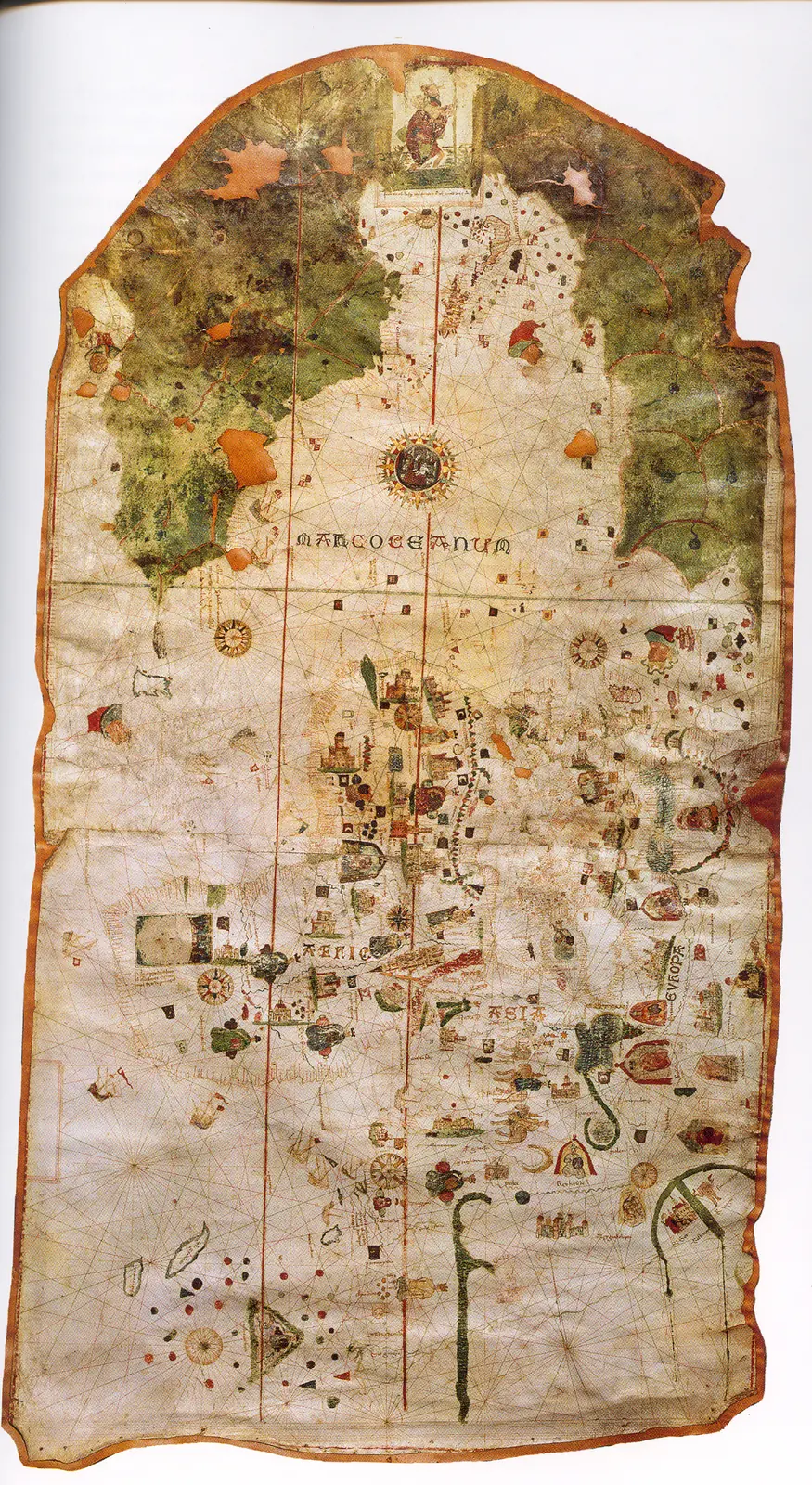
Juan de la Cosa's chart · 1500. It is not a map of the route of Columbus's first voyage. The image reproduces the chart preserved in the Naval Museum, MNM 257.
Art and memory
- Portrait of Bartolomé Colón · 1889 (reproduced edition)
Other expeditions with shared protagonists
- Establishment and founding of Santo Domingo (1496–1498)
- Third Voyage of Columbus: Discovery of the Mainland
- Fourth Voyage of Christopher Columbus
Sources and references
- [B24] Historia de las Indias, volumen 2 de 5. Bartolomé de las Casas. Work written between 1527 and 1561; edition of 1875. Original record
- [B65] Bartolomé Colón. Jesús Varela Marcos. Undated electronic edition; consulted on 2 November 2026. Original record
- [B237] Antonio de Torres. Luis Arranz Márquez. Undated electronic edition; consulted on 2 November 2026. Original record
- History of the Indies, annotated edition. Bartolomé de las Casas; ed. José Miguel Martínez Torrejón · Miguel de Cervantes Virtual Library, 2006. It narrates the relief expeditions sent to Hispaniola in 1494–1495 and the arrival of Diego Columbus in 1509. Las Casas used Columbian documentation now lost, but writes from a theological and polemical perspective that should be cross-checked.
- Instruction of the Catholic Monarchs for Columbus's voyage, 1493. General Archive of the Indies, INDIFERENTE,418,L.1,F.1V-4R · PARES. Instructions for the second voyage: fitting-out, government and conduct after arrival. It explains the framework of the later relief expeditions but is not a record of their departures.
General bibliography guides further reading; it is not a pinpoint reference for every claim. Page, chapter and archival references are identified at the relevant passages.
Send comments to the author
Found an error or have information to contribute? Write privately to the author.