

Discovery of the Pacific Ocean
In this entry · 16 sections
Episode · 1513. Vasco Núñez de Balboa.
Lucena places departure from Santa María on 1 September 1513 in a small vessel and canoes. Reports of another sea and the assistance of isthmian guides and porters form part of his explanation of the journey. [B98] [B98]
The study distinguishes the fighting at Quareca, the ascent to sight the ocean and the coastal ceremony of 29 September. It records the traditional sighting date of 25 September and Rómoli’s objection to the discrepancy with the weekday in the record. The date is attributed to that tradition, preserving the criticism. [B98]
The expedition continued along the coast and returned to Santa María on 19 January 1514 according to Lucena. The Spanish possession ceremony is distinguished from Indigenous knowledge and occupation of these territories. [B98] [B98]
Context
The settlement of Santa María la Antigua served as a base for new surveys. The news of another sea came from Indigenous interlocutors; the route crossed territories with authorities, populations and communication networks of their own. [B98]
Stages
- 1513, Santa María la Antigua: Preparation and departure of the survey. [B98]
- September 1513, Mountains of the isthmus: Crossing and sighting of the South Sea. [B98]
- September 1513, Gulf of San Miguel: Arrival at the coast and ceremony of Castilian possession. [B98]
- 1514, Darién: Return to the colonial area of departure. [B98]
Events of this expedition
Route data
- About 190 Spaniards and hundreds of Indigenous guides and porters.
- Balboa took possession of the ocean by wading into the water with the flag of Castile.
- Pedrarias Dávila, who arrived in 1514, had Balboa executed in 1519.
Outcome
Lucena continues the coastal reconnaissance and return through January 1514; the itinerary does not end with the September ceremony. [B98]
The name South Sea belongs to the Spanish account of an inhabited coast; it does not imply that its inhabitants were unaware of that ocean. [B98]
Limits of the evidence
The campaign combined departure in a small vessel and canoes with a land march across the isthmus; it was not a naval crossing from Europe to the Pacific. [B98]
The traditional category “discovery” is kept as a historiographic designation, with the European perspective expressly identified.
Expedition facts
| Date | 1513 |
|---|---|
| Leader | Vasco Núñez de Balboa |
| Departure | Not specified in this entry |
| Destination | — |
| Period | 1513–1514 |
Organisation
The campaign was mainly overland, supported by guides, porters and local allies. Canoes and Indigenous knowledge were essential for moving across the isthmus and the coasts. [B98]
Objectives
- To reach the sea of which the isthmus populations told [B98]
- To gather information on coasts and resources [B98]
Encounters and societies
Lucena describes dependence on guides and porters, fighting and pillage at Quareca and the possession ceremony of 29 September. He distinguishes that ceremony from the sighting and records Rómoli’s objection to its traditional dating. [B98]
People and societies
- Vasco Núñez de Balboa: Led the Spanish contingent [B98]
- Guides and allies of the isthmus: They provided information, routes and support; relations varied among communities [B98]
Related people
Related cartography
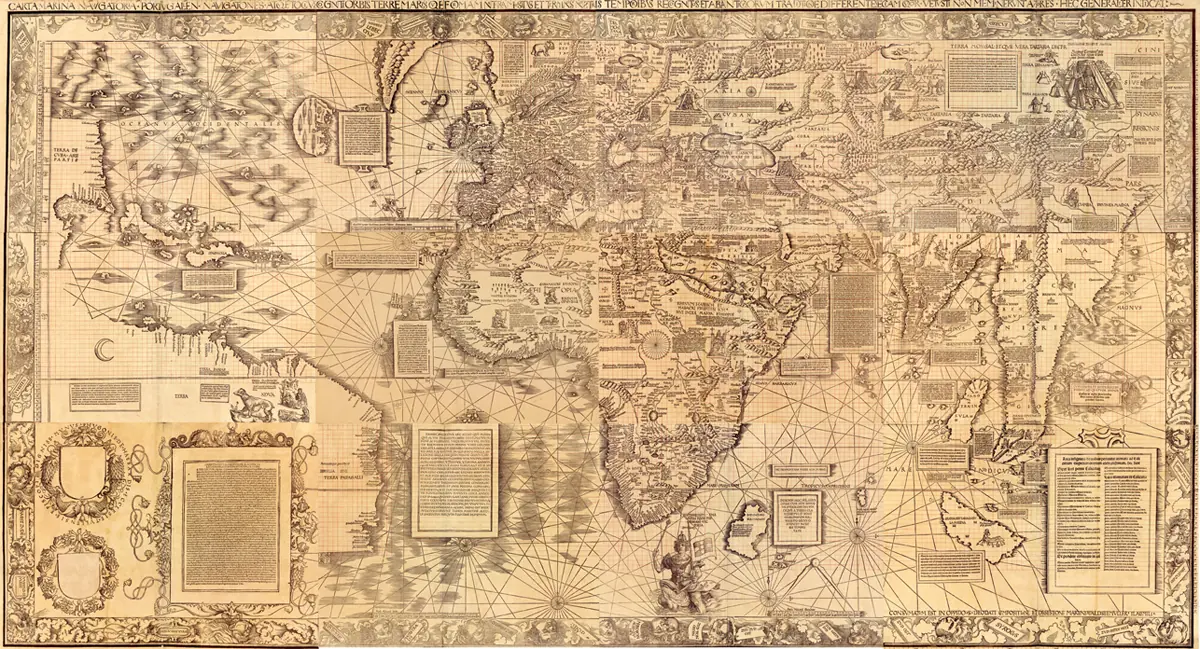
Carta marina navigatoria · 1516. The images and texts combine nautical information and the author's interpretations. It does not record the voyage of Solís or Magellan.
Americae sive quartae orbis partis nova et exactissima descriptio · 1562. The copy in the image is reproduced from Wikimedia Commons; the institutional record allows comparison with another copy of the same work. It is not a reconstruction of all the routes.
Americae sive novi orbis, nova descriptio · 1570. The depictions of the far south and the interior territories contain incomplete information and hypotheses of the period.
Art and memory
- Portrait of Vasco Núñez de Balboa · Nineteenth century, after an engraving of 1791
- Vasco Núñez takes possession of the South Sea · 1726
Sources and references
- [B137] Vasco Núñez de Balboa and the arrival at the South Sea. General Archive of the Indies, Ministry of Culture. Contemporary synthesis on the Darién and the survey of 1513. Original record
- [B50] To live in freedom! Documented history of the Guna people, 1501–1728. Luis Carlos Arenas. Documented history of the period 1501–1728. Original record
- [B1] General and Natural History of the Indies: second part, first volume. Gonzalo Fernández de Oviedo; edition by José Amador de los Ríos. Work of the 16th century; linked volume edited in 1852. Original record
- [B5] De Orbe Novo, volumen 1. Pedro Mártir de Anglería; traducción de Francis A. MacNutt. Decades written from 1493; translation of 1912. Original record
- [B29] Historia general y natural de las Indias, islas y tierrafirme del mar océano (edición de la Real Academia de la Historia). Gonzalo Fernández de Oviedo; edition by José Amador de los Ríos. Madrid edition, 1851. Original record
- [B98] Vasco Núñez de Balboa. Manuel Lucena Salmoral. Undated electronic edition; consulted on 2 November 2026. Original record
- Vasco Núñez de Balboa and the arrival at the South Sea. Ministry of Culture, General Archive of the Indies. It contextualizes the role of the Darién, Indigenous contacts and the survey of 1513.
- Documented history of the Guna people, 1501–1728. CLACSO repository. Documentary study of the societies of the Darién and their relationship to the first colonial expeditions.
Documents and call numbers
- PATRONATO,190 · Balboa's letter to the King
General bibliography guides further reading; it is not a pinpoint reference for every claim. Page, chapter and archival references are identified at the relevant passages.
Send comments to the author
Found an error or have information to contribute? Write privately to the author.