

Balboa sights the Pacific Ocean
In this entry · 5 sections
25 September 1513 · Isthmus of Darién (Panama)
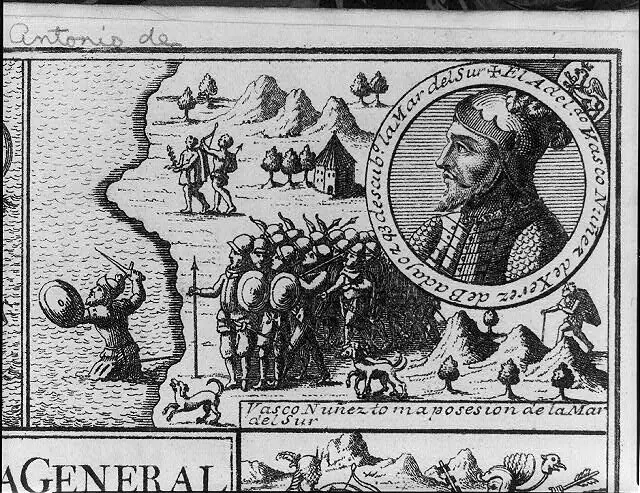
It is the morning of 25 September 1513, on the Isthmus of Panama. Since the start of the month Vasco Núñez de Balboa has been advancing south with about one hundred and ninety Spaniards, a brigantine, ten canoes, war dogs and many Indigenous guides and allies; the figure and the early-September departure are Las Casas’s. [B33]¶ They set out from Santa María la Antigua del Darién, the first stable Castilian town on the mainland, which he had governed for some years.
The road is hard: jungle, rivers, marsh and heat. On the way Balboa makes pacts with some chiefs and fights others, and from the former he gathers news of a sea and of lands rich in gold beyond the mountains.
That day, told that from the summit of a ridge he could see the sea, Balboa, according to Las Casas, orders everyone to halt, climbs alone and from the top gazes on the South Sea; the Indians of Quarequa had warned him they were close. [B33]¶ When the others arrive they celebrate with a cross, a Te Deum and marks on the trees.
Four days later he reaches the coast of the Gulf of San Miguel and took possession of the ocean in the name of the monarchs of Castile, wading into the water with the banner.
The crossing depends on guides, information and relations with Indigenous authorities of the isthmus. For Europeans, knowledge of another sea expands; it was not an unknown ocean to the peoples of its shores. [B137] The caciques Chiapes and Tumaco, who had helped him, took leave of Balboa on his return, [B33]¶ and Las Casas, who tells the march in detail, judges that the discovery was made at the expense of peaceful peoples and against God’s law. [B33]
Balboa would return to the Darién with news of gold and of an empire to the south. Soon afterwards the Crown sent Pedrarias Dávila as governor, with whom he ended in conflict, and Balboa was executed in 1519.
Context
Discovery of the Pacific Ocean
Overland expedition of Vasco Núñez de Balboa across the Darién isthmus to the ocean the Spaniards called the South Sea. [B137] [B98]
The settlement of Santa María la Antigua served as a base for new surveys. The news of another sea came from Indigenous interlocutors; the route crossed territories with authorities, populations and communication networks of their own. [B98]
Why it matters
It transforms the European idea of America and opens the exploration of its western coasts and the search for new routes to Asia.
Where it appears
Expeditions and episodes
Maps
- Carta marina navigatoria
- Americae sive quartae orbis partis nova et exactissima descriptio
- Americae sive novi orbis, nova descriptio
Art
Linked people
Sources for this milestone
- [B137] Vasco Núñez de Balboa and the arrival at the South Sea
- [B1] General and Natural History of the Indies: second part, first volume
- [B5] De Orbe Novo, volumen 1
- [B29] Historia general y natural de las Indias, islas y tierrafirme del mar océano (edición de la Real Academia de la Historia)
- [B50] To live in freedom! Documented history of the Guna people, 1501–1728
- [B98] Vasco Núñez de Balboa
Send comments to the author
Found an error or have information to contribute? Write privately to the author.