

Entry of Gonzalo Pizarro and Orellana's Descent (1541–1542)
In this entry · 18 sections
- Context
- Stages
- Events of this expedition
- Route data
- Outcome
- Limits of the evidence
- Expedition facts
- Organisation
- Objectives
- Encounters and societies
- Recorded vessels
- People and societies
- Related people
- Related cartography
- Art and memory
- Other expeditions with shared protagonists
- Sources and references
- Further reading and comparison
Episode · 1541. Francisco de Orellana.
Gonzalo Pizarro assembled an expedition to the Land of Cinnamon with soldiers, Indigenous companions and enslaved Africans. López Martínez describes arrival at Quito and construction of San Pedro; Cuesta Domingo reconstructs Orellana’s departure to seek food. [B76] [B66]
Continuation downstream generated conflicting accounts. Gonzalo’s accusation, recorded in his August 1542 letter, is distinguished from the justification and Orellana’s election by his companions described by Cuesta. “Treason” is not adopted as the atlas’s verdict. [B76] [B66]
Cuesta follows Carvajal’s account to reconstruct Aparia, the Omagua, provisioning and fighting and the passage into the Atlantic in August 1542. This descent is separated from Orellana’s new venture from the Atlantic in 1545–1546. [B66] [B80]
Context
The search for cinnamon and wealth drove an entry from the Andes. The enterprise depended on Indigenous workers and companions and crossed ecosystems and societies that the Spaniards knew incompletely. [B76]
Stages
- 1541, Quito: Organization and departure toward the east of the Andes. [B76]
- 1541, Napo basin: Supply crisis and formation of the embarked group. [B66]
- 1541–1542, Rivers of the Amazon basin: Actual separation and continuation of the descent. [B66]
- 1542, Course of the Amazon: Contacts, provisioning and clashes described by Carvajal. [B66]
- August 1542, Atlantic: Arrival of Orellana's group at the mouth. [B66]
Events of this expedition
Route data
- Orellana and about 57 men went down the river in a brigantine and canoes.
- Friar Gaspar de Carvajal wrote the account of the descent.
- Gonzalo Pizarro returned to Quito in 1542 with the survivors of his host.
Outcome
A documented European descent took place from the Andean basin to the Atlantic. [B66]
The itinerary reconstructed by Cuesta starts in the Coca and Napo basin and ends in the Atlantic; its starting point is not equated with the Amazon’s modern hydrological source. [B66]
Limits of the evidence
This campaign of 1541–1542 is separated from Orellana's enterprise begun in 1545. [B66] [B80]
The explanation of why Orellana did not return to Gonzalo Pizarro depends on conflicting testimonies; no single version is presented as incontrovertible. [B76] [B66]
Expedition facts
| Date | 1541 |
|---|---|
| Leader | Francisco de Orellana |
| Departure | Not specified in this entry |
| Destination | — |
| Period | 1541–1542 |
Organisation
Gonzalo Pizarro led the overland entry. Orellana was left in charge of a group embarked to look for food; the decision not to return was the subject of disputes and later justifications. [B76] [B66]
Objectives
- To seek resources east of the Andes [B76]
- To find provisions during the expedition's crisis [B66]
- After the separation, to continue downriver to an outlet to the Atlantic [B66]
Encounters and societies
Cuesta Domingo follows Carvajal’s account to reconstruct encounters, provisioning and fighting. Reports of women warriors belong to that testimony and its interpretation; they are not presented as an independent ethnographic description. [B66]
Recorded vessels
- Brigantines used in different phases of the descent; they are not the four ships of the 1545 campaign [B66] [B66]
People and societies
- Gonzalo Pizarro: Head of the entry from Quito [B76]
- Francisco de Orellana: In charge of the group that descended to the Atlantic [B66]
- Gaspar de Carvajal: Friar and chronicler of the descent [B66]
- Indigenous companions and populations: Their labor, navigation and supply were essential [B76] [B66]
Related people
Related cartography
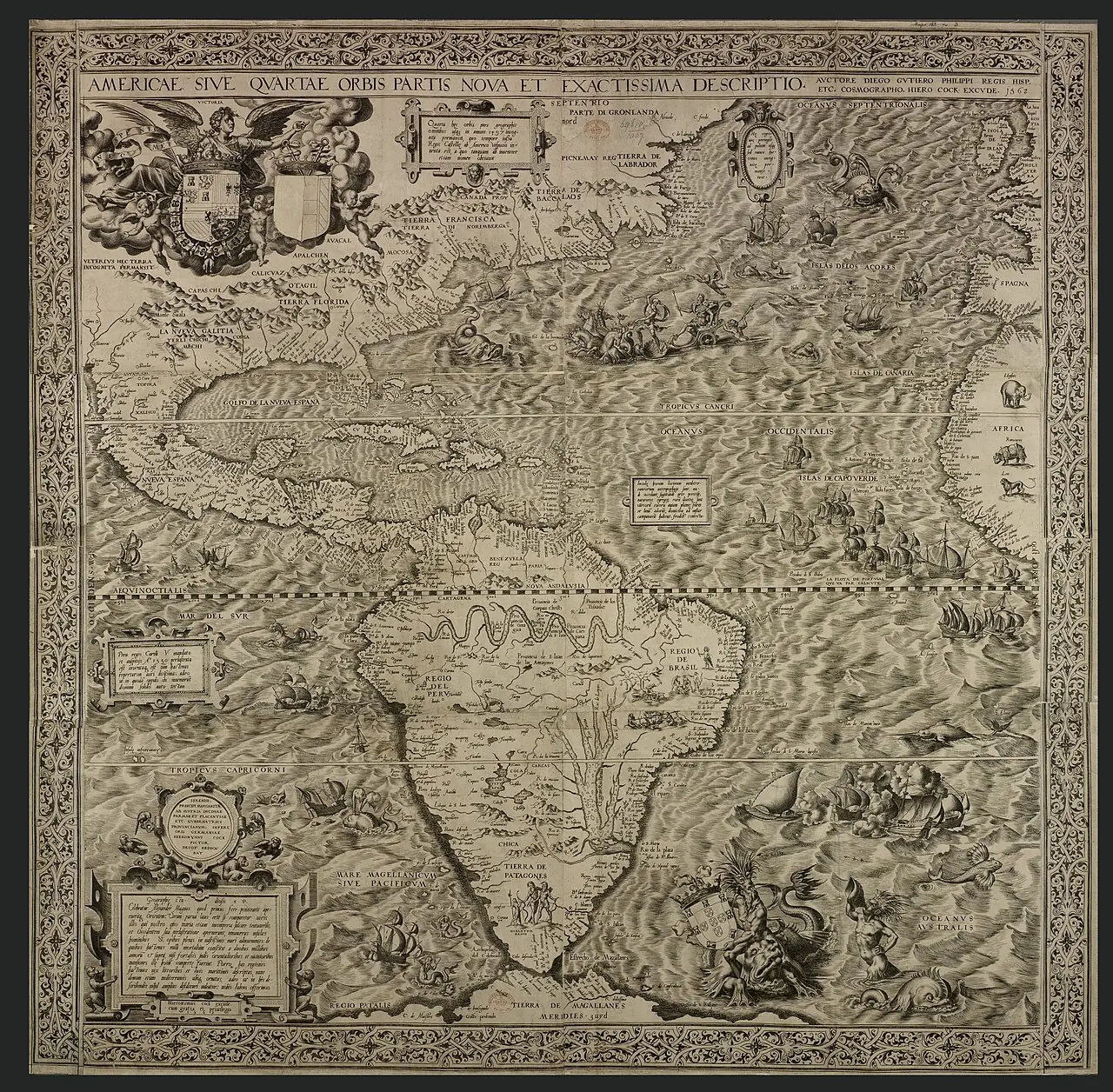
Americae sive quartae orbis partis nova et exactissima descriptio · 1562. The copy in the image is reproduced from Wikimedia Commons; the institutional record allows comparison with another copy of the same work. It is not a reconstruction of all the routes.
La descrittione di tutto il Peru · 1565. The historical use of Peru in the title does not coincide with present-day borders. It is not a map drawn by Pizarro or Orellana.
Americae sive novi orbis, nova descriptio · 1570. The depictions of the far south and the interior territories contain incomplete information and hypotheses of the period.
Descriptionis Ptolemaicae augmentum: set of plates · Atlas of 1597; record of a 1964 facsimile; montage of reproductions with no precise date. The linked record describes a 1964 facsimile with an introduction by R. A. Skelton. The image is a montage of plates, not a single historical sheet. To cite a specific region its plate and edition must be located.
Art and memory
- Portrait of Francisco de Orellana · 1930 (record dating)
Other expeditions with shared protagonists
Sources and references
- [B80] Francisco de Orellana: biography and two expeditions. Museum of the Americas, Ministry of Culture. Contemporary biography on the enterprises of 1541–1542 and 1545–1546. Original record
- [B132] Francisco de Orellana, 1541–1542 and the later expedition. Spanish Geographical Society. n.d.; edition date not established. Original record
- [B1] General and Natural History of the Indies: second part, first volume. Gonzalo Fernández de Oviedo; edition by José Amador de los Ríos. Work of the 16th century; linked volume edited in 1852. Original record
- [B76] Gonzalo Pizarro Viedma. Héctor López Martínez. Undated electronic edition; consulted on 2 November 2026. Original record
- [B66] Francisco de Orellana. Mariano Cuesta Domingo. Undated electronic edition; consulted on 2 November 2026. Original record
- Francisco de Orellana: biography and two expeditions. Ministry of Culture, Museum of the Americas. It distinguishes the descent of 1541–1542 from the enterprise capitulated in 1544 and undertaken in 1545.
- Francisco de Orellana, 1541–1542 and the later expedition. Spanish Geographical Society. Article on the history of exploration. The identifications of places and dates are checked against the sources of the Museum of the Americas.
Documents and call numbers
- PATRONATO,95 · Orellana's account of the Amazon
General bibliography guides further reading; it is not a pinpoint reference for every claim. Page, chapter and archival references are identified at the relevant passages.
Send comments to the author
Found an error or have information to contribute? Write privately to the author.