

Orellana completes the Amazon crossing
In this entry · 5 sections
11 September 1542 · Cubagua (Venezuela)
It is 11 September 1542. Francisco de Orellana’s brigantine reaches the island of Cubagua, off the coast of Venezuela, at the town of Nueva Cádiz; the other, smaller brigantine had arrived two days earlier, on the 9th. [B202]¶ Both had been built in the middle of the jungle, with nails made by two expeditionaries, Juan de Alcántara and Sebastián Rodríguez. [B202]¶ Aboard are exhausted men who have just done what no European had done: come down from the Andes to the Atlantic by the mightiest river in the world.
It had all begun a year earlier. Francisco de Orellana had set out from Quito with Gonzalo Pizarro for the Land of Cinnamon. When the expedition ran out of food, Orellana went ahead downriver in search of supplies with fifty-seven men, in the boat Pizarro had ordered built, although Orellana, according to Carvajal, had been against building it, and in canoes taken from the Indigenous people. [B202]¶ [B202]¶ The strong current did not let them return.
After sailing from the Andean region through the great Amazon river system and reaching the Atlantic on 26 August, St Louis’s day, Francisco de Orellana arrives at Cubagua. [B202]
Friar Gaspar de Carvajal told of the voyage. He says that a riverside lord, Aparia, gave them news of the Amazons, and describes a fight in which women “very white and tall”, with bows and arrows, fought “like ten Indians”. It is his testimony, not a verified fact, and from it comes the river’s name, the Amazon. [B202]
The expeditionaries depend on food and knowledge from the riverside populations, with whom they also fight. The 1542 descent should be distinguished from Pinzón’s reconnaissance of the river mouth and from Orellana’s new venture setting out from Spain. [B80]
Orellana returned to Spain and obtained permission to explore the region, but his second expedition, in 1545, ended badly and he died in the delta, around December 1546 according to the Museo de América. [B80]
Context
Entry of Gonzalo Pizarro and Orellana's Descent (1541–1542)
Expedition of Gonzalo Pizarro from Quito and the separation of Orellana's group, which descended through the Amazon basin to the Atlantic in 1542. [B80] [B76] [B66]
The search for cinnamon and wealth drove an entry from the Andes. The enterprise depended on Indigenous workers and companions and crossed ecosystems and societies that the Spaniards knew incompletely. [B76]
Why it matters
It completes the first documented European crossing of the Amazon from its upper course to the ocean.
Where it appears
Expeditions and episodes
Maps
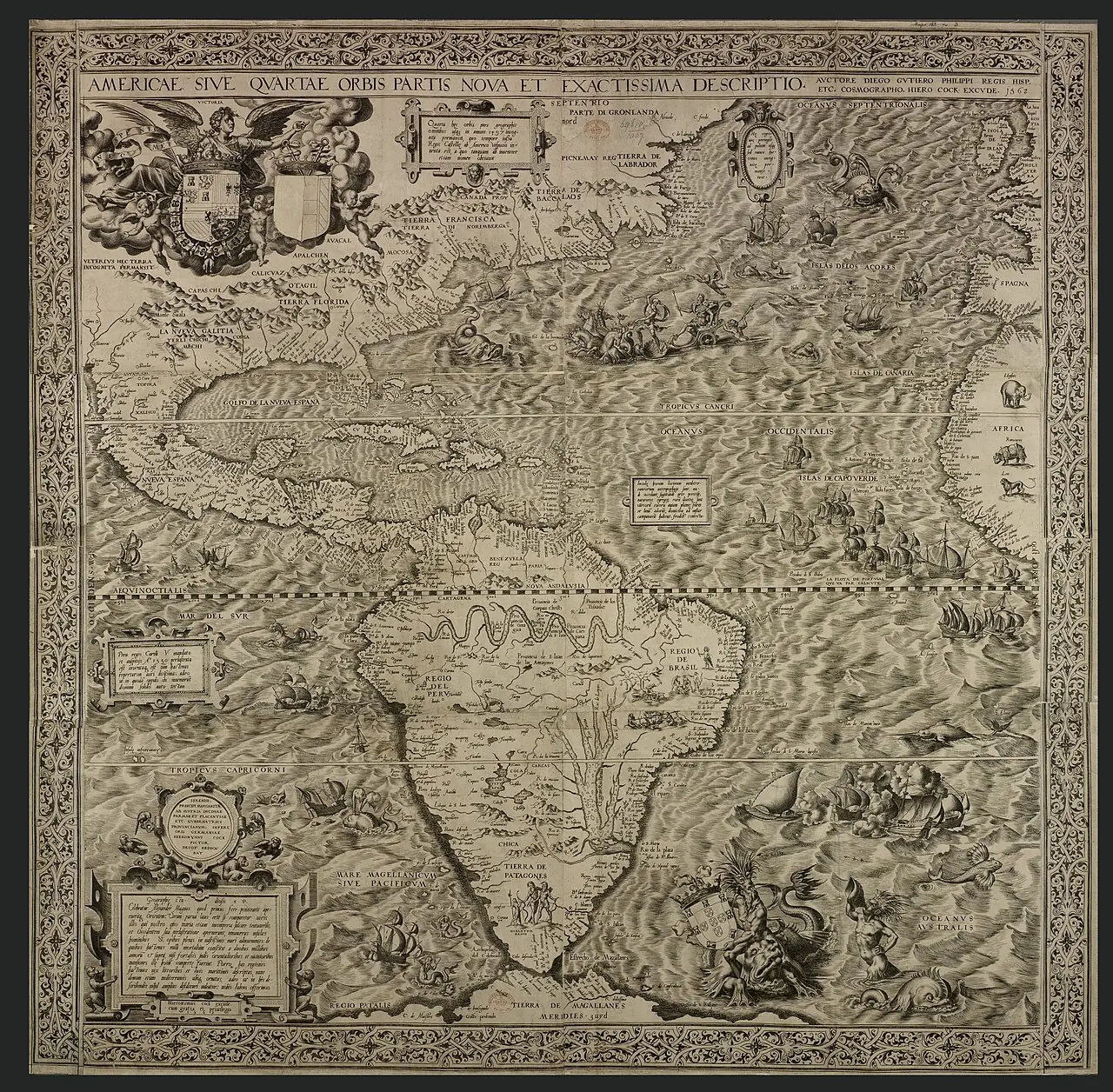
- Americae sive quartae orbis partis nova et exactissima descriptio
- La descrittione di tutto il Peru
- Americae sive novi orbis, nova descriptio
- Descriptionis Ptolemaicae augmentum: set of plates
Send comments to the author
Found an error or have information to contribute? Write privately to the author.