

Diego de Ordás
In this entry · 11 sections
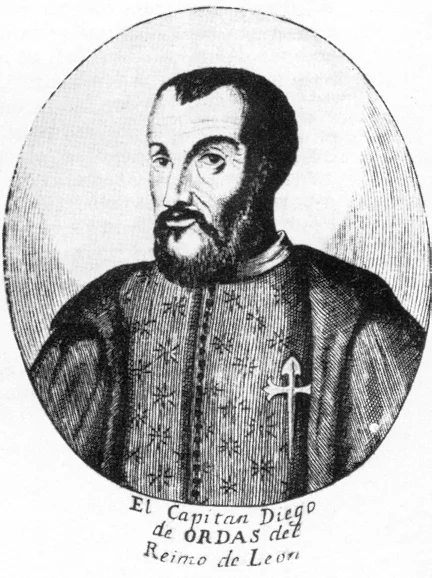
Antonio de Herrera · 1615.
A captain in the conquest of Mexico who ascended Popocatépetl with Cortés’s permission. Piqueras dates the grant of a coat of arms with a volcano to 1523; this is identified as the study’s date, without claiming examination of the original grant. [B236]
Birth: Castroverde de Campos; exact date not established in the passages used [B236]. Death: Atlantic, 22 July 1532 according to Piqueras [B236].
Cuba and Cortés's fleet
Piqueras records his presence with Ojeda in Tierra Firme in 1509 and subsequent service with Velázquez in Cuba. In 1518 he appears as Velázquez’s steward and joined Cortés’s fleet. The study places him in command of infantry in Tabasco in March 1519. Its reproduction of Bernal Díaz’s portrait distinguishes difficulties in pronunciation from a modern clinical diagnosis. [B236]
The conquest of Mexico
Following the foundation of Villa Rica, Ordás initially opposed Cortés’s assumed authority and was temporarily detained. He later received permission to ascend Popocatépetl with two companions and Indigenous guides. Piqueras dates the heraldic grant to 1523. He also records wounds during the June 1520 retreat from Tenochtitlán and service at Tepeaca; the journey to Spain prevented participation in the final assault of 1521. [B236]
Sent to Spain
The study dates the journey to Spain with Francisco de Montejo to October 1520, to defend Cortés against Velázquez’s claims. It records recognition as a commander of Santiago in 1522, return to New Spain and encomiendas. That mission is distinguished from supposed presence at Tenochtitlán’s fall. [B236]
The Marañón and the Orinoco
Piqueras dates the capitulation to conquer and settle from the Marañón to Cape de la Vela to 20 May 1530, citing Del Vas Mingo’s edition, document 32, and AGI, Indiferente General, 416, L. III, ff. 1–4v. He describes departure from Sanlúcar five months later, establishment of San Miguel de Paria and ascent of the Orinoco in 1531. After imprisonment at Cubagua and release at Santo Domingo, he died on the return journey to Spain on 22 July 1532. The poisoning hypothesis is attributed to Aguado and is not treated as established. The archival reference is obtained through the study, without direct examination of the manuscript. [B236]
Offices
Chronology
A life, step by step. Follow the dates and open each milestone or image to explore its sources.
- 1509
1615 About this image
Portrait of Diego de Ordás · 1615. Context portrait; it does not depict this event. Representation attributed to this person in the provenance record. It is not treated as evidence of physical appearance or as a record of their expeditions. The date of the work is distinguished from its digitisation date.Tierra Firme with Ojeda. [B236]
Explore this year - 1519
Ascent of Popocatépetl. [B236]
Explore this year - 1520
Wounded at Tenochtitlán and journey to Spain in October. [B236]
Explore this year - 1523
Heraldic grant according to Piqueras. [B236]
Explore this year - 1530
Capitulation of 20 May. [B236]
Explore this year - 1531
Orinoco campaign. [B236]
Explore this year - 1532
Death on the return journey. [B236]
Explore this year
Disputed dates and open questions
- The poisoning account is not regarded as proven. [B236]
Participation
- Diego de Ordás's Expedition to the Orinoco (1530): Captain general and governor
Maps
People and entries mentioned
Sources
- Diego de Ordás, Ricardo Piqueras Céspedes
- Historia verdadera de la conquista de la Nueva España, Bernal Díaz del Castillo · Miguel de Cervantes Virtual Library
- Diego de Ordás, Istituto della Enciclopedia Italiana, Treccani
Send comments to the author
Found an error or have information to contribute? Write privately to the author.