

Conquest of Mexico: fall of the Aztec Empire
In this entry · 20 sections
- Context
- Stages
- Events of this expedition
- Route data
- Outcome
- Limits of the evidence
- Expedition facts
- Organisation
- Objectives
- Encounters and societies
- Recorded vessels
- People and societies
- Related people
- Related cartography
- Art and memory
- Other expeditions with shared protagonists
- Mentioned in other entries
- Sources and references
- Further reading and comparison
- Sources of the related expeditions
Expedition · 1519. Hernán Cortés.
In February 1519 a fleet of eleven ships with about five hundred men under Hernán Cortés leaves Cuba for Cozumel. [B22]¶ He is sent by Diego Velázquez, but Cortés has set out to build an authority of his own. On the Gulf coast of Mexico he founds Villa Rica de la Vera Cruz and has its council name him captain general, which frees him from Velázquez. [B94] [B93]
After fighting in Tabasco he takes on interpreters, among them Malintzin, and advances inland. At Tlaxcala, after several clashes, he seals an alliance with the local lords, decisive for the campaign. On 8 November 1519 he enters Mexico-Tenochtitlan and meets Moctezuma. [B22]¶ In June 1520, after the violence of Tóxcatl and the outbreak of war in the capital, Spaniards and allies are forced to withdraw in the Noche Triste. [B94] [B94]
With new reinforcements, and the support of tens of thousands of Indigenous allies, Cortés besieges Tenochtitlan between May and August 1521. The city falls on 13 August, after the smallpox epidemic and the war. The Mexica political centre is destroyed and new relations of colonial domination are built. But the fall of the capital did not mean the immediate conquest of the whole territory, nor the disappearance of Indigenous societies. [B10]¶ [B94] [B94]
Context
The expedition arose from the government of Cuba, but Cortés built an authority of his own through the town council of Veracruz. Mesoamerica contained diverse powers and conflicts: the war cannot be reduced to a small Spanish group facing a homogeneous empire. [B93] [B90]
Stages
- February 1519, Cuba and Cozumel: Start of the voyage; the header note identifies the date used. [B22]
- 1519, Tabasco and Veracruz: Clashes, incorporation of interpreters and establishment of a political base. [B94] [B93]
- 1519, Tlaxcala: After combat a decisive alliance was formed. [B94]
- November 8, 1519, México-Tenochtitlan: Entry into the city and progressive political crisis. [B22]
- June–July 1520, México-Tenochtitlan: Withdrawal of Spaniards and allies after the violence of Tóxcatl and the war in the capital. [B94]
- May–August 1521, Basin of Mexico: Land and lake siege; fall of Tenochtitlan and Tlatelolco on 13 August. [B94] [B93]
Events of this expedition
Route data
- 11 ships and a little over 500 Spaniards in the classic figures.
- Thousands of Tlaxcalan warriors and those of other peoples were decisive in the war.
- Malintzin and Jerónimo de Aguilar made linguistic mediation possible.
- Tenochtitlan and Tlatelolco fell on 13 August 1521 after a long siege.
Outcome
The Mexica political center was destroyed and new relations of colonial domination were built. [B94]
The fall of the capital did not mean the immediate conquest of all the territory of present-day Mexico or the disappearance of Indigenous societies. [B94]
Limits of the evidence
The withdrawal of 1520 did not occur in May; this confusion in the earlier account is corrected. [B94]
Bernal describes removing anchors, ropes and sails and running the ships ashore; that description is retained instead of depicting a burning. [B22]
García Márquez’s and Pastrana’s studies enable comparison with an image of homogeneous, permanently loyal alliances: they describe negotiation, ruptures and distinct interests. [B84] [B90]
Expedition facts
| Date | 1519 |
|---|---|
| Leader | Hernán Cortés |
| Departure | Not specified in this entry |
| Destination | — |
| Period | 1519–1521; the conquest of other territories continued afterward |
Organisation
The fleet of eleven ships reached Cozumel and Tabasco before settling on the Veracruz coast. The figures for men and horses change according to the moment of the conflict; the forces of 1519 are not equivalent to those of the siege of 1521. [B22]¶ [B94]
Objectives
- To survey and establish a base on the coast [B93]
- To obtain alliances, resources and recognition from the Crown [B84]
- To subdue the center of Mexica power [B94]
Encounters and societies
The Indigenous allies contributed armies, food, knowledge and political capacity. War, hunger, destruction and epidemics affected the population unequally; Nahua voices make it possible to contrast the Spanish accounts of victory. [B84] [B90] [B95]
Recorded vessels
- Eleven ships in the initial fleet [B22]
- Brigantines built for the operations on the lake during the siege of 1521 [B94]
People and societies
- Hernán Cortés: Head of the Spanish enterprise [B22]
- Malintzin or Doña Marina: Interpreter, mediator and central political figure [B94]
- Jerónimo de Aguilar: Maya-language interpreter [B94]
- Moctezuma II and Cuauhtémoc: Mexica rulers in different phases of the conflict [B94] [B93]
- Authorities and armies of Tlaxcala, Cempoala and other peoples: Allies with political projects of their own [B84] [B90]
Related people
Related cartography
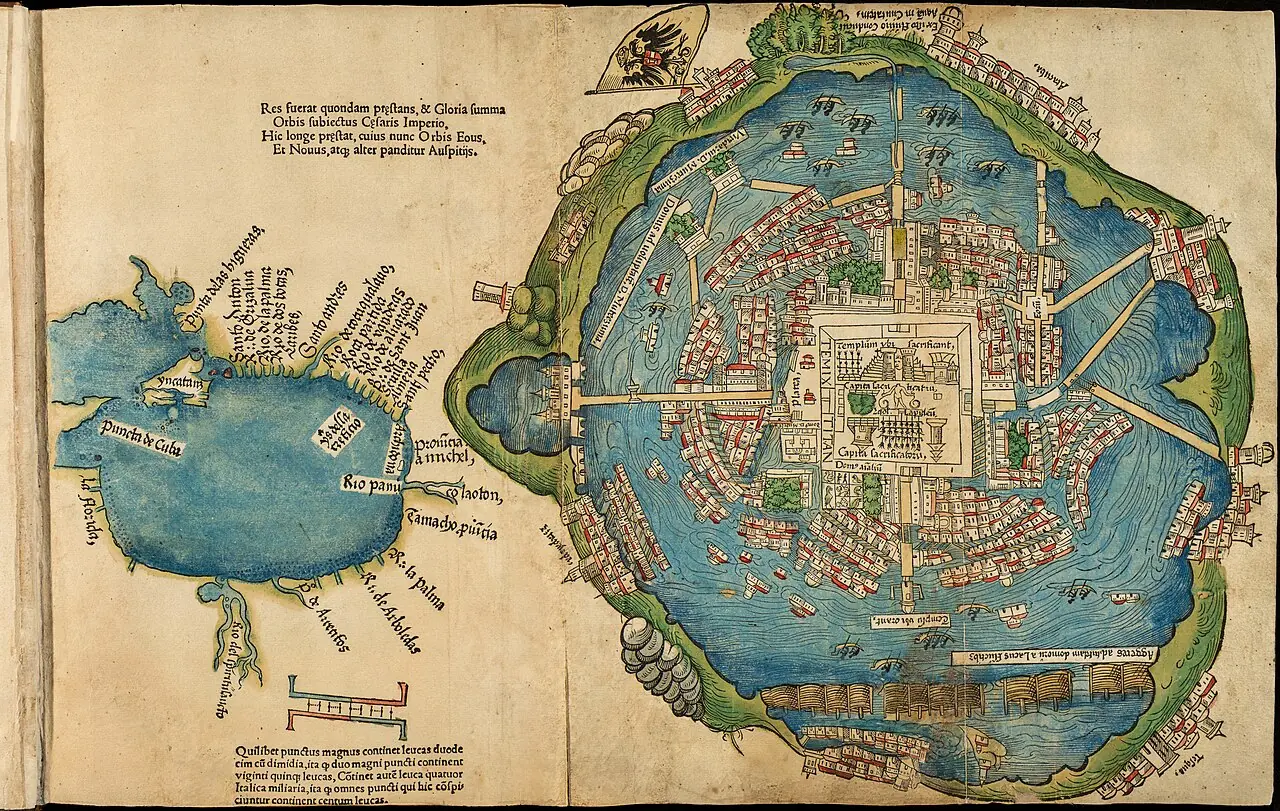
Tenochtitlan and the Gulf of Mexico · 1524. Cortés is the author of the associated account, which does not automatically identify the draftsman or engraver of the map. The plan is later than the siege of 1521.
Americae sive quartae orbis partis nova et exactissima descriptio · 1562. The copy in the image is reproduced from Wikimedia Commons; the institutional record allows comparison with another copy of the same work. It is not a reconstruction of all the routes.
Americae sive novi orbis, nova descriptio · 1570. The depictions of the far south and the interior territories contain incomplete information and hypotheses of the period.
Painting of Teozacoalco and documentation of its geographic report · 1580. It is consulted within the file, with maps and documents. It is colonial Indigenous cartography; it does not represent an expedition nor should it be read only with European cartographic conventions.
Descriptionis Ptolemaicae augmentum: set of plates · Atlas of 1597; record of a 1964 facsimile; montage of reproductions with no precise date. The linked record describes a 1964 facsimile with an introduction by R. A. Skelton. The image is a montage of plates, not a single historical sheet. To cite a specific region its plate and edition must be located.
Granata Nova et California · 1597. It represents California as a peninsula, with unreliable names and distances for the northern coast. Copy from the Bibliothèque nationale de France; it is not the plate of the 1964 facsimile in the other Wytfliet record.
Hispaniae Novae sive Magnae, recens et vera descriptio · Italian edition of 1608; cartography dated on the plate to 1579. The year 1579 inscribed on the plate does not automatically date the copy. The reproduction comes from the Italian atlas of 1608 in the Rumsey collection.
Art and memory
- Portrait of Hernán Cortés · Eighteenth century
- Portrait of Malintzin o doña Marina · 1916 (reproduced edition)
- Plan of Tenochtitlan from the second Letter of Relation · 1524
- Azcatitlan Codex: arrival of Cortés and the Spaniards · Around 1530 according to the LOC; last third of the 16th century according to the BnF
- Huexotzinco Codex · 1531
- Lienzo de Tlaxcala · 1552; original lost
- Massacre of Cholula, from the Lienzo de Tlaxcala · Original of 1552, lost; later copy and edition
- Mexico and Cusco, in Civitates Orbis Terrarum · 1572
- Aubin Codex: arrival of Cortés · 1576, with continuations
- Florentine Codex, Book XII: the conquest of Mexico · Around 1575–1577
- History of the Indies of New Spain: Cortés and Malintzin · Around 1579–1581
- Glasgow Manuscript: Description of Tlaxcala · Around 1585
- Description of the West Indies and title pages of the Décadas · 1601–1615
- Cortés's entry into Tabasco · Second half of the 17th century
- Arrival of Cortés at Veracruz · Second half of the 17th century
- Meeting of Cortés and Moctezuma · Second half of the 17th century
- Death of Moctezuma · Second half of the 17th century
- The Noche Triste (Sad Night) · Second half of the 17th century
- Battle of Otumba · Second half of the 17th century
- Capture of Tenochtitlan · Second half of the 17th century
- Capture of Cuauhtémoc · Second half of the 17th century
- Conquest of Mexico: series of 24 enconchados · 1698
- The Interview of Cortes and Motezuma · 1748
- Hernán Cortés and Moctezuma's Ambassadors. April 1519 · 1854
Other expeditions with shared protagonists
Mentioned in other entries
- Diego de Ordás
- Diego Velázquez de Cuéllar
- Pánfilo de Narváez
- Establishment of the Viceroyalty of New Spain
- 1535: Lima and the Viceroyalty of New Spain
Una mención permite investigar una relación; no implica participación en la expedición ni acredita por sí sola el pasaje citado.
Sources and references
- [B79] From Cozumel to Cempoala: cross-checked chronology of 1519. Memórica edition; testimonies of Cortés and Bernal Díaz. Historical comparison of episodes of 1519; contemporary digital edition. Original record
- [B78] The alliances and military forces before the siege of México-Tenochtitlan. Team and collaborators of Noticonquista, UNAM. Contemporary studies on the war of 1519–1521. Original record
- [B81] Hernán Cortés portal: works and documents. Hernán Cortés and authors of his time; editorial compilation. 16th-century texts and later editions and studies. Original record
- [B10] True History of the Conquest of New Spain. Bernal Díaz del Castillo; edition by Alonso Remón. Written in the 16th century; linked edition: Madrid, 1632. Original record
- [B70] Florentine Codex: digital edition. Bernardino de Sahagún and Nahua collaborators. Manuscript completed around 1575–1577. Original record
- [B61] Lienzo de Tlaxcala. Tlaxcalan pictographic tradition and later copyists. Model of the mid-16th century; later surviving copies. Original record
- [B86] The Pleasant Historie of the Conquest of the Weast India, now called New Spayne. Francisco López de Gómara; traducción de Thomas Nicholas. Work of 1552; English translation of 1578. Original record
- [B22] Memoirs of the Conquistador Bernal Diaz del Castillo, volumen 1. Bernal Díaz del Castillo; traducción de John Ingram Lockhart. Chronicle written in the sixteenth century; translation of 1844. Original record
- [B77] Crónica de la Nueva España. Francisco Cervantes de Salazar. Sixteenth-century work; 1914 edition. Original record
- [B92] History of the Conquest of Mexico, volumen 1. William Hickling Prescott. Work of 1843; modern digital edition. Original record
- [B89] History of the Indians of New Spain. Toribio de Benavente, Motolinía. Mid-sixteenth-century work; 1914 edition. Original record
- [B94] Hernán Cortés, Diccionario Biográfico Español. Bartolomé Bennassar · Real Academia de la Historia. n.d.; edition date not established. Original record
- [B93] Cronología de Hernán Cortés. Manuel Ramos Medina. Sin fecha de publicación indicada; consulta: 10 de noviembre de 2026. Original record
- [B84] Alliance and conflict with the totonaque. Agustín García Márquez. Digital publication; accessed 10 November 2026. Original record
- [B90] The Mexica and their alliance policy during the conquest. Miguel Pastrana Flores. Digital publication; accessed 10 November 2026. Original record
- [B95] Florentine Codex, Book 12: transcriptions and translations. Bernardino de Sahagún y colaboradores nahuas; transcripción y traducciones de James Lockhart. Texto del siglo XVI; edición digital contemporánea. Original record
- From Cozumel to Cempoala: cross-checked chronology of 1519. Memórica, Government of Mexico. It compares the accounts of Cortés and Bernal Díaz; their figures and perspectives should not be mistaken for a neutral census.
- The alliances and military forces before the siege of México-Tenochtitlan. UNAM, Noticonquista. It makes it possible to study the Indigenous allies as political and military actors in the conflict.
Documents and call numbers
General bibliography guides further reading; it is not a pinpoint reference for every claim. Page, chapter and archival references are identified at the relevant passages.
Further reading and comparison
- First Circumnavigation: The Magellan–Elcano Expedition · 1519
- Expedition of Gil González Dávila and Andrés Niño · 1519
Send comments to the author
Found an error or have information to contribute? Write privately to the author.