

The fall of Tenochtitlan
In this entry · 5 sections
13 August 1521 · Mexico City
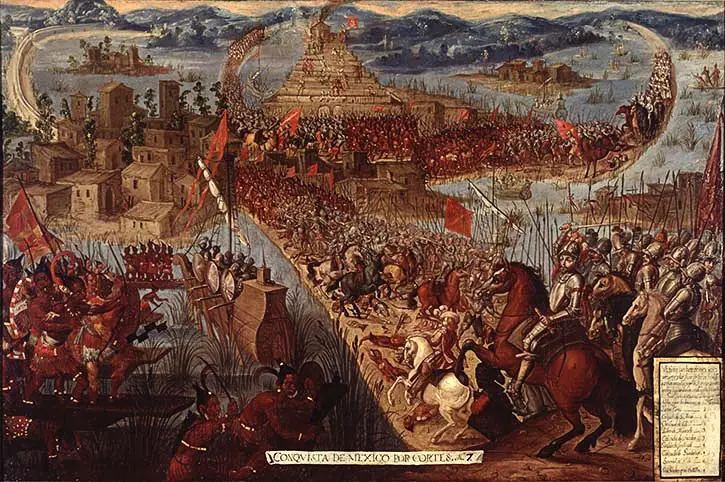
It is 13 August 1521. For three months Hernán Cortés and his allies have besieged Tenochtitlan, the great Mexica capital built on a lake. The Spaniards have built brigantines to control the water, have cut the aqueduct and the causeways, and advance house by house.
They are not alone. With them fight tens of thousands of Indigenous warriors, above all from Tlaxcala but also from Texcoco and other peoples who saw the Mexica as their oppressors. Nor were the Mexica fighting only the siege: before the war a smallpox epidemic had killed many of them, among them the ruler Cuitláhuac.
The forces of Hernán Cortés and his numerous Indigenous allies, above all Tlaxcalans, take Tenochtitlan after a long siege by land and lake. Cuauhtémoc was captured the same day. According to Bernal Díaz, he was about twenty-five and had succeeded the lord of Mexico who died of smallpox. [B22]
War and the smallpox epidemic devastated the city, on whose ruins the capital of New Spain was built.
The fall of the city after the siege was the result of Spanish forces and numerous allied Indigenous forces, together with the health and food crisis. Destruction and subjugation do not erase the continuity of the communities or of the Indigenous voices that told what happened. [B10]
The fall of Tenochtitlan opens a new stage: Mexico City will rise over the destroyed city, and from it new expeditions will set out to the interior and to the Pacific.
Context
Conquest of Mexico: fall of the Aztec Empire
Cortés's expedition and the war for México-Tenochtitlan: a campaign sustained by Spanish forces and numerous Indigenous allies, with linguistic mediation, political conflicts and grave effects on the population. [B10]¶ [B94] [B84]
The expedition arose from the government of Cuba, but Cortés built an authority of his own through the town council of Veracruz. Mesoamerica contained diverse powers and conflicts: the war cannot be reduced to a small Spanish group facing a homogeneous empire. [B93] [B90]
Why it matters
Decisive for the establishment of New Spain, from which expeditions to North America and the Pacific were launched.
Where it appears
Expeditions and episodes
Other milestones of those expeditions
- Villa Rica de la Vera Cruz
- Alliance with the lords of Tlaxcala
- Cortés and Moctezuma meet in Tenochtitlan
- Smallpox epidemic in central Mexico
- Retreat from Tenochtitlan: the Noche Triste
Also mentioned in
Maps
- Tenochtitlan and the Gulf of Mexico
- Americae sive quartae orbis partis nova et exactissima descriptio
- Americae sive novi orbis, nova descriptio
- Painting of Teozacoalco and documentation of its geographic report
- Descriptionis Ptolemaicae augmentum: set of plates
- Granata Nova et California
- Hispaniae Novae sive Magnae, recens et vera descriptio
Art
- Portrait of Hernán Cortés
- Portrait of Malintzin o doña Marina
- Plan of Tenochtitlan from the second Letter of Relation
- Azcatitlan Codex: arrival of Cortés and the Spaniards
- Huexotzinco Codex
- Lienzo de Tlaxcala
- Massacre of Cholula, from the Lienzo de Tlaxcala
- Mexico and Cusco, in Civitates Orbis Terrarum
- Aubin Codex: arrival of Cortés
- Florentine Codex, Book XII: the conquest of Mexico
- History of the Indies of New Spain: Cortés and Malintzin
- Glasgow Manuscript: Description of Tlaxcala
- Description of the West Indies and title pages of the Décadas
- Cortés's entry into Tabasco
- Arrival of Cortés at Veracruz
- Meeting of Cortés and Moctezuma
- Death of Moctezuma
- The Noche Triste (Sad Night)
- Battle of Otumba
- Capture of Tenochtitlan
- Capture of Cuauhtémoc
- Conquest of Mexico: series of 24 enconchados
- The Interview of Cortes and Motezuma
- Hernán Cortés and Moctezuma's Ambassadors. April 1519
Linked people
Sources for this milestone
- [B10] True History of the Conquest of New Spain
- [B11] Cronología General Iberoamericana: siglo XVI
- [B13] Relatos de viaje del siglo XVI
- [B15] La Era de la Exploración: navegantes y conquistadores del siglo XVI
- [B22] Memoirs of the Conquistador Bernal Diaz del Castillo, volumen 1
- [B61] Lienzo de Tlaxcala
- [B70] Florentine Codex: digital edition
- [B77] Crónica de la Nueva España
- [B78] The alliances and military forces before the siege of México-Tenochtitlan
- [B79] From Cozumel to Cempoala: cross-checked chronology of 1519
- [B81] Hernán Cortés portal: works and documents
- [B84] Alliance and conflict with the totonaque
- [B86] The Pleasant Historie of the Conquest of the Weast India, now called New Spayne
- [B89] History of the Indians of New Spain
- [B90] The Mexica and their alliance policy during the conquest
- [B92] History of the Conquest of Mexico, volumen 1
- [B93] Cronología de Hernán Cortés
- [B94] Hernán Cortés, Diccionario Biográfico Español
- [B95] Florentine Codex, Book 12: transcriptions and translations
Send comments to the author
Found an error or have information to contribute? Write privately to the author.