

Start of the conquest of Peru
In this entry · 19 sections
- Context
- Stages
- Events of this expedition
- Route data
- Outcome
- Limits of the evidence
- Expedition facts
- Organisation
- Objectives
- Encounters and societies
- Recorded vessels
- People and societies
- Related people
- Related cartography
- Art and memory
- Other expeditions with shared protagonists
- Sources and references
- Further reading and comparison
- Sources of the related expeditions
Episode · 1531. Francisco Pizarro.
At the start of 1531 Francisco Pizarro leaves Panama with some one hundred and eighty men and several dozen horses, and advances along the coast of present-day Ecuador and Peru. For months the host suffers disease and fighting, and establishes a first base at Tumbes and San Miguel. Earlier expeditions and the Capitulation of Toledo had prepared the venture. [B17] [B17]
The expedition enters a region shaped by the conflict between Huáscar and Atahualpa. López Martínez’s biography describes the succession war and the cooperation of groups such as the Huanca and Chachapoya with the conquerors. These Andean actors must not be treated as a single Indigenous bloc. [B17]
In November 1532, at Cajamarca, the Spaniards capture Atahualpa by an attack. After collecting a great ransom they execute him in 1533, and the host enters Cusco. A phase of expansion and colonial administration opens, followed by wars among conquistadors and Andean resistance. The taking of Cusco does not equal the immediate subjugation of the whole former Inca space. [B17] [B17]
Context
The Toledo capitulation of 1529 preceded the new campaign. López Martínez relates the war between Huáscar and Atahualpa to alliances sought by the Huanca and Chachapoya against Cuzco’s rule. [B17] [B17]
Stages
- 1531, Panamá: Departure of a new campaign after the capitulation. [B17]
- 1531–1532, Equatorial coast and Tumbes: Advance, landings and establishment of support. [B17]
- November 1532, Cajamarca: Capture of Atahualpa by means of a Spanish attack. [B17]
- 1533, Cajamarca: Execution of Atahualpa after the ransom. [B17]
- 1533, Cuzco: Entry into the capital and reorganization of power under occupation. [B17]
Events of this expedition
Route data
- 3 ships in the early phases and about 180 Spaniards in the traditional figures.
- The civil war between Atahualpa and Huáscar conditioned the conquest.
- Atahualpa paid an enormous ransom and was executed in July 1533.
Outcome
The occupation opened a phase of colonial expansion and administration, followed by wars among conquistadors and Andean resistance. [B17]
The taking of Cuzco does not equal the immediate subjugation of the whole former Inca space. [B17]
Limits of the evidence
The Capitulation of Toledo is of 1529, not of 1526. [B17]
Xerez's account, the traditions collected by Betanzos and later Andean interpretations are compared; none is a neutral record of all the participants.
Expedition facts
| Date | 1531 |
|---|---|
| Leader | Francisco Pizarro |
| Departure | Not specified in this entry |
| Destination | — |
| Period | 1531–1533; later wars and resistance |
Organisation
A force with infantry, cavalry and vessels left Panama in 1531. Later reinforcements, supply and Indigenous support changed its capacity for action; the figures from Cajamarca are not extrapolated to the whole campaign. [B17]
Objectives
- To conquer and settle the territories granted by the Crown [B17]
- To obtain resources and establish a governorship [B17]
Encounters and societies
López Martínez’s reconstruction distinguishes Andean alliances, the ambush against Atahualpa, the ransom and execution. Its continuation describes new authorities, Manco Inca’s siege and wars among conquistadors. [B17] [B17] [B17] [B17]
Recorded vessels
- Flotilla from Panama; names of ships are not attributed without cross-checking [B17]
People and societies
- Francisco Pizarro: Head of the enterprise [B17]
- Diego de Almagro and Hernando de Luque: Partners in the earlier projects; their positions changed with the grants [B17]
- Atahualpa and Huáscar: Rivals in the Inca war of succession [B17]
- Francisco de Xerez: Secretary and author of a testimony [B135]
- Andean authorities and populations: Allies, interlocutors and resisters with diverse interests [B17]
Related people
Related cartography
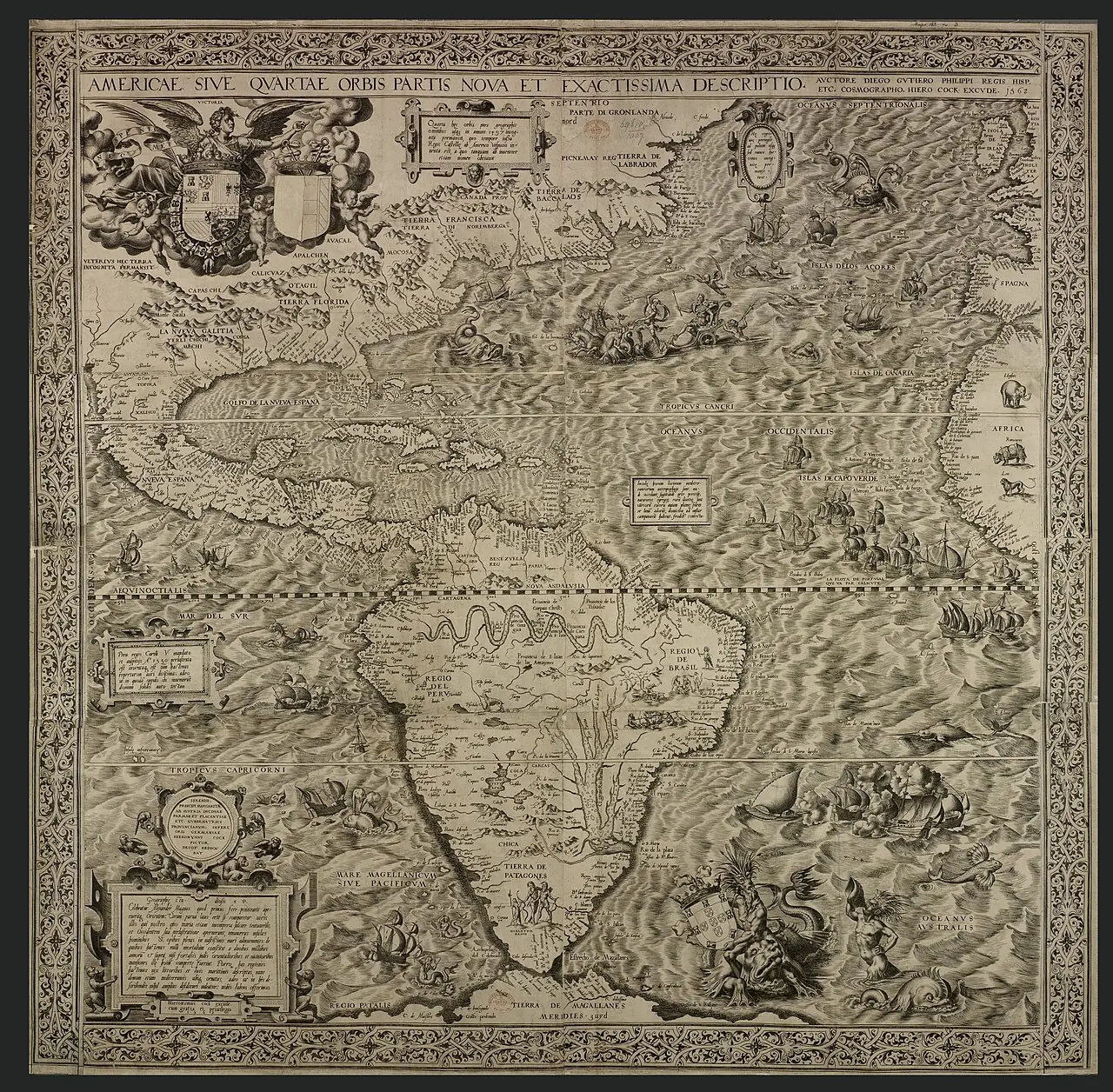
Americae sive quartae orbis partis nova et exactissima descriptio · 1562. The copy in the image is reproduced from Wikimedia Commons; the institutional record allows comparison with another copy of the same work. It is not a reconstruction of all the routes.
La descrittione di tutto il Peru · 1565. The historical use of Peru in the title does not coincide with present-day borders. It is not a map drawn by Pizarro or Orellana.
Americae sive novi orbis, nova descriptio · 1570. The depictions of the far south and the interior territories contain incomplete information and hypotheses of the period.
Descriptionis Ptolemaicae augmentum: set of plates · Atlas of 1597; record of a 1964 facsimile; montage of reproductions with no precise date. The linked record describes a 1964 facsimile with an introduction by R. A. Skelton. The image is a montage of plates, not a single historical sheet. To cite a specific region its plate and edition must be located.
Art and memory
- Portrait of Diego de Almagro · 1873
- Portrait of Francisco Pizarro · 1834–1835
- La Descrittione di tutto il Peru · 1564
- Portolan chart of the American Pacific coast · Mid-16th century
Other expeditions with shared protagonists
Sources and references
- [B99] Capitulation for the conquest and settlement of Peru, Toledo, 26 July 1529. Charles I and administration of the Crown. 26 July 1529; digital documentary edition. Original record
- [B63] True Account of the Conquest of Peru. Francisco de Xerez. 16th-century chronicle; Madrid edition, 1891; digitization, 2006. Original record
- [B74] Narrative of the Incas (Suma y narración de los Incas). Juan de Betanzos. 16th-century text; 1880 edition. Original record
- [B34] New Chronicle and Good Government. Felipe Guaman Poma de Ayala. Manuscript from the early 17th century, around 1615; GKS 2232 4º. Original record
- [B110] Royal Commentaries of the Incas. Volume one. Inca Garcilaso de la Vega; prologue by Ricardo Rojas. Work published in 1609; later edition with prologue by Ricardo Rojas. Original record
- [B88] Reports on the Discovery of Peru. Francisco de Xerez, Miguel de Estete, Hernando Pizarro y Pedro Sancho; edición de Clements R. Markham. Hakluyt Society edition (1872). Original record
- [B31] History of the Conquest of Peru. William Hickling Prescott. Work of 1847; modern digital edition. Original record
- [B91] Relation of the Discovery and Conquest of the Kingdoms of Peru. Pedro Pizarro; traducción de Philip Ainsworth Means. Account of 1571; English translation of 1921. Original record
- [B136] The Travels of Pedro de Cieza de León, parte 2. Pedro de Cieza de León; traducción de Clements R. Markham. Sixteenth-century chronicle; Hakluyt Society translation. Original record
- [B17] Francisco Pizarro González, Diccionario Biográfico Español. Héctor López Martínez · Real Academia de la Historia. n.d.; edition date not established. Original record
- [B135] Francisco López de Jerez. Jorge Huamán Machaca. Undated electronic edition; consulted on 2 November 2026. Original record
- Capitulation for the conquest and settlement of Peru, Toledo, 26 July 1529. Biblioteca Virtual Miguel de Cervantes. Edition of a normative document: what the Crown granted does not by itself describe what happened in the conquest.
Documents and call numbers
- PATRONATO,90A · Account of the conquest of Peru
General bibliography guides further reading; it is not a pinpoint reference for every claim. Page, chapter and archival references are identified at the relevant passages.
Further reading and comparison
- Capitulation of Toledo for the Conquest and Settlement of Peru · 1529
- Pizarro's Expedition from Spain for the Conquest of Peru · 1530
- Capture of Atahualpa at Cajamarca · 1532
- Execution of Atahualpa and taking of Cuzco · 1533
- Founding of Lima · 1535
Send comments to the author
Found an error or have information to contribute? Write privately to the author.