

Mendaña's Second Expedition: Marquesas and Santa Cruz
In this entry · 19 sections
- Context
- Stages
- Events of this expedition
- Route data
- Outcome
- Limits of the evidence
- Expedition facts
- Organisation
- Objectives
- Encounters and societies
- Ships and crew
- People and societies
- Related people
- Related cartography
- Art and memory
- Other expeditions with shared protagonists
- Sources and references
- Examine and compare documents
- Sources of the related expeditions
Expedition · 1595. Álvaro de Mendaña and Isabel Barreto.
On 9 April 1595 an expedition of four vessels leaves Callao to settle the Solomons. Families and crew travel aboard; the short account to Morga estimates about four hundred people. Mendaña is accompanied by his wife Isabel Barreto and chief pilot Pedro Fernández de Quirós. [B72] [B127]
In July they reach the Marquesas, amid contact and violence. They continue west and, in September, try to settle on the island of Santa Cruz, far from the Solomons they sought and never found. Conflicts with the islanders, disease and internal rivalries make the attempt fail. On 18 October Mendaña dies. [B127]¶ [B127]¶ [B127]¶ [B127]
On Mendaña’s death, Isabel Barreto receives the governorship and Lorenzo Barreto the captaincy-general, according to the account. Quirós continues as pilot. The survivors reach the Philippines in 1596; the cited accounts differ by one day over entry into Cavite. The planned colony was not established permanently. [B127]¶ [B127]
Context
The new expedition was prepared decades after the first voyage, in a context of expansion and competition in the Pacific. It included settlers and families and sought a colonial settlement, not just a survey. [B72]
Stages
- April 1595, Callao: Departure with crew, settlers and families. [B72]
- July 1595, Marquesas Islands: Survey and contacts with populations of the archipelago. [B127]
- September 1595, Santa Cruz: Attempt at colonial settlement, far from a safe return to the Solomons of the first voyage. [B72]
- October 18, 1595, Santa Cruz: Death of Mendaña; his will appears in the documentary file. [B127]
- Late 1595–1596, Road to the Philippines: Barreto led the survivors with Quirós as pilot. [B72]
- 1596, Manila: Arrival of the survivors of the enterprise. [B127]
Events of this expedition
Route data
- 4 ships with about 380 people, among them families of settlers.
- Isabel Barreto took command: the first woman at the head of a fleet in the Pacific.
- The vice-flagship Santa Isabel disappeared near Santa Cruz.
Outcome
The planned permanent colony was not established. [B72]
Barreto's command and Quirós's experience form part of the campaign's outcome; it is not reduced to a supposed absolute failure without consequences. [B72]
Limits of the evidence
Mendaña died on Santa Cruz, not in the Marquesas. [B72]
It is not claimed that the expedition reached and colonized the same Solomons of the first voyage. Counts of those embarked and of survivors vary according to the moment and the source. [B127]¶ [B72]
Expedition facts
| Date | 1595 |
|---|---|
| Leader | Álvaro de Mendaña and Isabel Barreto |
| Departure | Not specified in this entry |
| Destination | — |
| Period | 1595–1596 |
Organisation
Four vessels left Callao in April 1595. Loss of contact with one ship, illness, internal conflicts and lack of provisions affected the enterprise. [B72] [B72]
Objectives
- To locate the Solomons again and establish a colony [B72]
- To survey territories in the South Pacific [B72]
Encounters and societies
Landings and demands for food also ended in violence. Local resistance, disease and internal disputes prevented consolidating the settlement at Santa Cruz. [B127]¶ [B72]
Ships and crew
| Ship | Captain | Master | Pilot | Reference |
|---|---|---|---|---|
| San Jerónimo | Álvaro de Mendaña (chief embarked on the flagship) | Not documented here | Pedro Fernández de Quirós (chief pilot) | Revista General de Marina, November 2014, p. 623; captains of the auxiliaries: naval almanac of December 2011 [B144] |
| Santa Isabel | Lope de Vega | Not documented here | Not documented here | Revista General de Marina, November 2014, p. 623; captains of the auxiliaries: naval almanac of December 2011 [B144] |
| Santa Catalina | Alonso de Leyra | Not documented here | Not documented here | Revista General de Marina, November 2014, p. 623; captains of the auxiliaries: naval almanac of December 2011 [B152] |
| San Felipe | Felipe Curzo | Not documented here | Not documented here | Revista General de Marina, November 2014, p. 623; captains of the auxiliaries: naval almanac of December 2011 [B152] |
San Jerónimo: After Mendaña's death, Isabel Barreto took command of the expedition; she was neither a field marshal (maestre de campo) nor a ship's master.
Santa Catalina: Captain and owner according to the naval almanac of December 2011.
San Felipe: Command cited in the naval almanac of December 2011.
People and societies
- Álvaro de Mendaña: Adelantado and head until his death [B72]
- Isabel Barreto: Took over government and command after Mendaña's death [B127]
- Pedro Fernández de Quirós: Chief pilot [B72]
- Pedro Merino Manrique: Field marshal (maestre de campo); protagonist of the campaign's conflicts [B127]
Related people
Related cartography
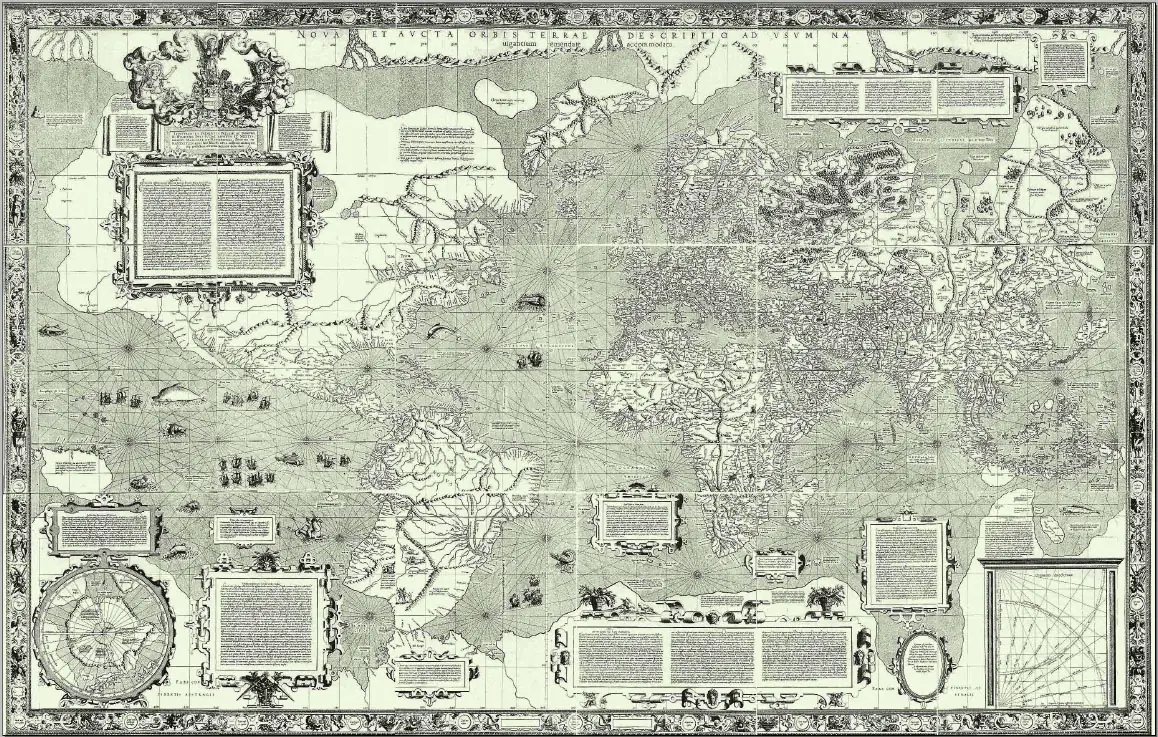
Nova et aucta orbis terrae descriptio · 1569. The projection enlarges surfaces toward the poles. Distances should not be measured directly on the image nor its lines confused with routes actually sailed.
Asiae nova descriptio · Copy of 1579, based on the author's earlier cartography. The record dates the copy to 1579. Luzon does not appear and several geographic shapes are distorted: its usefulness is to compare the knowledge of the period.
Maris Pacifici · 1589. The ship Victoria recalls the circumnavigation, but does not make the map a layout of the route of 1519–1522. The date of the map must be distinguished from that of the voyage.
Indiae Orientalis, insularumque adiacentium typus · Copy of the Latin edition of 1603; plate first published in 1570. The image is of 1603, not of the first edition of 1570. It does not describe Urdaneta's tornaviaje nor Mendaña's complete routes.
Art and memory
- Portrait of Álvaro de Mendaña · Date not established
- Portrait of Pedro Fernández de Quirós · Date not established
Other expeditions with shared protagonists
Sources and references
- [B127] The Voyages of Pedro Fernandez de Quiros, 1595 to 1606, volumen 1. Pedro Fernández de Quirós; edición de Clements R. Markham. Hakluyt Society edition (1904). Original record
- [B53] The practical conditions of Mendaña’s and Quirós’s voyages to Oceania. Annie Baert. Accessed 1 November 2026. Original record
- [B25] Portuguese Cartography in the Renaissance. The History of Cartography, volume 3. Modern research on Renaissance cartography. Original record
- [B150] Terra Australis Incognita; Or, A New Southern Discovery. Pedro Fernández de Quirós. Memorial of 1617; English translation. Original record
- [B72] Álvaro de Mendaña y Neira, Diccionario Biográfico Español. Real Academia de la Historia. n.d.; edition date not established. Original record
- [B144] Isabel Barreto, admiral of the Spanish fleet, between fiction and reality. María Luisa Burguera Nadal. Revista General de Marina, November 2014, from p. 621. Original record
- [B152] Spain and the New World: December anniversaries. Revista General de Marina. December 2011, p. 939. Original record
- Documents of Mendaña's expeditions and will of 1595. AGI / PARES. The file includes accounts of the first voyage, documentation of the 1595 fleet and the will made at Santa Cruz.
- Álvaro de Mendaña and his Bierzo origins. Revista Española del Pacífico / Miguel de Cervantes Virtual Library. Study of the navigator and his two voyages; it places his death on Santa Cruz, not in the Marquesas.
General bibliography guides further reading; it is not a pinpoint reference for every claim. Page, chapter and archival references are identified at the relevant passages.
Examine and compare documents
- Pacification: legislation and non-compliance — Does changing a name establish that violence ceased? ·
Documentary supplements with their own review scope; they do not certify a complete collation of this entry.
Sources of the related expeditions
- [B3] The Spanish Lake
- [B4] España y el Pacífico: un breve repaso a las expediciones españolas de los siglos XVI al XVIII
- [B6] Spanish discoveries in the South Sea
- [B7] Los hallazgos españoles en el Pacífico
- [B68] Documents of Mendaña's expeditions and will of 1595
- [B149] Spanish women overseas in history and literature
Send comments to the author
Found an error or have information to contribute? Write privately to the author.