

Orellana's Second Expedition: Nueva Andalucía
In this entry · 17 sections
Expedition · 1545. Francisco de Orellana.
The Museum of the Americas distinguishes the new capitulation of 13 February 1544 from the earlier Amazon descent: it envisaged two settlements and an expedition from the Atlantic. It places departure in May 1545 and explains financing and equipment difficulties. [B80]
Escudero describes stops at Tenerife and Cape Verde and losses before the crossing. The Museum places arrival at the river mouth in December 1545. [B132] [B80]
The Museum entry records Nueva Sevilla and dates Orellana’s death to December 1546, probably from malaria. The SGE article places Ana de Ayala among the survivors arriving at Margarita. This campaign is distinct from Carvajal’s 1541–1542 account. [B80] [B132]
Context
After his first Amazon voyage, Orellana obtained capitulations in 1544 to organize a new enterprise. The lack of financing and supplies conditioned the preparation and the voyage. [B80]
Stages
- May 1545, Sanlúcar: Departure for the province granted. [B132]
- 1545, Canary Islands: Stopover and equipment difficulties. [B132]
- 1545, Cape Verde: Disease and human losses during the preparation for the crossing. [B132]
- Late 1545, Amazon estuary: Arrival of a much reduced force and start of attempts at penetration. [B80]
- 1546, Amazonian setting: Attempts at settlement and search for resources; Orellana died during the enterprise. [B80]
Route data
- 4 vessels on departure, financed by merchants.
- Orellana's wife, Ana de Ayala, traveled with him and survived.
- It is not the river descent of 1541–1542 but the attempt to settle the province granted.
Outcome
The expedition did not establish the lasting dominion that the capitulations envisaged. [B80]
Orellana's death and the dispersal of the force closed the enterprise without repeating the river journey of his first voyage. [B80] [B132]
Limits of the evidence
Carvajal’s account concerns the 1541–1542 descent; it is not used as an eyewitness account of the later 1545–1546 venture. [B66] [B80]
The Museum of the Americas dates the death to December 1546 and proposes malaria as a probable cause. That probability is not turned into a confirmed diagnosis. [B80]
Expedition facts
| Date | 1545 |
|---|---|
| Leader | Francisco de Orellana |
| Departure | Sanlúcar de Barrameda |
| Destination | — |
| Period | 1545–1546 |
Organisation
He sailed from Sanlúcar in May 1545 with four vessels. Prolonged stopovers and the loss of people and ships reduced its chances before reaching the estuary. [B132] [B80]
Objectives
- To establish settlements and exercise the government granted in Nueva Andalucía [B80]
- To go up the Amazon from the Atlantic and develop a colonial occupation [B80]
Encounters and societies
The Museum of the Americas entry records the attempted settlement of Nueva Sevilla; the SGE describes food searches and survivors’ return, including Ana de Ayala. These passages do not securely identify every community along the 1545–1546 route. [B80] [B132]
Recorded vessels
- Four vessels on departure; the composition of the force changed before reaching the Amazon [B66] [B132]
People and societies
- Francisco de Orellana: Governor of Nueva Andalucía according to the Museum of the Americas entry [B80]
- Ana de Ayala: Accompanied the campaign and survived the failure [B132]
- Crews and settlers: They suffered lack of food, disease and loss of vessels [B132]
Related people
Related cartography
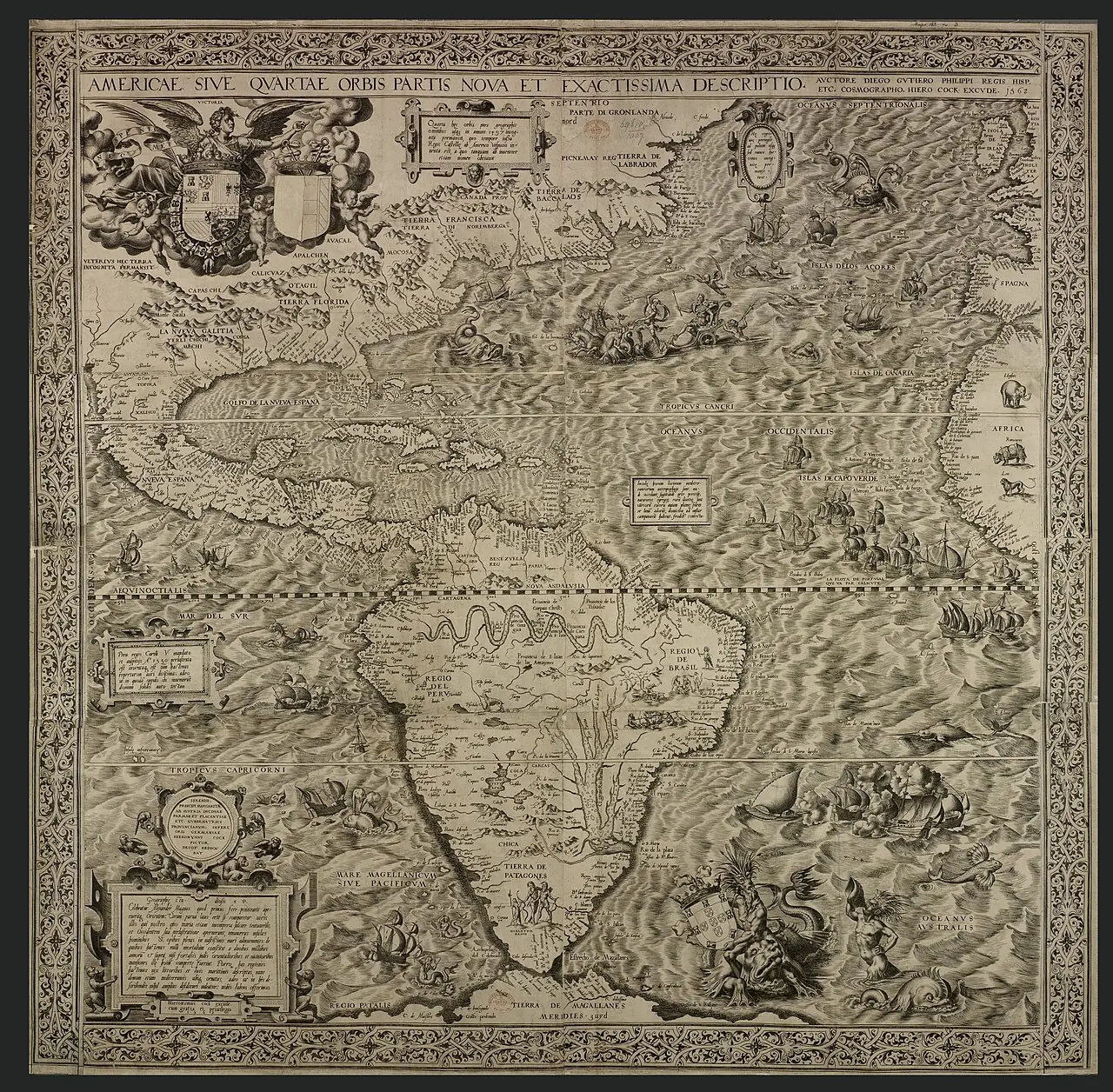
Americae sive quartae orbis partis nova et exactissima descriptio · 1562. The copy in the image is reproduced from Wikimedia Commons; the institutional record allows comparison with another copy of the same work. It is not a reconstruction of all the routes.
La descrittione di tutto il Peru · 1565. The historical use of Peru in the title does not coincide with present-day borders. It is not a map drawn by Pizarro or Orellana.
Americae sive novi orbis, nova descriptio · 1570. The depictions of the far south and the interior territories contain incomplete information and hypotheses of the period.
Descriptionis Ptolemaicae augmentum: set of plates · Atlas of 1597; record of a 1964 facsimile; montage of reproductions with no precise date. The linked record describes a 1964 facsimile with an introduction by R. A. Skelton. The image is a montage of plates, not a single historical sheet. To cite a specific region its plate and edition must be located.
Art and memory
- Portrait of Francisco de Orellana · 1930 (record dating)
Sources and references
- [B80] Francisco de Orellana: biography and two expeditions. Museum of the Americas, Ministry of Culture. Contemporary biography on the enterprises of 1541–1542 and 1545–1546. Original record
- [B132] Francisco de Orellana, 1541–1542 and the later expedition. Spanish Geographical Society. n.d.; edition date not established. Original record
- [B1] General and Natural History of the Indies: second part, first volume. Gonzalo Fernández de Oviedo; edition by José Amador de los Ríos. Work of the 16th century; linked volume edited in 1852. Original record
- [B66] Francisco de Orellana. Mariano Cuesta Domingo. Undated electronic edition; consulted on 2 November 2026. Original record
- Francisco de Orellana: biography and two expeditions. Ministry of Culture, Museum of the Americas. It distinguishes the descent of 1541–1542 from the enterprise capitulated in 1544 and undertaken in 1545.
- Francisco de Orellana, 1541–1542 and the later expedition. Spanish Geographical Society. Article on the history of exploration. The identifications of places and dates are checked against the sources of the Museum of the Americas.
General bibliography guides further reading; it is not a pinpoint reference for every claim. Page, chapter and archival references are identified at the relevant passages.
Further reading and comparison
- Entry of Gonzalo Pizarro and Orellana's Descent (1541–1542) · 1541
- Discovery of the Potosí mines · 1545
Examine and compare documents
- Carvajal: witness, justification and provisioning — What did Carvajal witness, and how does he explain Orellana’s continuation? ·
- El Dorado: separating campaigns and accounts — Does a shared quest make all expeditions one story? ·
Documentary supplements with their own review scope; they do not certify a complete collation of this entry.
Send comments to the author
Found an error or have information to contribute? Write privately to the author.