

Diego Velázquez de Cuéllar
In this entry · 14 sections
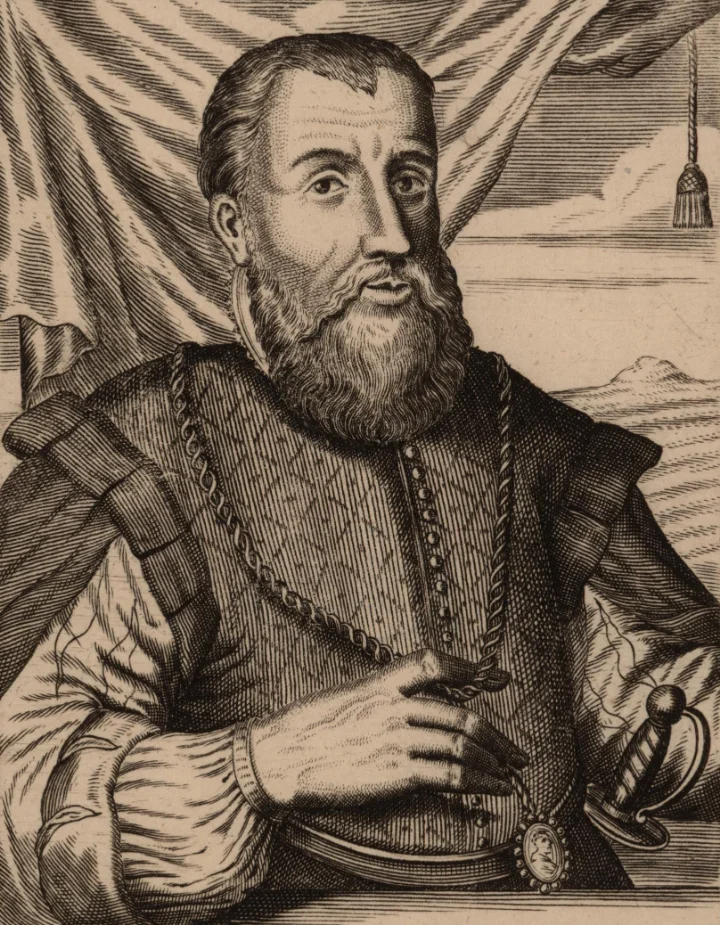
Unidentified artist · 1728.
A hidalgo born in Cuéllar around 1464 who reached Hispaniola on Columbus’s second voyage, which began on 25 September 1493. He did not return to the Iberian Peninsula. [B414] [B414]
Birth: Cuéllar, around 1464 [B414]. Death: Santiago de Cuba, 1524 [B414].
From Cuéllar to Hispaniola
He was born around 1464 or 1465 at Cuéllar, into a family of the local nobility; he had brothers who also went to the Indies and relatives in the Crown's administration, such as Cristóbal de Cuéllar, Ovando's treasurer. Some sources credit him with taking part in the war of Granada, but this has not been confirmed. He went to the Indies on Columbus's second voyage (1493) and settled permanently on Hispaniola. During the Columbian government the sources record few actions of his, but he secured a favorable position through the repartimientos of Indigenous people and land. [B414]
Under Ovando
The arrival of Nicolás de Ovando in 1502 favored his rise. He took part in the Jaragua campaign (1503–1504) against the chiefdom of Anacaona, whose repression included the execution of numerous caciques and the hanging of Anacaona herself. Ovando later founded towns in the west of the island and Velázquez was lieutenant governor in some of them, with major encomiendas in the repartimientos of 1504 and 1505. [B414]
The conquest of Cuba
In 1511 Diego Colón appointed him captain and lieutenant to conquer and settle Cuba. Arranz describes a flotilla of three or four ships and about three hundred men assembled with Velázquez’s resources, accompanied by his secretaries Cortés and Duero and by Las Casas. Occupation began in eastern Cuba and faced resistance from Hatuey, a refugee from Hispaniola, who was captured and sentenced to burning. Narváez became his principal captain. The same study describes the 1512–1513 campaigns and Las Casas’s denunciation of massacres, dating Baracoa to 1511 without assigning a month unsupported by the passage. [B414]
The expeditions to Yucatán and Mexico
Cuba served as a base for enterprises towards Yucatán. Arranz describes Velázquez’s sponsorship of Hernández de Córdoba’s 1517 and Grijalva’s 1518 expeditions and efforts to increase his autonomy from Diego Colón. For Cortés’s enterprise he distinguishes shared financing, whose exact proportions are unknown, from instructions and the subsequent political rupture. After the Veracruz procurators departed, Velázquez sent Narváez to displace Cortés; Narváez’s defeat in 1520 frustrated that attempt. [B414]
End
He remained governor of Cuba until his death at Santiago in 1524, without recovering authority over the conquest of Mexico. [B414]
Documentary comparison of a specific episode
Las Casas, book III, chapters XXV–XXVIII, recounts the conquest of Cuba and Hatuey’s resistance. The account should be read with attention to both its criticism of violence and its author’s perspective. [B33]
Offices
Chronology
A life, step by step. Follow the dates and open each milestone or image to explore its sources.
- 1493
1728 About this image
Portrait of Diego Velázquez de Cuéllar · 1728. Context portrait; it does not depict this event. Representation attributed to this person in the provenance record. It is not treated as evidence of physical appearance or as a record of their expeditions. The date of the work is distinguished from its digitisation date.Columbus’s second voyage. [B414]
Explore this year - 1503–1505
Jaragua, lieutenant governorship and encomiendas. [B414]
Explore this year - 1511
Cuban enterprise and Baracoa. [B414]
Explore this year - 1512–1513
Campaigns in central Cuba. [B414]
Explore this year - 1517–1518
Sponsors Córdoba’s and Grijalva’s enterprises. [B414]
Explore this year - 1519–1520
Rupture with Cortés and dispatch of Narváez. [B414]
Explore this year - 1524
Dies in Santiago de Cuba. [B414]
Explore this year
Disputed dates and open questions
- Participation in the Granada war is attributed to local chronicles rather than established independently. [B414]
Participation
- Conquest of Cuba (1511): Led the colonial occupation
Related milestones
Sources
- Diego Velázquez de Cuéllar, Luis Arranz Márquez
- Historia verdadera de la conquista de la Nueva España, Bernal Díaz del Castillo · Miguel de Cervantes Virtual Library
- Historia de las Indias, volumen 4 de 5, Bartolomé de las Casas
Examine and compare documents
- The Caribbean: tribute, captivity and resistance — Which voices does a conquest account preserve, and which are mediated? ·
Documentary supplements with their own review scope; they do not certify a complete collation of this entry.
Send comments to the author
Found an error or have information to contribute? Write privately to the author.