

Loaísa's Expedition: Second Attempt on the Moluccas
In this entry · 21 sections
- Context
- Stages
- Development
- Events of this expedition
- Route data
- Outcome
- Limits of the evidence
- Expedition facts
- Organisation
- Objectives
- Encounters and societies
- Ships and crew
- People and societies
- Related people
- Related cartography
- Art and memory
- Other expeditions with shared protagonists
- Mentioned in other entries
- Sources and references
- Examine and compare documents
- Sources of the related expeditions
Expedition · 1525. García Jofre de Loaísa.
Mellén dates departure from La Coruña to 24 July 1525 and lists seven ships and about 450 men, including Elcano and Urdaneta. He describes mercantile interest in spices and the search for Trinidad survivors. The order of 13 May distinguishes succession in governing the Moluccas from naval command. [B114] [B114] [B125]
The study distinguishes the Sancti Spiritus wreck in January 1526 from the strait passage between April and May and subsequent Pacific dispersal. Only Santa María de la Victoria reached the Moluccas. Mellén dates the deaths of Loaísa to 30 July, Elcano to 4 August and Salazar to 13 September; Lucena’s Elcano biography gives 6 August, a discrepancy retained here. [B114] [B113]
The survivors took refuge at Tidore and fought the Portuguese at Ternate. Mellén’s account extends the campaign through their surrender and some survivors’ return in 1536, after the Treaty of Zaragoza. Loaísa’s death is therefore not presented as the end of every itinerary. [B114]
Context
After the Victoria's return, the Crown and the mercantile interests of La Coruña sought to consolidate access to the spices. The location of the demarcation and the rights claimed by Portugal and Castile remained a matter of conflict. [B114]
Stages
- July 24, 1525, La Coruña: Departure of the fleet. [B114]
- 1525–1526, South American Atlantic: Storms and separation of vessels. [B114]
- 1526, Strait of Magellan: Eventful crossing; the fleet did not continue together. [B114]
- 1526, Pacific: Successive deaths of Loaísa, Elcano and Salazar; changes of command. [B114]
- 1526, Moluccas: The Victoria reached the archipelago; conflicts and difficulties persisted. [B114]
- Later years, Moluccas: The presence of the survivors and their returns extended beyond the arrival of 1526. [B114]
Development
The Crown distinguished succession to the Moluccan governorship from succession to naval command: Pedro de Vera and Elcano respectively headed the two lists in the order of 13 May 1525. [B125]
Events of this expedition
Route data
- 7 ships and about 450 men; the flagship Santa María de la Victoria, of 360 toneles.
- Elcano went as chief pilot; with him traveled the young Andrés de Urdaneta.
- Loaísa, Elcano and Salazar died in succession; only the flagship reached the Moluccas.
Outcome
The enterprise did not establish a regular trade route from La Coruña. [B114]
The survivors provided information on navigation and on the Moluccas; the Treaty of Zaragoza of 1529 changed the framework of Iberian claims. [B114]
Limits of the evidence
Urdaneta was not the commander who took the Victoria to the Moluccas, nor did Elcano captain the Santa María del Parral in this campaign. [B114]
Mellén describes San Lesmes as lost in the Pacific; the passage does not establish a landing in Australia or New Zealand. [B114]
Expedition facts
| Date | 1525 |
|---|---|
| Leader | García Jofre de Loaísa |
| Departure | La Coruña |
| Destination | — |
| Period | 1525–1526; resistance in the Moluccas and later returns |
Organisation
Seven vessels left La Coruña on 24 July 1525. Provisioning for so long a voyage and coordination of the fleet proved decisive; shipwrecks and separations altered the initial plan. [B114] [B114]
Objectives
- To reach and establish a presence in the Moluccas [B114]
- To organize a commercial link with the Castilian Crown [B114]
Encounters and societies
Mellén places the survivors at Tidore facing Portuguese forces at Ternate. Cuesta Domingo describes Saavedra’s assistance and the European groups’ negotiations with the archipelago’s rulers. [B114] [B57]
Ships and crew
| Ship | Captain | Master | Pilot | Reference |
|---|---|---|---|---|
| Santa María de la Victoria | García Jofre de Loaísa | Not documented here | Not documented here | Institute of Naval History and Culture, García Jofre de Loaísa expedition [B119] |
| Sancti Spiritus | Juan Sebastián Elcano | Not documented here | Not documented here | Institute of Naval History and Culture, García Jofre de Loaísa expedition [B119] |
| Anunciada | Pedro de Vera | Not documented here | Not documented here | Institute of Naval History and Culture, García Jofre de Loaísa expedition [B119] |
| San Gabriel | Rodrigo de Acuña | Not documented here | Not documented here | Institute of Naval History and Culture, García Jofre de Loaísa expedition [B119] |
| Santa María del Parral | Jorge Manrique de Nájera | Not documented here | Not documented here | Institute of Naval History and Culture, García Jofre de Loaísa expedition [B119] |
| San Lesmes | Francisco de Hoces | Not documented here | Not documented here | Institute of Naval History and Culture, García Jofre de Loaísa expedition [B119] |
| Santiago | Santiago de Guevara | Not documented here | Not documented here | Institute of Naval History and Culture, García Jofre de Loaísa expedition [B119] |
Santa María de la Victoria: Command at the start of the expedition of 1525. No master, pilot or complement is attributed per ship without an account that allows them to be identified.
Sancti Spiritus: Command at the start of the expedition of 1525. No master, pilot or complement is attributed per ship without an account that allows them to be identified.
Anunciada: Command at the start of the expedition of 1525. No master, pilot or complement is attributed per ship without an account that allows them to be identified.
San Gabriel: Command at the start of the expedition of 1525. No master, pilot or complement is attributed per ship without an account that allows them to be identified.
Santa María del Parral: Command at the start of the expedition of 1525. No master, pilot or complement is attributed per ship without an account that allows them to be identified.
San Lesmes: Command at the start of the expedition of 1525. No master, pilot or complement is attributed per ship without an account that allows them to be identified.
Santiago: Command at the start of the expedition of 1525. No master, pilot or complement is attributed per ship without an account that allows them to be identified.
People and societies
- García Jofre de Loaísa: Captain general [B114]
- Juan Sebastián Elcano: Captain of the Sancti Spiritus and brief successor in command [B114] [B114]
- Andrés de Urdaneta: Participant who gained experience in the Pacific and the Moluccas [B114]
- Alonso de Salazar: Took command after the earlier deaths [B114]
- Hernando de la Torre: Led the Spaniards in the Moluccas in a later phase [B114]
Related people
Related cartography
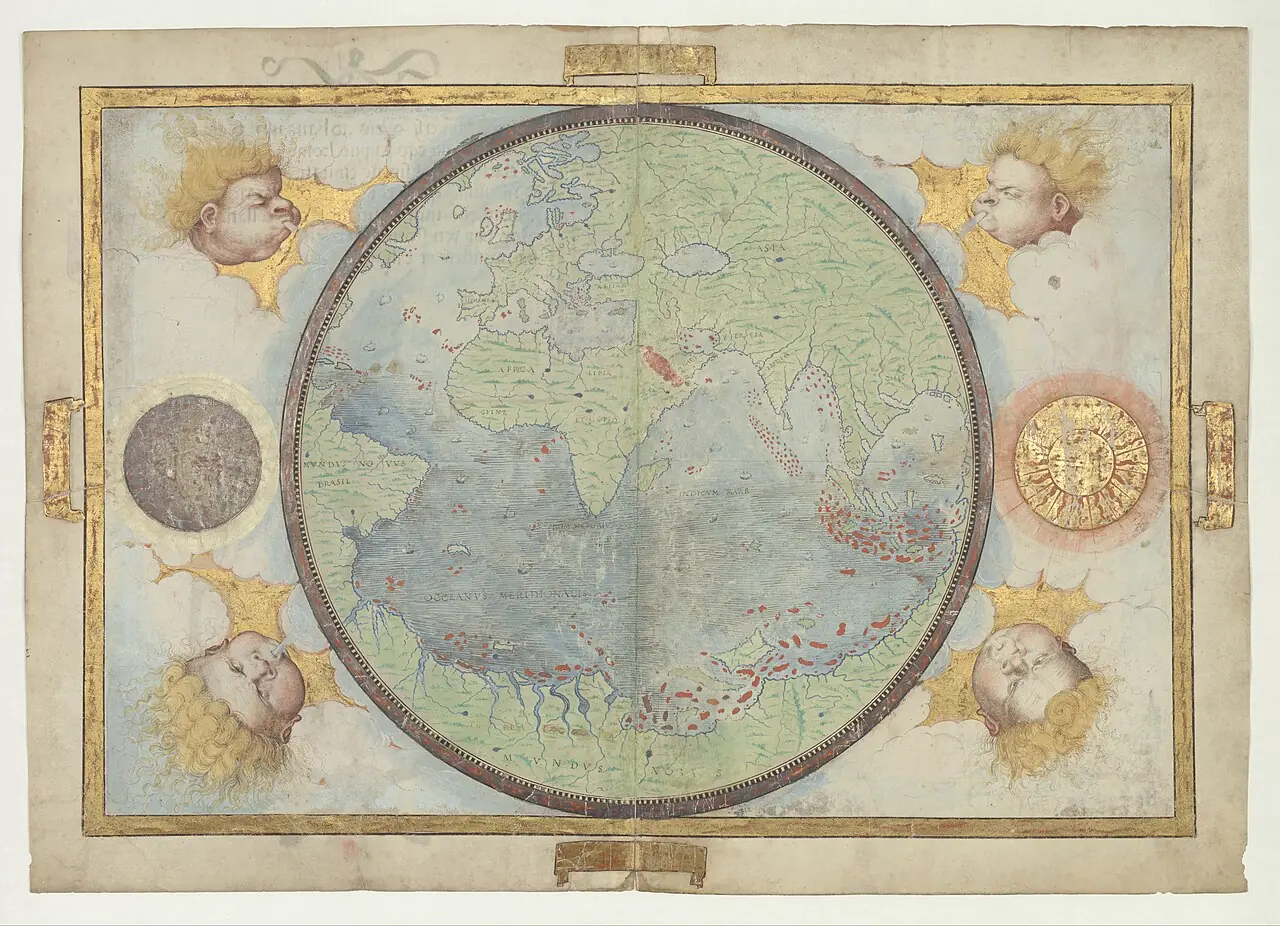
Miller Atlas: world map · 1519. The world map is shown, not all the atlas's sheets. Its composition and decoration also express a political vision of Portuguese dominion.
Universal chart of Diego Ribero: reproduction · Model of 1529; 2019 reproduction based on a 19th-century facsimile. The linked copy is a 2019 reproduction, not the original of 1529. The chain of reproduction is expressly kept.
Nautical planisphere of Lopo Homem · Original of 1554; the museum displays a facsimile. The Galileo Museum distinguishes the original from the facsimile displayed. The record allows consultation of the work; no license is attributed here to its photographs.
Universale descrittione di tutta la terra conosciuta fin qui · 1565. The continental shapes and the hypothetical southern land belong to the cartography of the time. The presence of a place does not prove a visit by the selected expedition.
Nova et aucta orbis terrae descriptio · 1569. The projection enlarges surfaces toward the poles. Distances should not be measured directly on the image nor its lines confused with routes actually sailed.
Asiae nova descriptio · Copy of 1579, based on the author's earlier cartography. The record dates the copy to 1579. Luzon does not appear and several geographic shapes are distorted: its usefulness is to compare the knowledge of the period.
Maris Pacifici · 1589. The ship Victoria recalls the circumnavigation, but does not make the map a layout of the route of 1519–1522. The date of the map must be distinguished from that of the voyage.
Indiae Orientalis, insularumque adiacentium typus · Copy of the Latin edition of 1603; plate first published in 1570. The image is of 1603, not of the first edition of 1570. It does not describe Urdaneta's tornaviaje nor Mendaña's complete routes.
Art and memory
- Portrait of Andrés de Urdaneta · Date not established
Other expeditions with shared protagonists
- First Circumnavigation: The Magellan–Elcano Expedition
- Return of the nao Victoria to Sanlúcar
- Saavedra's Expedition: Relief of the Moluccas
- Conquest of the Philippines
- Urdaneta's discovery of the return route (tornaviaje)
Mentioned in other entries
Una mención permite investigar una relación; no implica participación en la expedición ni acredita por sí sola el pasaje citado.
Sources and references
- [B55] Colección de los viages y descubrimientos: Expediciones al Maluco. Viages de Loaisa y de Saavedra. Martín Fernández de Navarrete. Edition of 1837. Original record
- [B32] Caminos sobre la mar. Las expediciones a las islas de la especiería después de Magallanes, 1525–1564. Luis Alonso Álvarez. 2022. Original record
- [B119] García Jofre de Loaísa's expedition, 1525–1526. Institute of Naval History and Culture. Contemporary synthesis of the voyage begun in 1525. Original record
- [B25] Portuguese Cartography in the Renaissance. The History of Cartography, volume 3. Modern research on Renaissance cartography. Original record
- [B62] Nautical treatises and documents of Magellan and Elcano. Naval Museum / Institute of Naval History and Culture. Contemporary catalog; works by Medina, Cortés and other 16th-century authors. Original record
- [B26] The Discovery and Conquest of the Molucco and Philippine Islands. Bartolomé Leonardo de Argensola. Work of 1609; English translation of 1708. Original record
- [B125] A legal and historical study of Loaísa’s expedition and the sale of rights over the Moluccas. José María Ortuño Sánchez-Pedreño. 2003. Original record
- [B114] García Jofre de Loaysa. Francisco Mellén Blanco. Undated electronic edition; consulted on 2 November 2026. Original record
- [B113] Juan Sebastián Elcano, Diccionario Biográfico Español. Manuel Lucena Salmoral · Real Academia de la Historia. n.d.; edition date not established. Original record
- [B57] Álvaro Saavedra Cerón. Mariano Cuesta Domingo. Undated electronic edition; consulted on 2 November 2026. Original record
- García Jofre de Loaísa's expedition, 1525–1526. Institute of Naval History and Culture, Armada. It describes organization, ships and course; it distinguishes the arrival in the Moluccas from the survivors' later return.
- The tornaviaje and Saavedra's attempts to return. Ministry of Defense, Revista Ejército 924. Synthesis of Pacific voyages and the problem of returning toward America.
General bibliography guides further reading; it is not a pinpoint reference for every claim. Page, chapter and archival references are identified at the relevant passages.
Examine and compare documents
- The eastward return: failed attempts and two returns in 1565 — Why are reaching Asia from America and finding a return route different problems? ·
- Legazpi, Urdaneta and Arellano: expedition and return voyages — Are the settlement at Cebu and the return voyage the same episode? ·
Documentary supplements with their own review scope; they do not certify a complete collation of this entry.
Send comments to the author
Found an error or have information to contribute? Write privately to the author.