

Pizarro captures Atahualpa
In this entry · 5 sections
16 November 1532 · Cajamarca (Peru)
It is Saturday, 16 November 1532, at Cajamarca, in the Andes of what is now northern Peru. Francisco Pizarro entered it the previous afternoon with about one hundred and seventy-seven men, sixty-seven of them cavalry, [B31]¶ [B31]¶ after months of marching from the coast, and has heard that the ruler of the Tahuantinsuyu, Atahualpa, is camped nearby with a large army.
Atahualpa had just won a civil war against his brother Huáscar, and the empire was divided and weary of the struggle. Cieza de León, who gathered the account of the Inca nobles of Cuzco, says that Huáscar, the legitimate heir, was taken prisoner at the Cotabamba crossing by Atahualpa’s captains. [B424]¶ That situation, together with surprise and weapons, would help the Spaniards.
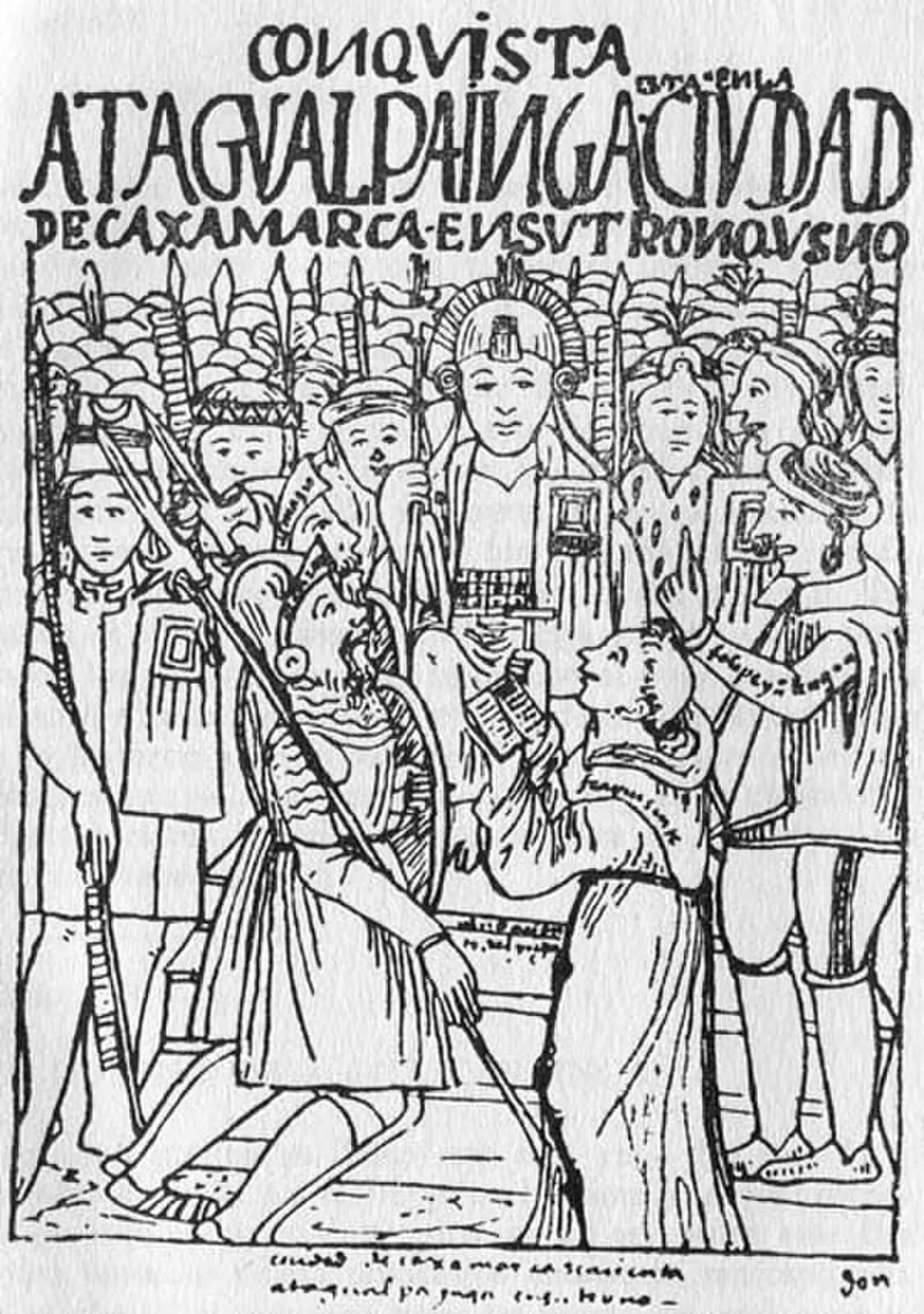
The forces of Francisco Pizarro capture at Cajamarca the ruler of the Tahuantinsuyu, newly victorious in the civil war against his brother Huáscar. [B31]
According to Spanish chronicles, the friar Vicente de Valverde approaches Atahualpa to read him the Requerimiento. Soon afterwards the Spaniards attack his attendants, kill a large number of them and capture the sovereign. According to Prescott, Atahualpa took the book with which Valverde justified his speech and threw it to the ground. [B31]
The captive offered gold and silver as ransom. Its delivery did not lead to Atahualpa’s release; he was executed in 1533 (Prescott gives 29 August); [B31]¶ the exact date and the interpretation of the proceedings require comparing the chronicles. [B31]
The capture of Atahualpa opened the way to Cuzco and the conquest of Peru. But the Andean peoples did not disappear: they resisted, negotiated and went on telling their own version of what happened.
Context
Capture of Atahualpa at Cajamarca
Capture of Atahualpa by Pizarro's forces at Cajamarca, during a meeting that ended in attack and massacre. [B31]
Inca power was marked by the war of succession and by regional alliances and rivalries. Atahualpa was not an actor without information or political capacity, even though the victors' accounts stress his surprise.
The captivity allowed Pizarro to condition decisions and demand a large ransom.
The Spanish testimonies justified the intervention through legal and religious arguments.
Start of the conquest of Peru
Pizarro's campaign from Panama to the Andes: advance along the coast, capture of Atahualpa and occupation of Cuzco, in a context of Inca succession conflict and local alliances. [B99]¶ [B17] [B17] [B17]
The Toledo capitulation of 1529 preceded the new campaign. López Martínez relates the war between Huáscar and Atahualpa to alliances sought by the Huanca and Chachapoya against Cuzco’s rule. [B17] [B17]
Why it matters
A decisive point in the conquest of the Inca Empire, which prompted new explorations towards Chile, the Amazon and the Pacific.
Where it appears
Expeditions and episodes
Also mentioned in
Maps
- Americae sive quartae orbis partis nova et exactissima descriptio
- La descrittione di tutto il Peru
- Americae sive novi orbis, nova descriptio
- Descriptionis Ptolemaicae augmentum: set of plates
Art
- Portrait of Diego de Almagro
- Portrait of Francisco Pizarro
- La Descrittione di tutto il Peru
- Americae pars sexta: Pizarro and the conquest of Peru
- Portolan chart of the American Pacific coast
- Illustrations of Martín de Murúa's histories
- New Chronicle and Good Government: Pizarro and Atahualpa at Cajamarca
Linked people
Sources for this milestone
- [B31] History of the Conquest of Peru
- [B17] Francisco Pizarro González, Diccionario Biográfico Español
- [B34] New Chronicle and Good Government
- [B59] The descendants of licenciado Gaspar de Espinosa
- [B60] Origins of the San Juan governorship: Gaspar de Espinosa
- [B63] True Account of the Conquest of Peru
- [B74] Narrative of the Incas (Suma y narración de los Incas)
- [B88] Reports on the Discovery of Peru
- [B91] Relation of the Discovery and Conquest of the Kingdoms of Peru
- [B99] Capitulation for the conquest and settlement of Peru, Toledo, 26 July 1529
- [B110] Royal Commentaries of the Incas. Volume one
- [B135] Francisco López de Jerez
- [B136] The Travels of Pedro de Cieza de León, parte 2
- [B147] The Royal Commentaries of Peru
Send comments to the author
Found an error or have information to contribute? Write privately to the author.