

Córdoba's Expedition: Discovery of Yucatán
In this entry · 17 sections
Expedition · 1517. Francisco Hernández de Córdoba.
Bernal recounts the election of Hernández de Córdoba by 110 companions and describes three ships, with Alaminos, Camacho and Álvarez as pilots. He states that they rejected Velázquez’s condition of seeking slaves at Guanajas: this is his retrospective account of the voyage’s purposes. [B22]¶ [B22]¶ [B22]
At Catoche, Bernal describes buildings, objects removed from temples and two captives later called Melchor and Julián. Carlos Macías identifies Lázaro as Campeche and recalls the shipwreck survivors of 1511. These passages avoid a claim of an absolute first European contact. [B22]¶ [B19]
The Bernal translation describes over fifty deaths at Champotón, thirst and the return via Florida. It places Córdoba’s death ten days after arrival at Sancti Spíritus; González Ochoa gives Santiago de Cuba. The difference of place is retained. [B22]¶ [B22]¶ [B22]¶ [B22]¶ [B142]
Context
Cuba became the base for new maritime enterprises. The campaign took place in the context of a search for resources and for people to be subjected to forced labor; its specific purposes must be reconstructed by comparing chronicles, not through a single retrospective explanation. [B22]¶ [B22]
Stages
- February 1517, Cuba: Departure of the campaign for Yucatán. [B22]
- March 1517, Northeast coast of Yucatán: First contacts and violent episodes. [B22]
- March 1517, Campeche: Recognition of a settlement with its own architecture and political organization. [B19]
- 1517, Champotón: Fierce clash with casualties in the expedition and wounds to Córdoba. [B22]
- 1517, Cuba: Return; Hernández de Córdoba died. [B22]¶ [B142]
Events of this expedition
Route data
- 3 ships and about 110 men, according to the chronicles.
- The pilot Antón de Alaminos took the return route via Florida to take advantage of the currents.
- Bernal Díaz del Castillo, a participant, narrated the journey decades later.
- Hernández de Córdoba died of his wounds shortly after returning to Cuba.
Outcome
The campaign did not establish a permanent colony in Yucatán. [B22]
The news that reached Cuba contributed to preparing the voyages of Grijalva and Cortés. [B142]
Limits of the evidence
The contacts of 1517 are distinguished from earlier castaways and from Columbus's fourth voyage. [B19]
Dramatic phrases attributed to Córdoba without a cross-checked edition, and exact casualty figures that the sources do not uniformly support, are removed.
Expedition facts
| Date | 1517 |
|---|---|
| Leader | Francisco Hernández de Córdoba |
| Departure | Not specified in this entry |
| Destination | — |
| Period | 1517 |
Organisation
Three ships were prepared and the pilot Antón de Alaminos took part. The surviving chronicles are not a uniform record of all the days and differ on decisions and casualty figures. [B22]
Objectives
- To survey lands west of Cuba [B22]
- To obtain information and resources that would justify new expeditions [B22]
Encounters and societies
Bernal describes stone buildings, objects taken from temples and the capture of two men baptised Melchor and Julián. Carlos Macías’s chapter enables comparison with reports of the 1511 shipwreck survivors. [B22]¶ [B19]
Recorded vessels
People and societies
- Francisco Hernández de Córdoba: Campaign leader [B22]
- Antón de Alaminos: Pilot [B22]
- Bernal Díaz del Castillo: Participant and later chronicler [B22]
- Maya settlements on the coast: Interlocutors, traders and defenders of their territories [B22]
Related people
Related cartography
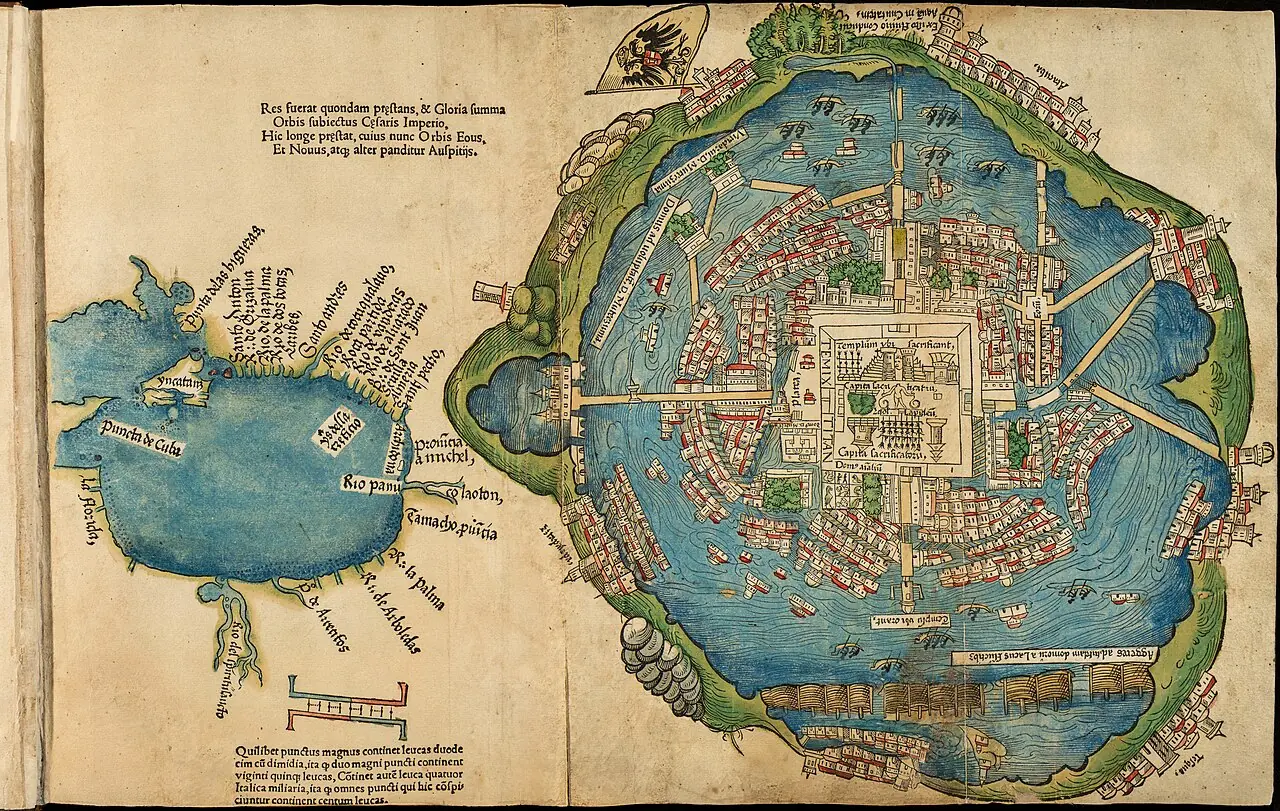
Tenochtitlan and the Gulf of Mexico · 1524. Cortés is the author of the associated account, which does not automatically identify the draftsman or engraver of the map. The plan is later than the siege of 1521.
Americae sive quartae orbis partis nova et exactissima descriptio · 1562. The copy in the image is reproduced from Wikimedia Commons; the institutional record allows comparison with another copy of the same work. It is not a reconstruction of all the routes.
Americae sive novi orbis, nova descriptio · 1570. The depictions of the far south and the interior territories contain incomplete information and hypotheses of the period.
Art and memory
Other expeditions with shared protagonists
Sources and references
- [B56] Préstamos latentes entre el maya y el español en cuatro textos del siglo XVI en Yucatán. Raúl Arístides Pérez Aguilar. Cuicuilco 89, enero–abril de 2024. Original record
- [B19] The Yucatán–Honduras coast, scene of contact 500 years ago (Francisco Hernández de Córdoba, 1517). Carlos Macías (identified as “Calos Macías” on the chapter's cover). Chapter published in 2022 on the expeditions of the early 16th century. Original record
- [B145] Bernal Díaz describes the expedition of Francisco Hernández de Córdoba. Bernal Díaz del Castillo; selection from Noticonquista. Account written in the 16th century on the voyage of 1517; contemporary digital selection. Original record
- [B10] True History of the Conquest of New Spain. Bernal Díaz del Castillo; edition by Alonso Remón. Written in the 16th century; linked edition: Madrid, 1632. Original record
- [B1] General and Natural History of the Indies: second part, first volume. Gonzalo Fernández de Oviedo; edition by José Amador de los Ríos. Work of the 16th century; linked volume edited in 1852. Original record
- [B22] Memoirs of the Conquistador Bernal Diaz del Castillo, volumen 1. Bernal Díaz del Castillo; traducción de John Ingram Lockhart. Chronicle written in the sixteenth century; translation of 1844. Original record
- [B142] Francisco Hernández de Córdoba. José María González Ochoa. Undated electronic edition; consulted on 2 November 2026. Original record
- Latent loans between Maya and Spanish. INAH, Cuicuilco. It distinguishes earlier contacts, the campaign of 1517 and Grijalva's itinerary of 1518.
- First expeditions toward Central America and Yucatán. UNAM, Institute of Legal Research / Anáhuac Veracruz University. Study with references to chronicles and to the itinerary of the chaplain Juan Díaz; useful for the campaigns of 1509–1510 and Grijalva's departure.
- Bernal Díaz describes the expedition of Francisco Hernández de Córdoba. UNAM, Noticonquista. Fragment of a participant's account of the departure from the north of Cuba and the survey of Yucatán; it should be read as testimony, with its limits and historical identifications.
Documents and call numbers
- PATRONATO,191 · Account of the expedition to Yucatán
General bibliography guides further reading; it is not a pinpoint reference for every claim. Page, chapter and archival references are identified at the relevant passages.
Send comments to the author
Found an error or have information to contribute? Write privately to the author.