

Grijalva's Expedition: Contact with the Aztec Empire
In this entry · 18 sections
- Context
- Stages
- Events of this expedition
- Route data
- Outcome
- Limits of the evidence
- Expedition facts
- Organisation
- Objectives
- Encounters and societies
- Recorded vessels
- People and societies
- Related people
- Related cartography
- Art and memory
- Other expeditions with shared protagonists
- Sources and references
- Further reading and comparison
Expedition · 1518. Juan de Grijalva.
Bernal–Lockhart describes four ships and 220 men; Isabelo Macías Domínguez estimates about 250. The Bernal translation dates departure to 5 April; Carlos Macías’s note 24, citing Juan Díaz’s itinerary, gives 1 May. Grijalva’s kinship with Velázquez also has differing versions. [B22]¶ [B22]¶ [B106] [B19] [B106]
Isabelo Macías reconstructs travel through Cozumel, Champotón, the Grijalva river and the Veracruz coast, including fighting, exchange and Moctezuma’s messengers. In that reconstruction, news of the interior comes through interlocutors; it does not equate to a visit to Tenochtitlan by Grijalva. [B106]
The study describes Alvarado’s early return and debate over whether Velázquez’s instructions allowed settlement. It presents Las Casas’s and Bernal’s differing interpretations, before Cortés’s new enterprise. [B106]
Context
After Córdoba's campaign, Diego Velázquez organized a broader survey from Cuba. Its commercial and exploratory aim is not automatically identified with the conquest program that Cortés would adopt. [B22]
Stages
- May 1, 1518, Cuba: 1 May comes from Carlos Macías’s note 24 on Juan Díaz. Bernal–Lockhart dates departure to 5 April; the discrepancy remains visible. [B19] [B22]
- May 1518, Cozumel and Yucatán: Coastal survey and contacts with Maya populations. [B106]
- 1518, Champotón and Tabasco: Continuation westward, amid clashes and exchanges. [B106]
- 1518, San Juan de Ulúa: Contacts and exchange of information on the coast of present-day Veracruz. [B106]
- 1518, Cuba: Return and transmission of news to Velázquez. No Cuban return port is imposed with an unverified coordinate. [B106]
Events of this expedition
Route data
- 4 ships; with Grijalva went Pedro de Alvarado, Francisco de Montejo and the pilot Antón de Alaminos.
- News of a great power in the interior decided Velázquez to prepare Cortés's fleet.
- The chaplain Juan Díaz left an itinerary of the voyage.
Outcome
The voyage gathered knowledge that served Cortés's expedition. [B106]
It was neither a complete conquest of the peninsula nor a visit by Grijalva to Tenochtitlan. [B106]
Limits of the evidence
The expedition took place in 1518. Preparation and departure dates and the April and May versions are distinguished, without treating any one as agreed. [B19] [B22]
The place names in the chronicles do not always allow a landing to be identified with modern precision.
Expedition facts
| Date | 1518 |
|---|---|
| Leader | Juan de Grijalva |
| Departure | Not specified in this entry |
| Destination | — |
| Period | 1518 |
Organisation
Bernal–Lockhart counts four ships and 220 recruits; Isabelo Macías Domínguez estimates about 250. The Bernal translation gives 5 April for departure; Carlos Macías cites 1 May when referring to Juan Díaz’s itinerary. Counts and dates are distinguished. [B22]¶ [B22]¶ [B19]
Objectives
- To extend the survey of the Mesoamerican coast [B22]
- To carry out exchanges and obtain information on territories and authorities [B106]
Encounters and societies
Relations with the coastal inhabitants were varied and depended on each community. The obtaining of objects and news about the Mexica relied on intermediaries and interpreters, not on direct observation of their whole political sphere. [B106]
Recorded vessels
People and societies
- Juan de Grijalva: Fleet commander [B22]
- Antón de Alaminos: Pilot [B106]
- Pedro de Alvarado: Captain and emissary sent back to Cuba [B106]
- Francisco de Montejo: Captain [B22]
- Juan Díaz: Chaplain and author of an itinerary [B106]
Related people
Related cartography
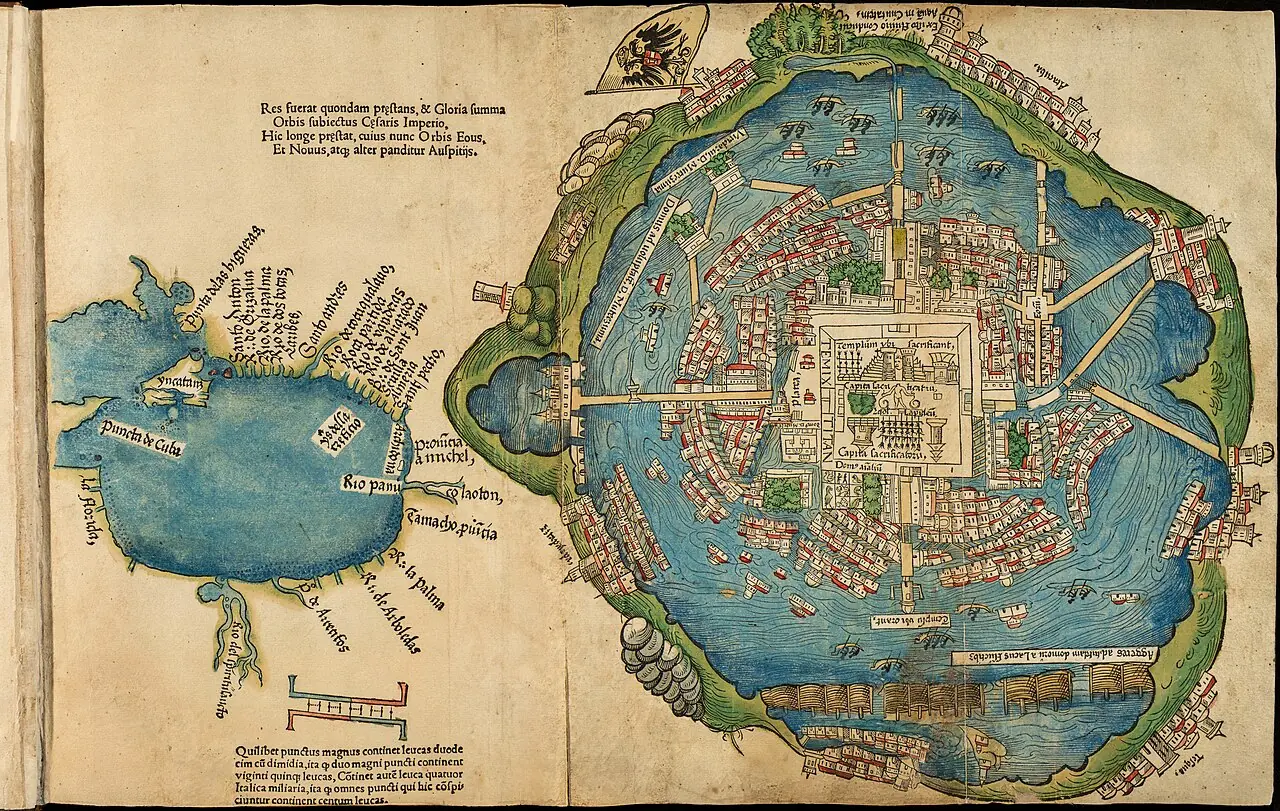
Tenochtitlan and the Gulf of Mexico · 1524. Cortés is the author of the associated account, which does not automatically identify the draftsman or engraver of the map. The plan is later than the siege of 1521.
Americae sive quartae orbis partis nova et exactissima descriptio · 1562. The copy in the image is reproduced from Wikimedia Commons; the institutional record allows comparison with another copy of the same work. It is not a reconstruction of all the routes.
Americae sive novi orbis, nova descriptio · 1570. The depictions of the far south and the interior territories contain incomplete information and hypotheses of the period.
Art and memory
- Portrait of Juan de Grijalva · Nineteenth century
- Portrait of Pedro de Alvarado · 1906
- Plan of Tenochtitlan from the second Letter of Relation · 1524
Other expeditions with shared protagonists
Sources and references
- [B56] Préstamos latentes entre el maya y el español en cuatro textos del siglo XVI en Yucatán. Raúl Arístides Pérez Aguilar. Cuicuilco 89, enero–abril de 2024. Original record
- [B19] The Yucatán–Honduras coast, scene of contact 500 years ago (Francisco Hernández de Córdoba, 1517). Carlos Macías (identified as “Calos Macías” on the chapter's cover). Chapter published in 2022 on the expeditions of the early 16th century. Original record
- [B10] True History of the Conquest of New Spain. Bernal Díaz del Castillo; edition by Alonso Remón. Written in the 16th century; linked edition: Madrid, 1632. Original record
- [B103] General History of the Indies. Francisco López de Gómara; edition with prologue by Jorge Gurría Lacroix. 16th-century work; Caracas edition, 1978; digitization, 1999. Original record
- [B22] Memoirs of the Conquistador Bernal Diaz del Castillo, volumen 1. Bernal Díaz del Castillo; traducción de John Ingram Lockhart. Chronicle written in the sixteenth century; translation of 1844. Original record
- [B106] Juan de Grijalba. Isabelo Macías Domínguez. Undated electronic edition; consulted on 2 November 2026. Original record
- Latent loans between Maya and Spanish. INAH, Cuicuilco. It distinguishes earlier contacts, the campaign of 1517 and Grijalva's itinerary of 1518.
- First expeditions toward Central America and Yucatán. UNAM, Institute of Legal Research / Anáhuac Veracruz University. Study with references to chronicles and to the itinerary of the chaplain Juan Díaz; useful for the campaigns of 1509–1510 and Grijalva's departure.
Documents and call numbers
- PATRONATO,191,R.2 · Account of Grijalva
General bibliography guides further reading; it is not a pinpoint reference for every claim. Page, chapter and archival references are identified at the relevant passages.
Send comments to the author
Found an error or have information to contribute? Write privately to the author.