

Second founding of Buenos Aires
In this entry · 5 sections
11 June 1580 · River Plate
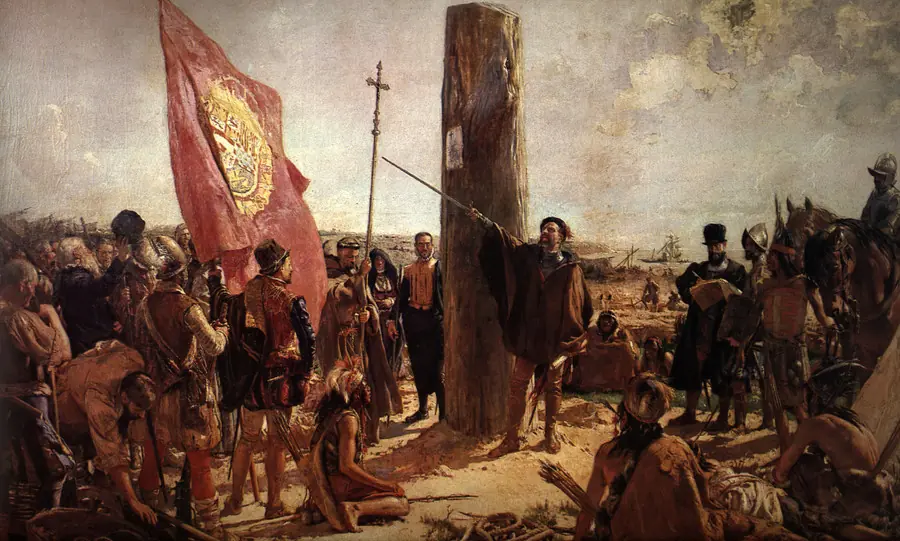
It is 11 June 1580, on the banks of the River Plate. About sixty settlers who have come from Asunción, the city of Paraguay, raise a cross and mark the site of a new city. They are led by Juan de Garay, a Basque with long experience of the region.
It is not the first attempt. In 1536 Pedro de Mendoza had founded a first settlement on those shores, but hunger and attacks by the peoples of the region forced him to abandon it within a few years.
Juan de Garay, come from Asunción, founds the City of the Trinity and the port of Santa María de los Buenos Aires, near the abandoned site of Pedro de Mendoza.
Garay distributes plots, marks the site of the fort, the town council and the church, and lays the city out in a grid, with a main square, following the Ordinances of Settlement of 1573.
Garay’s foundation was carried out from the network of River Plate settlements, above all Asunción. It should be distinguished from Mendoza’s first settlement of 1536 and from the Indigenous territories and societies over which colonial settlement advances. [B205]
In the years that followed, the little port, far from the main routes of the empire, would grow through trade, legal and contraband, until it became capital of the Viceroyalty of the River Plate in 1776.
Context
Definitive founding of Buenos Aires
Juan de Garay's founding from Asunción and establishment of a city with a continuity different from Mendoza's settlement.
Río de la Plata expansion was organized downriver from already formed colonial centers. The territory kept Indigenous populations and uses that did not depend on Spanish founding.
The enterprise left Asunción and constituted the new center in June 1580. [B205]
A town council, allocation of space and relations with the surroundings were organized.
Mendoza's Expedition: First Founding of Buenos Aires
Pedro de Mendoza's enterprise to settle the Río de la Plata. The 1536 establishment suffered hunger, conflict and loss of support; colonial consolidation moved upriver. [B73]¶ [B117] [B117]
Rodríguez de la Torre relates the venture to expectations of the Sierra de la Plata, Portuguese competition and the 1534 capitulations. Espínola describes the Querandí as initial food suppliers and their resistance to the later attack led by Diego de Mendoza. [B117] [B118]
Why it matters
It gave the Spanish Monarchy an Atlantic link with the South American interior.
Where it appears
Expeditions and episodes
Other milestones of those expeditions
Maps
- Nautical planisphere of Lopo Homem
- Americae sive quartae orbis partis nova et exactissima descriptio
- La descrittione di tutto il Peru
- Americae sive novi orbis, nova descriptio
- Descriptionis Ptolemaicae augmentum: set of plates
Art
- Portrait of Domingo Martínez de Irala
- Portrait of Juan de Ayolas
- Portrait of Juan de Garay
- Portrait of Ulrico Schmidel
- Americae sive quartae orbis partis nova et exactissima descriptio
- Founding of Buenos Aires
Linked people
Sources for this milestone
- [B205] Calendario histórico: junio
- [B73] The Conquest of the River Plate (1535–1555)
- [B97] Ulrich Schmidl's Voyage to the Río de la Plata in Samuel Lafone Quevedo's translation (1903)
- [B102] Juan de Salazar de Espinoza. Journey to the Río de la Plata
- [B107] Juan de Salazar de Espinoza
- [B109] History of Espinosa de los Monteros: notable people
- [B116] Domingo Martínez de Irala
- [B117] Pedro de Mendoza y Luján
- [B118] Ulrich Schmidl
- [B120] The first Buenos Aires and archaeology
- [B130] Evidencias de arquitectura de materiales perecederos en Buenos Aires, Argentina (siglos XVI–XVIII)
Send comments to the author
Found an error or have information to contribute? Write privately to the author.