

Columbus reaches America
In this entry · 5 sections
12 October 1492 · Guanahaní (Bahamas)
It is the early hours of 12 October 1492. For more than two months three Castilian ships, the Santa María, the Pinta and the Niña, have been at sea since leaving Palos de la Frontera, and for more than five weeks they have been sailing an ocean with no landmarks since the Canaries. The crews are exhausted and tension aboard is rising.
Then, from the Pinta, the lookout Rodrigo de Triana raises the cry that will enter history: “Land!”. In the distance, under the moonlight, a coastline can be made out. Las Casas records that Triana was the first to see land, but that the Monarchs awarded the promised ten thousand maravedís of annuity to Columbus, who had earlier seen a light. [B2]
In command is Christopher Columbus, a Genoese navigator who had persuaded the Catholic Monarchs that Asia could be reached by sailing west. The sovereigns had signed the Capitulations of Santa Fe with him earlier that year, after the fall of Granada.
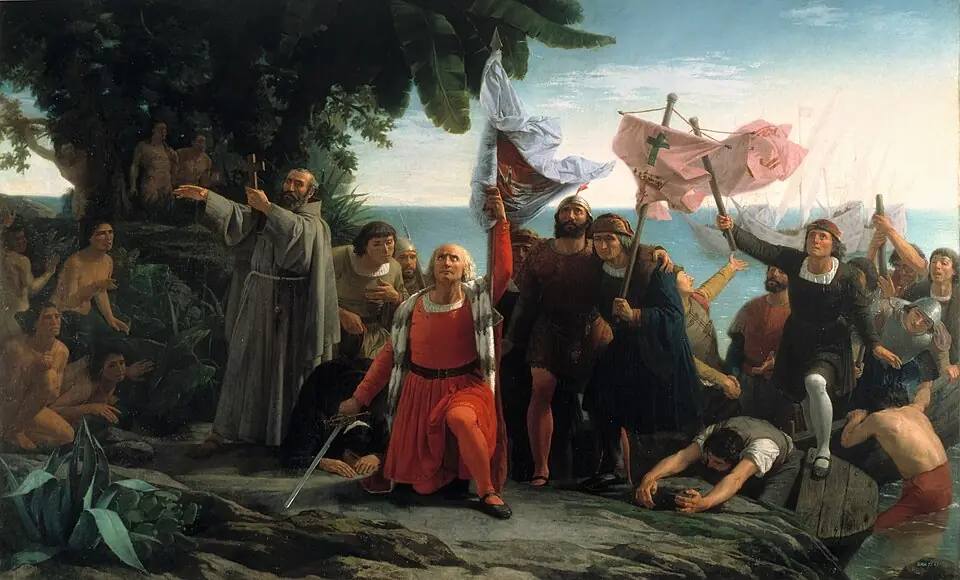
At dawn Columbus lands with the captains Martín Alonso and Vicente Yáñez Pinzón and with the fleet’s notary. Before them he takes possession of the island in the name of the monarchs of Castile and calls it San Salvador. [B9]¶ Its inhabitants, the Lucayan Taíno, called it Guanahaní and come out to see those clothed men who have come from the sea.
Columbus believes he is at the gates of Asia. He sails on to the south and west: he reconnoitres Cuba and Hispaniola, where the Santa María runs aground on Christmas Eve, forcing him to leave a small garrison ashore, the fort of La Navidad.
The contact is with the inhabitants of Guanahaní, not with an empty land. The identification of the island with a present-day place in the Bahamas remains disputed; the European name San Salvador does not by itself settle the question. [B9]
That October day opens a new era: from this first voyage will come a permanent Castilian presence in the Caribbean and an exchange of people, plants, animals, diseases and ideas that will transform both sides of the Atlantic.
Context
First Voyage of Columbus: Discovery of America
The first Columbian voyage: Atlantic crossing, landfall at Guanahani and reconnaissance of Cuba and Hispaniola. It did not reach the Asian coasts it sought. [B9]¶ [B8]
The Castilian Crown backed a western route to Asia through the Capitulations of Santa Fe. The project relied on resources of the monarchy, shipowners and maritime networks of Andalusia; it set out toward inhabited territories with histories of their own. [B8] [B75] [B9]
Why it matters
It marks the beginning of a permanent sea link between Europe and America and of Castilian expansion across the continent.
Where it appears
Expeditions and episodes
Other milestones of those expeditions
- Capitulations of Santa Fe
- Columbus reaches Cuba
- Columbus reaches Hispaniola
- Loss of the Santa María and La Navidad fort
- Return of Columbus’s first voyage
Maps
- Juan de la Cosa's chart
- Cantino planisphere
- Caverio planisphere
- Universalior cogniti orbis tabula
- Universalis cosmographia
- Fragment of the Piri Reis world map
- Carta marina navigatoria
- Americae sive quartae orbis partis nova et exactissima descriptio
- Americae sive novi orbis, nova descriptio
- Descriptionis Ptolemaicae augmentum: set of plates
Art
- Portrait of Juan de la Cosa
- Woodcuts of Columbus's letter (De insulis nuper inventis)
- Universal chart of Juan de la Cosa
- Americae pars quarta: the Columbian cycle
- Portrait of Christopher Columbus, frontispiece of Americae pars quinta
- Americae pars quinta: portrait of Christopher Columbus
- Christopher Columbus informing King Ferdinand of the discovery of the Indies
- The Landing of Columbus, Oct. 11th 1492
- First Landing of Christopher Columbus in America
- To Christopher Columbus, on the Fourth Centenary of the discovery
Linked people
Sources for this milestone
- [B9] Select Letters of Christopher Columbus
- [B2] History of the Indies. Volume I
- [B5] De Orbe Novo, volumen 1
- [B8] Cristóbal Colón, Diccionario Biográfico Español
- [B11] Cronología General Iberoamericana: siglo XVI
- [B12] Historia del almirante don Cristóbal Colón
- [B14] Colección de los viages y descubrimientos, tomo II: Documentos de Colón y de las primeras poblaciones
- [B15] La Era de la Exploración: navegantes y conquistadores del siglo XVI
- [B29] Historia general y natural de las Indias, islas y tierrafirme del mar océano (edición de la Real Academia de la Historia)
- [B36] Juan de la Cosa, Diccionario Biográfico Español
- [B43] Vicente Yáñez Pinzón, Diccionario Biográfico Español
- [B67] Historia de las Indias, volumen 1 de 5
- [B75] Martín Alonso Pinzón
- [B82] Explorers and conquerors of the Indies: geographical accounts
- [B85] La reescritura del Diario de a bordo y la figura de Cristóbal Colón en The Accidental Indies de Robert Finley
- [B87] New documented list of Columbus’s crew in 1492: notes
- [B96] Capitulations of Santa Fe: registry copy
Send comments to the author
Found an error or have information to contribute? Write privately to the author.