

Juan de la Cosa
In this entry · 15 sections
- Origin and the Santa María
- The chart of 1500
- With Bastidas and the Lisbon mission
- The fleet of 1504, the patrol of 1507 and the last voyage
- Comparing the reconstruction of the voyages
- Offices
- Disputed dates and open questions
- Participation
- Related protagonists
- Maps
- Related milestones
- Mentioned in other entries
- Sources
- Linked sources
- Sources of the related expeditions
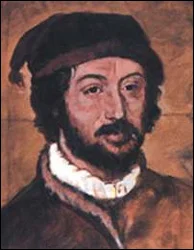
Unidentified artist · Date not established.
Owner and master of the Santa María on Columbus’s first voyage. After the ship was lost in Hispaniola he received compensation from the Crown. [B36] [B36]
Birth: Probably Santoña (Cantabria), mid-fifteenth century; date unknown [B36] [B36]. Death: Turbaco, late 1509 according to the RAH heading [B36].
Origin and the Santa María
His Santoña origin rests on several clues: his surname corresponds to one of the five historic districts of Santoña, the sources call him «vizcaíno» (a term that then covered Cantabrians) and Columbus's Diary says the crew of the Santa María were «all or most of them from his land». Some historians have gone so far as to think of two different people, the navigator and the cartographer; the Royal Academy of History considers them one. [B36]
He was a merchant with a nao of his own, La Gallega, and had settled in El Puerto de Santa María. When the people of Palos failed to provide the ships they owed, Columbus chartered his, which was renamed Santa María. La Cosa was her master, not a partner, unlike the Pinzón brothers. [B36]
During the voyage he became Columbus's interlocutor and pupil in navigation and cartography, although the relationship soured. On 22 September 1492, amid the crew's unrest, Columbus sent the Pinta a nautical chart with his predictions. On Christmas Eve the Santa María ran aground on Hispaniola; Columbus blamed La Cosa for neglecting the watch, but there is no record of any proceedings against him, and in 1494 the Crown compensated him for the lost ship. [B36]
The chart of 1500
After taking part in Columbus's second voyage (1493–1496) as cartographic chronicler, La Cosa joined Alonso de Ojeda and Amerigo Vespucci in 1499 as first pilot of a single caravel that sailed from El Puerto de Santa María on 18 May. They explored the coasts of the Guianas, Paria, Margarita, Curaçao and Cabo de la Vela and returned to Cádiz in June 1500 with gold, pearls and slaves. [B36]
His map of 1500, now in Madrid’s Naval Museum, assembled information from Atlantic voyages. Signing the 1494 declaration that Cuba was mainland does not prove that he retained that representation in the later map: the chart depicts Cuba as an island. The declaration and the cartographic image must be distinguished. [B421] [B36]
With Bastidas and the Lisbon mission
On Rodrigo de Bastidas's voyage of 1500–1502 he explored the coast from the Guajira to Urabá and the Darién. The ships, eaten by shipworm, were lost on Hispaniola: the captains were sent to Spain as prisoners, cleared and rewarded, and La Cosa received the appointment of chief constable of Urabá (3 April 1503). [B36]
In August 1503 the Monarchs entrusted him with a secret mission in Lisbon to find out whether expeditions were being prepared to the lands discovered by Spain. Detected, he was imprisoned and released soon after; in Segovia he delivered reports and sailing charts of the places visited by the Portuguese. [B36]
The fleet of 1504, the patrol of 1507 and the last voyage
Under the capitulation of 24 February 1504 he commanded four warcaravels to prevent Portuguese settlements on Tierra Firme. At Cartagena he found the remnants of Cristóbal Guerra's expedition and united both flotillas; the aim shifted largely to capturing slaves. After shipwrecks and the loss of all his ships, he built a brigantine at Urabá and returned by way of Jamaica. [B36]
Between July and October 1507 he patrolled against privateers in the area between Cádiz and Cape St Vincent. The Burgos pilots’ meeting should be dated to 1508 according to the biographies of Solís and Vicente Yáñez Pinzón; Juan de la Cosa’s biography places it in 1507. The two episodes are not assigned to the same year. [B129] [B36]
On 10 November 1509 he sailed with two hundred men in two brigantines and a nao, as Ojeda's lieutenant and governor of Urabá. He mediated in the boundary dispute between Ojeda and Nicuesa, but Ojeda's view prevailed that they should first go to Cartagena to capture slaves. In the fight near Turbaco more than seventy Spaniards died, La Cosa among them. [B36]
Comparing the reconstruction of the voyages
According to Navarrete’s reconstruction, Juan de la Cosa commanded four ships in 1504. [B20]
On pp. 161–162 Navarrete distinguishes the Lisbon mission of 1503, the four-ship voyage of 1504 and receipt of the royal fifth in 1506. His account also distinguishes the patrol of the Iberian coast in 1507. This reconstruction was printed in 1829 and cites Muñoz’s extracts and documents: reading it is not equivalent to collating those originals. [B20]
Offices
- Master and owner of the nao Santa María (1492) [B36]
- First pilot of the expedition of Ojeda and Vespucci (1499) [B36]
- Chief constable of Urabá (appointed in 1503) [B36]
- Captain of the Tierra Firme fleet (1504) and lieutenant of Ojeda (1509) [B36] [B36]
Chronology
A life, step by step. Follow the dates and open each milestone or image to explore its sources.
- 3 August 1492
Date not established About this image
Portrait of Juan de la Cosa · Date not established. Context portrait; it does not depict this event. Representation attributed to this person in the provenance record. It is not treated as evidence of physical appearance or as a record of their expeditions. The date of the work is distinguished from its digitisation date. The date of the work has not been established; the file upload date is not used to date the portrait.Departure from Palos of the fleet in which he served as master of the Santa María. [B43] [B36]
Explore this year - 24–25 December 1492
The Santa María runs aground on Hispaniola. [B36]
Explore this year - 25 September 1493
Sails from Cádiz with Columbus on the second voyage. [B36]
Explore this year - 18 May 1499
Sails with Ojeda and Vespucci for Tierra Firme. [B36]
Explore this year - 1500
Draws the chart now kept in the Naval Museum in Madrid. [B36]
Explore this year - 3 April 1503
Named chief constable of Urabá. [B36]
Explore this year - August 1503
Secret mission in Lisbon; he is imprisoned and released. [B36]
Explore this year - 24 February 1504
Capitulation to command four caravels to Tierra Firme. [B36]
Explore this year - 1507
Patrols against corsairs; the Burgos meeting is treated separately because of the date discrepancy. [B36] [B36]
Explore this year - 10 November 1509
Sails on his last voyage, as Ojeda's lieutenant. [B36]
Explore this year - Late 1509
Death at Turbaco, dated thus in the RAH heading. [B36]
Explore this year
Disputed dates and open questions
- The Santoña origin and the hypothesis of two namesakes are discussed by the study. [B36]
- The study notes possible later additions to the chart. [B36]
- Ballesteros’s proposed confusion between the final voyages is explicitly attributed to him. [B36]
Participation
- First Voyage of Columbus: Discovery of America (1492): Master and owner of the Santa María
- Ojeda's Expedition: Gulf of Venezuela (1499): Pilot and cartographer
- Expedition of Rodrigo de Bastidas and Juan de la Cosa (1501): Partner and pilot alongside Gonzalo de Lorca, according to Lucena
- Juan de la Cosa's Expedition to Urabá (1504): Commander of a flotilla of four caravels
- Ojeda's Expedition to Nueva Andalucía (1509–1510) (1509): Died during the campaign
Related protagonists
Maps
- Juan de la Cosa's chart
- Cantino planisphere
- Caverio planisphere
- Universalior cogniti orbis tabula
- Universalis cosmographia
- Fragment of the Piri Reis world map
- Carta marina navigatoria
- Americae sive quartae orbis partis nova et exactissima descriptio
Show all links (10)
Related milestones
- Capitulations of Santa Fe
- Columbus reaches America
- Columbus reaches Cuba
- Columbus reaches Hispaniola
- Loss of the Santa María and La Navidad fort
- Return of Columbus’s first voyage
- Voyage of Ojeda, Juan de la Cosa and Vespucci
- Juan de la Cosa’s world map
Mentioned in other entries
Una mención permite investigar una relación; no implica participación en la expedición ni acredita por sí sola el pasaje citado.
Sources
- Juan de la Cosa, Diccionario Biográfico Español, Real Academia de la Historia
- Juan de la Cosa: navigation, cartography and expeditions, Ministerio de Fomento
- Select Letters of Christopher Columbus, Cristóbal Colón; edición de R. H. Major
- Capitulaciones de Santa Fe: copia registral, Corona y Cristóbal Colón; registro del secretario Juan de Coloma
- Juan de la Cosa: viajes y documentación, Universidad de Valladolid, UVaDOC
- La carta de Juan de la Cosa (y III), Ricardo Cerezo Martínez
- Juan Díaz de Solís, Diccionario Biográfico Español, Real Academia de la Historia
- Vicente Yáñez Pinzón, Diccionario Biográfico Español, Real Academia de la Historia
- Colección de los viages y descubrimientos que hicieron por mar los españoles desde fines del siglo XV, tomo III, Martín Fernández de Navarrete
Linked sources
- [B9] Select Letters of Christopher Columbus
- [B20] Colección de los viages y descubrimientos que hicieron por mar los españoles desde fines del siglo XV, tomo III
- [B36] Juan de la Cosa, Diccionario Biográfico Español
- [B43] Vicente Yáñez Pinzón, Diccionario Biográfico Español
- [B96] Capitulations of Santa Fe: registry copy
- [B129] Juan Díaz de Solís, Diccionario Biográfico Español
- [B131] Juan de la Cosa: voyages and documentation
- [B187] Juan de la Cosa: navigation, cartography and expeditions
Show all links (9)
Sources of the related expeditions
- [B1] General and Natural History of the Indies: second part, first volume
- [B2] History of the Indies. Volume I
- [B5] De Orbe Novo, volumen 1
- [B8] Cristóbal Colón, Diccionario Biográfico Español
- [B11] Cronología General Iberoamericana: siglo XVI
- [B12] Historia del almirante don Cristóbal Colón
- [B14] Colección de los viages y descubrimientos, tomo II: Documentos de Colón y de las primeras poblaciones
- [B15] La Era de la Exploración: navegantes y conquistadores del siglo XVI
Show all links (22)
- [B19] The Yucatán–Honduras coast, scene of contact 500 years ago (Francisco Hernández de Córdoba, 1517)
- [B29] Historia general y natural de las Indias, islas y tierrafirme del mar océano (edición de la Real Academia de la Historia)
- [B37] Reivindicación burgalesa de Alonso de Ojeda, famoso conquistador y colonizador del Nuevo Mundo
- [B50] To live in freedom! Documented history of the Guna people, 1501–1728
- [B67] Historia de las Indias, volumen 1 de 5
- [B69] Juan de la Cosa's chart
- [B75] Martín Alonso Pinzón
- [B82] Explorers and conquerors of the Indies: geographical accounts
- [B85] La reescritura del Diario de a bordo y la figura de Cristóbal Colón en The Accidental Indies de Robert Finley
- [B87] New documented list of Columbus’s crew in 1492: notes
- [B121] Juan de la Cosa: the historical cartography of the Spanish discoveries
- [B173] The Letters of Amerigo Vespucci, and Other Documents Illustrative of His Career
- [B231] Rodrigo Gutiérrez de Bastidas
- [B235] Alonso de Ojeda
Send comments to the author
Found an error or have information to contribute? Write privately to the author.