

Magellan finds the strait
In this entry · 5 sections
21 October 1520 · Cabo Vírgenes (Patagonia)
It is 21 October 1520, the day of the Eleven Thousand Virgins. Five months of sailing and a hard winter at San Julián have left behind a mutiny, the loss of the Santiago and much exhaustion. The ships now explore the Patagonian coast, looking for a passage some believe mythical. According to Pigafetta, the captain general had resolved to go as far as 75° south latitude if he did not find it. [B23]
On reaching a cape the men make out a great opening in the coast, with strong tides. Magellan sends two ships to explore it, and they return with news that the channel continues.
The expedition identifies at the southern tip of the Americas the entrance to the natural passage between the Atlantic and the Pacific, beside the cape they named Eleven Thousand Virgins.
For five weeks the ships advance among channels, fogs and the fires of the Indigenous communities on the shore, which give Tierra del Fuego its name. One of them, the San Antonio, uses a night to leave the fleet and return to Spain.
After five weeks among channels, and the desertion of the San Antonio, three ships emerged into the South Sea on 28 November 1520.
The surveys of channels and the separation of the San Antonio show that finding the passage was not a single instant. The crossing involves geographical information, command decisions and risks that should be told apart in the account of the expedition. [B23]
On leaving, on 28 November, the fleet enters the sea Pigafetta calls the Pacific. There it will spend three months and twenty days without renewing provisions, eating biscuit reduced to powder and full of grubs, until nineteen men die. [B23]
Context
Discovery of the Strait of Magellan
Survey and crossing of the strait that allowed Magellan's fleet to pass from the Atlantic to the Pacific.
The Patagonian wintering, the losses and the conflicts of command had reduced the expedition's options. The search for the passage required surveys among channels.
The fleet explored the passage before emerging into the Pacific. [B23]
The San Antonio returned to Spain; the other ships did not all have the same fate.
First Circumnavigation: The Magellan–Elcano Expedition
Fleet meant to reach the Moluccas by the west. After Magellan's death, different leaders continued the campaign; the Victoria, commanded by Elcano on the return, completed the first documented circumnavigation. [B23]
The demand for spices and the dispute with Portugal drove a western route. The Castilian Crown authorized and organized the enterprise, supported by contracting networks and a crew of diverse origins. [B48] [B23]
The Trinidad repaired frames and keel in Tidore with local assistance before departing into the Pacific on 6 April 1522. The IHCN reconstruction follows Espinosa’s attempt separately from the Victoria’s return. [B47]
The Cochin letter is dated 12 January 1525 and bears the reference INDIFERENTE,1528,N.2: 1528 identifies the archival bundle, not the year of writing. The PARES summary places the return to the Moluccas after seven months at sea and records fourteen islands, tentatively associated there with Palau. It does not establish fourteen certain modern island identifications. [B42]
Why it matters
It opened a new ocean route between the Atlantic and the Pacific for European expeditions.
Where it appears
Expeditions and episodes
Other milestones of those expeditions
- Magellan begins the first circumnavigation
- Encounters in Patagonia during the winter stay
- Mutiny at San Julián
- Magellan’s fleet reaches Guam
- The expedition lands at Homonhon
- Magellan and Rajah Humabon at Cebu
- Battle of Mactan and death of Magellan
- The Trinidad attempts an eastward Pacific return
- Elcano completes the first circumnavigation
- Statements by survivors of the Trinidad
Maps
- Miller Atlas: world map
- Universal chart of Diego Ribero: reproduction
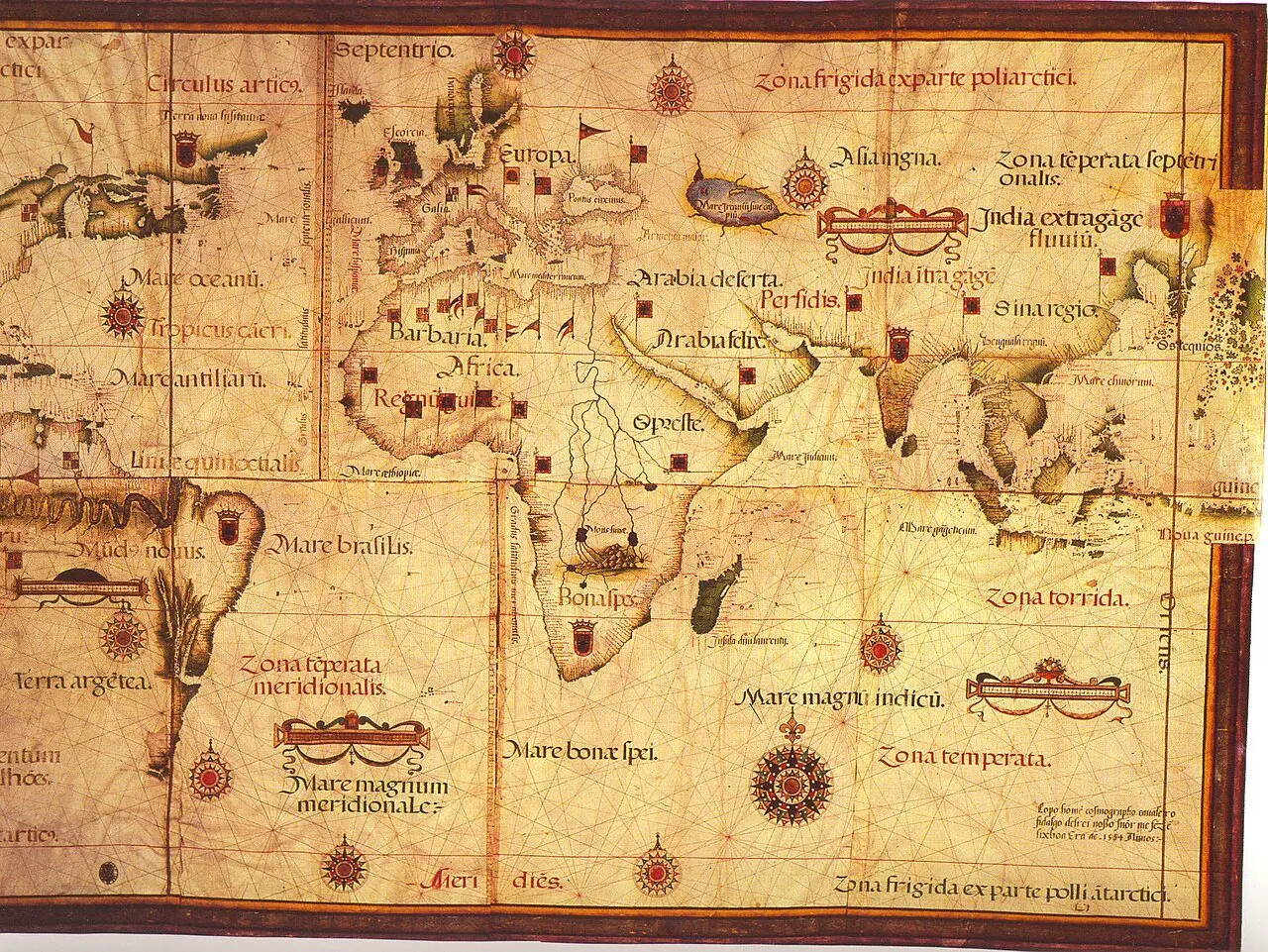
- Nautical planisphere of Lopo Homem
- Universale descrittione di tutta la terra conosciuta fin qui
- Nova et aucta orbis terrae descriptio
- Africae tabula nova
- Asiae nova descriptio
- Maris Pacifici
- Vera totius expeditionis nauticae: voyages of Drake and Cavendish
- Indiae Orientalis, insularumque adiacentium typus
- Straits of Magellan and San Vicente: the Nodal account
Art
- Coat of arms of Gonzalo Gómez de Espinosa
- Americae sive quartae orbis partis nova et exactissima descriptio
- Description of the West Indies and title pages of the Décadas
- Portrait of Ferdinand Magellan
- Imaginary portrait of Juan Sebastián Elcano
Linked people
- Fernando de Magallanes
- Gonzalo Gómez de Espinosa
- Juan Sebastián Elcano
- Antonio Pigafetta
- Juan Gómez de Espinosa
- Pedro Gómez
Sources for this milestone
- [B23] The First Voyage Round the World, by Magellan
- [B3] The Spanish Lake
- [B4] España y el Pacífico: un breve repaso a las expediciones españolas de los siglos XVI al XVIII
- [B6] Spanish discoveries in the South Sea
- [B7] Los hallazgos españoles en el Pacífico
- [B13] Relatos de viaje del siglo XVI
- [B21] Documentation of Magellan's fleet
- [B28] Colección de los viages y descubrimientos: Expediciones al Maluco. Viage de Magallanes y de Elcano
- [B30] First Voyage Around the World
- [B35] First Voyage Around the World: critical edition
- [B38] La Relación del primer viaje alrededor del mundo de Antonio Pigafetta y sus traducciones al español
- [B39] Reconstruction of the Trinidad’s route: the Navy’s KMZ file
- [B40] Primer viaje alrededor del mundo: edición de Leoncio Cabrero
- [B41] Punzorol’s letter from Tidore: critical edition and Spanish translation
- [B42] Gonzalo Gómez de Espinosa’s letter to Charles I about the Trinidad
- [B44] Elcano’s letter to the emperor (1522): copy and AGI transcription
- [B45] Pedro Gómez: servant aboard the Trinidad
- [B46] The crews of the first circumnavigation
- [B47] Virtual navigation of Gonzalo Gómez de Espinosa: attempted eastward return in 1522
- [B48] Gonzalo Gómez de Espinosa, Diccionario Biográfico Español
- [B49] Historia general y natural de las Indias, tomo II: primera parte de la segunda parte
- [B123] The maps and the first circumnavigation
Send comments to the author
Found an error or have information to contribute? Write privately to the author.