

Gonzalo Gómez de Espinosa
In this entry · 27 sections
- Origins and appointment
- The San Julián mutiny, 1520
- From the strait to the Philippines
- Ambassador in Borneo and captain general
- In the Moluccas
- The first attempt to cross the Pacific towards America, 1522
- Capture and captivity, 1522–1527
- The Cochin letter and its handwriting
- Return and statements before the Council of the Indies
- His own account, according to Fernández de Oviedo
- Rewards and last years in Seville
- Family and descendants
- Assessment
- Office recorded in the 1519 list
- Documentary comparison of a specific episode
- Offices
- Disputed dates and open questions
- Participation
- Related protagonists
- Maps
- Related milestones
- People and entries mentioned
- Mentioned in other entries
- Sources
- Examine and compare documents
- Linked sources
- Sources of the related expeditions
Chief constable of Magellan's fleet, he put down the San Julián mutiny and, after the captain general's death, came to command the expedition. He led the ships to the Moluccas, attempted with the Trinidad the first return to America across the North Pacific and, captured by the Portuguese, spent four years a prisoner in Asia and Lisbon before returning to Castile. His return must be distinguished from Elcano’s and those of other survivors who came back at different times. [B48]
Birth: Espinosa de los Monteros, 1474 according to the RAH heading [B48]. Death: Exact date and place unknown; a 2023 review proposes death probably after 1546 [B452].
Origins and appointment
The Real Academia de la Historia record identifies him as a native of Espinosa de los Monteros and dates his birth to 1474. This is an attribution to that source, not the result of checking a baptismal entry. [B48]
Guadalupe Fernández Morente dates his appointment as constable of the fleet to 19 April 1519, referring to the title registered in AGI, CONTRATACION,5090,L.4, ff. 40r–40v. In June he was sent with Baltasar Ginovés to Málaga to recruit seamen; Juan Bautista de Punzorol went to Cádiz and Juan Rodríguez Mafra to the ports of Huelva. Not all recruitment destinations are attributed to Espinosa. [B433]
The fleet left Seville on 10 August 1519 and Sanlúcar on 20 September. [B23]¶ [B23]¶ In the roll of the crew edited by Fernández de Navarrete he appears as constable of the Trinidad; on the same nao travelled as a ship's boy a man called Antón, recorded as enslaved by Gómez de Espinosa, a reminder that slavery formed part of life on these fleets. [B28]
The San Julián mutiny, 1520
The fleet reached the bay of San Julián, in Patagonia, on 31 March 1520 to winter. Between 1 and 2 April, Juan de Cartagena, Gaspar de Quesada and Luis de Mendoza rose against Magellan and seized the Concepción, the San Antonio and the Victoria. [B259] [B259]
Magellan sent Espinosa to the Victoria with five or six secretly armed men and a letter for her captain. While Mendoza was reading it, Espinosa and another of his men stabbed him to death; at the same time, Duarte Barbosa boarded the ship with fifteen men and took her without resistance. With the Victoria recovered, Magellan closed the mouth of the bay and the rebels surrendered. [B28]
Quesada was executed and his body quartered along with Mendoza's; Cartagena and the cleric Pedro Sánchez de Reina were abandoned on the coast when the fleet left, and the rest of the mutineers, among them Juan Sebastián Elcano, were pardoned. The recovery of Victoria formed part of the suppression of the mutiny. Pigafetta describes the punishments from the expedition’s perspective; his account alone does not establish Magellan’s personal trust in Espinosa. [B23]¶ [B113]
From the strait to the Philippines
After crossing the strait at the end of 1520 and traversing the Pacific, the fleet reached Guam on 6 March 1521, Samar on 16 March and Cebu on 7 April. Magellan died on 27 April at Mactan, intervening against Lapulapu in support of the king of Cebu, Humabon. [B48]
A few days later, at a banquet offered in Cebu, Duarte Barbosa, Juan Serrano and other expeditionaries died. At Bohol, without enough men for three ships, the survivors —some 108— burned the Concepción and elected Juan López de Carvalho captain general; Espinosa took command of the Victoria. [B23]¶ [B23]¶ [B48]
Ambassador in Borneo and captain general
In July 1521, in Borneo, Espinosa acted as envoy to the ruler called Siripada in Fernández-Carrión’s biography. This is the episode supported by the cited passage; the audience’s protocol is not reconstructed from that summary. [B48]
The fleet’s men subsequently replaced Carvalho with Espinosa as captain-general. Espinosa took command of the Trinidad and Elcano of the Victoria. The RAH biography describes this change but does not give an exact day in that paragraph. [B48]
In the Moluccas
Fernández-Carrión dates arrival at Tidore to 8 November 1521 and describes an agreement of friendship, trade and tribute with its ruler. The RAH biography of Elcano dates arrival to the 7th: both dates are retained as a disagreement between studies, not as two separate calls. [B113] [B48]
In December a leak prevented the Trinidad from departing. Elcano’s Victoria sailed on 21 December 1521; the Trinidad remained for repairs and to prepare a return towards America across the Pacific. These two route decisions must be distinguished. [B113] [B48]
At Tidore he had a trading post built where goods, rigging and part of the artillery were kept, conceived as a base for future Castilian expeditions, and he left some men in it. [B48]
The first attempt to cross the Pacific towards America, 1522
The account of the Trinidad included by Stanley dates its departure from Tidore to 6 April 1522, with fifty men on the muster roll and nine hundred quintals of cloves, bound for Panama. These figures belong to that testimony. [B23]
The same account places the voyage as far as 42° N and describes a five-day storm, severe damage to the ship and many deaths during the return. PARES’s description of the Cochin letter summarises seven months of navigation before returning to the Moluccas. These durations are not added as independent legs, nor are the two texts used to infer an exact death toll. [B23]¶ [B42]
In 1565 San Lucas, with Arellano and Lope Martín, returned to New Spain before San Pedro, with Salcedo and Urdaneta. Morga records both voyages; his assessment of the former is the chronicler’s interpretation. Similarities between routes do not establish that Urdaneta used Espinosa’s results directly. [B27]¶ [B27]
Capture and captivity, 1522–1527
Stanley’s account describes the appeal for help to António de Brito, the reply dated 21 October 1522 and the Portuguese seizure of the ship, instruments and papers. It counts seventeen Castilians, sick and healthy; Fernández-Carrión gives eighteen survivors. Each count is attributed to its source. [B23]¶ [B48]
Fernández-Carrión’s biography describes the prisoners’ transfer through Banda, Java and Malacca towards India. At Cochin, Espinosa wrote to Charles I on 12 January 1525. The letter, preserved as INDIFERENTE,1528,N.2, recounts the Trinidad’s voyage and captivity; 1528 in the archival reference is not its date. [B42] [B48]
Stanley’s account states that Espinosa, Ginés de Mafra and the bombardier Master Hans received permission from Henrique de Meneses to leave Cochin after news of John III’s marriage to Catherine, the emperor’s sister. They were imprisoned in Lisbon, where Hans died; Espinosa and Mafra remained captive for about seven months and were released following imperial letters, Espinosa twenty-seven days before Mafra. [B23]
The Cochin letter and its handwriting
The complete letter can be read in a reading transcription arranged by the four manuscript sides. Spelling is regularised and abbreviations expanded; the faded opening, uncertain words and names, and unclear deletions are marked in brackets. This is not a diplomatic edition. The final petition asks for release and repayment from his salary of a loan for provisions; these are statements in the testimony, not proof that repayment took place. [B42]¶ [B42]¶ [B42]
The manuscript’s final dating clause dates Espinosa’s letter at Cochin on 12 January 1525. [B42]
In the manuscript, Espinosa reports reaching forty-two degrees of north latitude. [B42]
Espinosa attributes twelve days to the storm in the manuscript of his letter. [B42]
The latitude and the storm’s duration are the sender’s statements, not a verified modern position or an independent weather record. The comparison does not attribute the handwriting of the letter’s body to Espinosa. [B42]¶ [B42]
In the Spanish account transmitted by Llorens, Espinosa assigns twelve days to a storm and links the crew’s weakness to the lack of bread. Describing the return, he reports seven months without fresh supplies and three hundred Portuguese building a fortress on Ternate. These remain the writer’s statements: the figure is not treated as an independent census, nor the account of illness as a modern diagnosis. [B371]¶ [B371]
In the letter, Espinosa reports departing from Tidore on 6 April 1522. [B42]
Espinosa writes that he encountered fourteen islands during that voyage. [B42]
Espinosa acknowledges that he could not find out what those islands contained because he did not understand the language. [B42]
The account does not establish fourteen secure modern island identifications. Llorens Asensio’s 1903 edition allows comparison between the printed transmission and the manuscript. [B371]
In the letter, Espinosa states that he had been a prisoner for twenty-seven months. [B42]
Writing from Cochin, Espinosa states that six men of his group remained there. [B42]
In the letter, Espinosa denounces the seizure of sea charts, sailing-direction books, astrolabes and quadrants. [B42]
The Cochin count is not the total number of survivors of the whole armada. The denunciation does not by itself establish what later happened to each instrument. The printed edition also preserves this account and its date. [B371]¶ [B371]
The editorial abstract on page 161 prints “1532” for departure from Maluku, whereas the letter itself on page 162 reads “mill y quinientos y veinte y dos” (1522). This is an error in the 1903 summary: it is preserved for verification, but is not adopted as the date of the voyage. [B371]¶ [B371]
Espinosa requests that the money lent for his provisions be repaid from his wages. [B42]
In the same letter, Espinosa presents Maluku, Banda and Timor to the monarch as “tres verjeles”, praising their spices and sandalwood. This praise forms part of his argument for the islands’ importance. He also states that the man he calls “taimon” lent him money for provisions and asks for repayment from his salary. The excerpt gives no amount and does not establish that repayment took place. [B371]¶ [B371]
The Cochin letter is dated 12 January 1525 and bears the reference INDIFERENTE,1528,N.2: 1528 identifies the archival bundle, not the year of writing. The PARES summary places the return to the Moluccas after seven months at sea and records fourteen islands, tentatively associated there with Palau. It does not establish fourteen certain modern island identifications. [B42]
The PARES handwriting note states that Espinosa could not write, citing PATRONATO,34,R.17, f. 6v. It suggests that Portuguese expressions in the letter may reflect a Portuguese scribe in Cochin. The author of the testimony should be distinguished from the hand that may have written it down: this explanation comes from the catalogue, not from a new palaeographic examination by the atlas. [B42]
Return and statements before the Council of the Indies
Fernández-Carrión identifies Espinosa, Ginés de Mafra and the Italian Leone Pancaldo among those who returned. He also describes Pancaldo’s escape attempt and recapture. He does not present all the Trinidad’s survivors as arriving together in Castile. [B48]
The commission reproduced by Navarrete as document XL is dated at Valladolid on 2 August 1527 and entrusts the bishop of Ciudad Rodrigo with examining Espinosa, Mafra and Pancaldo about the seizure of the Trinidad. [B28]¶ The following paragraph records their oath on the same day. [B28]¶ This passage does not establish the previously stated interrogation of 15 May with nineteen questions.
His own account, according to Fernández de Oviedo
The chronicler Gonzalo Fernández de Oviedo knew Espinosa in Seville after his return, when he was inspector for His Majesty of the Indies naos, and recorded his testimony in the General and Natural History of the Indies (book XX, chapter IV). He calls him «hidalgo» and explains that he went as chief constable of Magellan's fleet. [B49]
According to that account, after Magellan's death he gathered the people on the naos and had one of them burned, because they were too few to handle three; seeing his valour and the absence of Magellan and Juan Serrano, his companions accepted him as general. At Puluán (Palawan) he fought a naval battle against junks, leapt onto the king's and seized him; in Brunei he killed in person a nephew of the king who commanded the force sent against the Spaniards, cut off his head and sent it to his uncle, demanding the release of some Christian prisoners. [B49]
The same account adds that in the sea of Luzon a junk with some five hundred men attacked them, and that the king of Luzon was seized and later released as a vassal; that at the island of «Sanct Guyl» there was another battle, and that at Tidore the king declared himself a vassal of the emperor. Oviedo notes that the testimony of Espinosa and that of Elcano differ on some points. [B49]
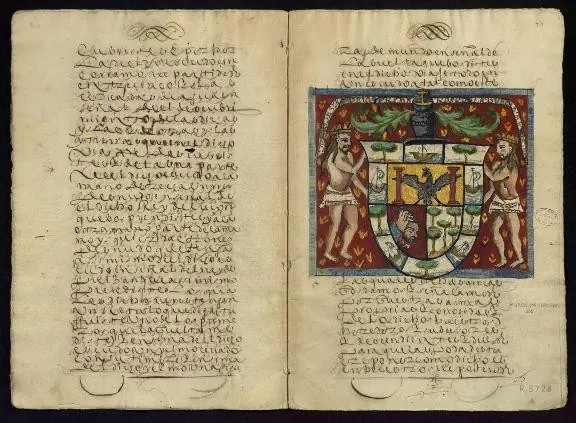
Oviedo states that he saw the original privilege of the arms granted in 1528, which said that Espinosa «discovered five islands in the Spice Islands and other lands, and defeated the king of Luzon and captured the king of Puluán, and was one of the first to circle the world». That text explains the islands, the supporting kings and the severed head on his coat of arms. It is, however, the account of a protagonist seeking favours from the Crown. [B49]
Rewards and last years in Seville
Fernández Morente dates the grant of a life pension of 300 gold ducats a year to 24 August 1527. This is the date and amount stated in her study, not an original royal decree examined here. [B433] The IHCN summary dates the grant of arms to 4 February 1528. [B47] The drawing surviving in the merits dossier of Ruy Gómez de Espinosa must be distinguished from the original grant. [B377]
Fernández-Carrión’s biography places his appointment as inspector and captain of the Indies ships, under Seville’s Casa de la Contratación, in 1529. The cession of Castilian rights over the Moluccas must be checked against the Zaragoza agreement, not inferred from that appointment. [B267] [B48]
The review of Mazón’s book in Revista de Historia Naval 159, p. 178, describes a final section covering his claims, defence of Magellan’s memory, command of the San Antonio and life in Seville. It places his death “probably after 1546”; neither its exact date nor place is known. This is an attribution to the review, not a claim to have read all the documents transcribed in the book. [B452]
The IHCN synthesis attributes to a royal decree issued in Ocaña on 20 March 1531 an order to pay him 41,200 maravedís for services and inheritance rights. This payment is distinct from the life pension; the amount is reported as information from the institutional synthesis, without claiming that the original decree has been examined here. [B47]
Family and descendants
The passenger catalogue, volume IV, p. 101, entry 791, records Rui Gómez de Espinosa on 22 January 1561 as unmarried, a native of Seville and the son of Gonzalo Gómez de Espinosa and Juliana de Bobadilla, with Guatemala as destination. This published documentary entry strengthens the family information previously taken only from a popular account; the manuscript and arrival have not been verified. [B317]
The 1617 inquiry of his descendant Ruy Gómez de Espinosa included a copy of the arms: AGI, PATRONATO,87,N.1,R.3, f. 79r; MP-ESCUDOS,231. PARES does not state his generation. The conjecture that he must have been a grandson or great-grandson is withdrawn: dates alone cannot distinguish him from the 1561 passenger. His biography brings together both references and explains the unresolved identification. [B377]
Assessment
Espinosa’s career provides evidence for the succession of command after Magellan, the division of the return routes and Portuguese imprisonment. The account of Trinidad collected by Stanley describes the departure from Tidore and subsequent imprisonment. It does not by itself demonstrate that this knowledge reached the navigators of 1565. [B23]¶ [B23]
His career also shows the harshness of these enterprises: the violence used to impose command, the tribute pacts with the sovereigns of the islands, the presence of enslaved people on board and the death of most of those who accompanied him. [B28]¶ [B48] [B28]¶ [B23]
Office recorded in the 1519 list
Another voice from the Trinidad is Juan Bautista de Punzorol: his letter dated at Tidore on 21 December 1521, in Braulio Vázquez Campos’s Spanish translation, reports a leak and the decision to send the Victoria ahead with the news. His plan to return by Tierra Firme does not establish that this route was completed. The critical edition places the Italian copy alongside different translations: the Spanish text available here is the 2021 translation, not a recovered Spanish original. [B41]¶ [B41]
The 1519 list records him as constable aboard Trinidad. This entry supports his initial office, not every subsequent command. [B28]
Documentary comparison of a specific episode
Oviedo, volume II of the 1852 edition, book XX, chapter IV, page 31, states that he spoke with Espinosa and Elcano and compares their accounts. This reference identifies that volume, not volume I of a different edition. [B49]
Offices
- Chief enforcement officer in Magellan’s fleet (1519) [B433]
- Captain of the Victoria in May 1521 according to Fernández-Carrión [B48]
- Captain-general and captain of the Trinidad after Carvalho’s replacement [B48]
- Visitor and captain of Indies ships from 1529 according to Fernández-Carrión [B48]
Family tree
Lines connect only recorded parents. Probable relationships have dashed borders. Expand each person to consult details and sources.
Scroll horizontally to explore the tree.
- GGGonzalo Gómez de EspinosaCaptain of the Trinidad
- RGRuy Gómez de EspinosaSon
Details and sources
Passenger entry for Guatemala, 22 January 1561
Documented · Published passenger catalogue IV, p. 101, entry 791 [B317]
Parents: Gonzalo Gómez de Espinosa · Juliana de Bobadilla
Chronology
A life, step by step. Follow the dates and open each milestone or image to explore its sources.
- 1519
Appointment as enforcement officer and recruitment. [B433]
Explore this year - 10 de agosto de 1519
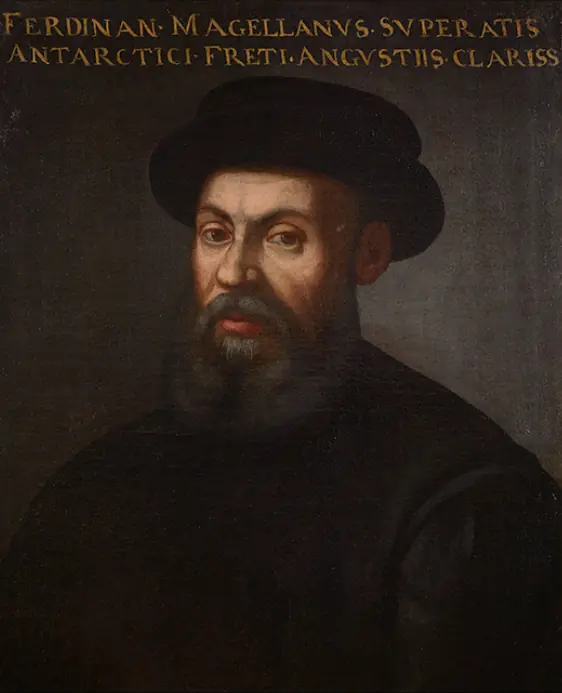
Image linked to the milestone About this image
Portrait of Ferdinand Magellan.Departure from Seville. [B23]
View the milestone: Magellan begins the first circumnavigation - Abril de 1520
Intervention in the San Julián mutiny. [B28]
View the milestone: Mutiny at San Julián - Mayo de 1521
Command of the Victoria according to Fernández-Carrión. [B48]
Explore this year - Julio de 1521
Embassy in Borneo. [B48]
Explore this year - 1521
Replacement of Carvalho and command of the Trinidad; the passage gives no day. [B48]
Explore this year - Noviembre de 1521
Arrival at Tidore: the 8th in Fernández-Carrión and 7th in Elcano’s biography. [B48] [B113]
Explore this year - 6 de abril de 1522
Trinidad departure according to the account edited by Stanley. [B23]
View the milestone: The Trinidad attempts an eastward Pacific return - Octubre de 1522
Portuguese capture, according to the Trinidad account. [B23]
Explore this year - 12 de enero de 1525
Cochin letter; the date can be read in the manuscript’s closing. [B42]
Explore this year - 2 de agosto de 1527
Commission and oath recorded in Navarrete’s document XL. [B28]¶ [B28]
Explore this year - 24 de agosto de 1527
Life annuity of 300 ducats according to Fernández Morente. [B433]
Explore this year - 4 de febrero de 1528
1528 About this image
Coat of arms of Gonzalo Gómez de Espinosa · 1528. Arms granted by Charles I by royal decree of 4 February 1528 to the chief constable of Magellan's fleet and last captain of the Trinidad. It is one of the few visual testimonies of the period directly linked to a participant in the first circumnavigation: each figure alludes to episodes and results of the expedition.Grant of arms according to the IHCN. [B47]
Explore this year - 1529
Appointment concerning Indies ships according to Fernández-Carrión. [B48]
Explore this year
Disputed dates and open questions
- The RAH gives 1474; this is a biographical attribution, rather than a birth record examined here. [B48]
- The armorial grant and Espinosa’s account transmitted by Oviedo must be distinguished when interpreting the severed head. [B47] [B49]
- The Trinidad account and Fernández-Carrión give different survivor counts. [B23]¶ [B48]
- The 1617 applicant’s exact relationship remains to be established; dates alone do not resolve identity. [B377]
Participation
- First Circumnavigation: The Magellan–Elcano Expedition (1519): Chief constable of the fleet; after Magellan's death, captain of the Victoria and then captain general and captain of the Trinidad
- Death of Magellan at Mactan (1521): After Mactan and the massacre at Cebu he took command of the Victoria
- Return of the nao Victoria to Sanlúcar (1522): He stayed at Tidore with the Trinidad and tried to return by the North Pacific
Related protagonists
Maps
- Miller Atlas: world map
- Universal chart of Diego Ribero: reproduction
- Nautical planisphere of Lopo Homem
- Universale descrittione di tutta la terra conosciuta fin qui
- Nova et aucta orbis terrae descriptio
- Africae tabula nova
- Asiae nova descriptio
- Maris Pacifici
Show all links (11)
Related milestones
- Encounters in Patagonia during the winter stay
- Magellan finds the strait
- Magellan’s fleet reaches Guam
- The expedition lands at Homonhon
- Magellan and Rajah Humabon at Cebu
- Battle of Mactan and death of Magellan
- Elcano completes the first circumnavigation
- Statements by survivors of the Trinidad
People and entries mentioned
Mentioned in other entries
- Gaspar de Espinosa
- Rodrigo de Espinosa (pilot)
- Statement by Gómez de Espinosa, Mafra and Pancado
- The descendants of licenciado Gaspar de Espinosa
- 1520: The strait and the Sad Night
Una mención permite investigar una relación; no implica participación en la expedición ni acredita por sí sola el pasaje citado.
Sources
- Carta desde las Islas de las Especias: una nueva edición de la misiva de Juan Bautista de Punzorol, Braulio Vázquez Campos · CSIC
- La primera vuelta al mundo: documentos y carta de Espinosa, Vicente Llorens Asensio; testimony by Gonzalo Gómez de Espinosa
- History of the Philippine Islands, Antonio de Morga
- General and Natural History of the Indies, book XX, ch. IV, Gonzalo Fernández de Oviedo · ed. José Amador de los Ríos, Real Academia de la Historia, 1852 · Internet Archive
- Coat of arms of Gonzalo Gómez de Espinosa (copy of 1617), Archivo General de Indias, MP-ESCUDOS,231 · PARES
- Discoverers of Oceania: Gonzalo Gómez de Espinosa, Federación Española de Sociedades Filatélicas (FESOFI), 2023
- Gonzalo Gómez de Espinosa, Diccionario Biográfico Español, Miguel Héctor Fernández-Carrión · Real Academia de la Historia
- Espinosa. The last captain of the circumnavigation, Tomás Mazón Serrano · Ediciones Encuentro, Madrid, 2022 (ISBN 978-84-1339-113-7)
- Gonzalo Gómez de Espinosa’s letter to Charles I about the Trinidad, Gonzalo Gómez de Espinosa · Archivo General de Indias
- Account of the first voyage around the world, Antonio Pigafetta
- The First Voyage Round the World, by Magellan, Antonio Pigafetta y otros testigos; traducción de Lord Stanley of Alderley
- Colección de los viages y descubrimientos: Expediciones al Maluco. Viage de Magallanes y de Elcano, Martín Fernández de Navarrete
- Historia general y natural de las Indias, tomo II: primera parte de la segunda parte, Gonzalo Fernández de Oviedo; edición de José Amador de los Ríos
- Documentación de la armada de Magallanes, Consejos de la Corona y administración de la expedición
- Primer viaje alrededor del mundo: edición crítica, Antonio Pigafetta; edición de José Eugenio Borao Mateo, traducción de José Toribio Medina
- Catálogo de pasajeros a Indias IV (1560–1566), Luis Romera Iruela y María del Carmen Galbis Díez
- Virtual navigation of Gonzalo Gómez de Espinosa: attempted eastward return in 1522, Institute of Naval History and Culture
- Reconstruction of the Trinidad’s route: the Navy’s KMZ file, Institute of Naval History and Culture
- Spanish discoveries in the South Sea, Amancio Landín Carrasco (director)
- Los hombres de la primera vuelta al mundo, Guadalupe Fernández Morente
- Juan Sebastián Elcano, Diccionario Biográfico Español, Manuel Lucena Salmoral · Real Academia de la Historia
- Tratado de Zaragoza, Carlos I y representantes de Portugal; descripción del Archivo General de Indias
- Fernando de Magallanes, Diccionario Biográfico Español, Carlos Márquez Montero · Real Academia de la Historia
- Gonzalo Gómez de Espinosa, Equipo Burgaleses en la Especiería
Examine and compare documents
- Espinosa: letter, testimony and route reconstruction — What can be established from the Cochin letter, and what does virtual navigation add? ·
- Victoria and Trinidad: two trajectories after the Moluccas — Why does the Victoria’s return not summarise the fate of the entire fleet? ·
Documentary supplements with their own review scope; they do not certify a complete collation of this entry.
Linked sources
- [B6] Spanish discoveries in the South Sea
- [B21] Documentation of Magellan's fleet
- [B23] The First Voyage Round the World, by Magellan
- [B27] History of the Philippine Islands
- [B28] Colección de los viages y descubrimientos: Expediciones al Maluco. Viage de Magallanes y de Elcano
- [B30] First Voyage Around the World
- [B35] First Voyage Around the World: critical edition
- [B39] Reconstruction of the Trinidad’s route: the Navy’s KMZ file
Show all links (23)
- [B41] Punzorol’s letter from Tidore: critical edition and Spanish translation
- [B42] Gonzalo Gómez de Espinosa’s letter to Charles I about the Trinidad
- [B47] Virtual navigation of Gonzalo Gómez de Espinosa: attempted eastward return in 1522
- [B48] Gonzalo Gómez de Espinosa, Diccionario Biográfico Español
- [B49] Historia general y natural de las Indias, tomo II: primera parte de la segunda parte
- [B113] Juan Sebastián Elcano, Diccionario Biográfico Español
- [B259] Fernando de Magallanes, Diccionario Biográfico Español
- [B267] Tratado de Zaragoza
- [B317] Passenger catalogue for the Indies, volume IV (1560–1566): Rui Gómez de Espinosa
- [B371] The first circumnavigation: documents and Espinosa’s letter
- [B377] Escudo de armas de Gonzalo Gómez de Espinosa (copia de 1617)
- [B426] Gonzalo Gómez de Espinosa
- [B433] Los hombres de la primera vuelta al mundo
- [B451] Descubridores de Oceanía: Gonzalo Gómez de Espinosa
- [B452] Review of Espinosa. El último capitán de la vuelta al mundo
Sources of the related expeditions
- [B3] The Spanish Lake
- [B4] España y el Pacífico: un breve repaso a las expediciones españolas de los siglos XVI al XVIII
- [B7] Los hallazgos españoles en el Pacífico
- [B13] Relatos de viaje del siglo XVI
- [B38] La Relación del primer viaje alrededor del mundo de Antonio Pigafetta y sus traducciones al español
- [B40] Primer viaje alrededor del mundo: edición de Leoncio Cabrero
- [B44] Elcano’s letter to the emperor (1522): copy and AGI transcription
- [B45] Pedro Gómez: servant aboard the Trinidad
Send comments to the author
Found an error or have information to contribute? Write privately to the author.