

Coat of arms of Gonzalo Gómez de Espinosa
In this entry · 9 sections
1528 · Anonymous drawing of Charles I's grant · General Archive of the Indies, MP-ESCUDOS,231 (from folio 79r of PATRONATO,87,N.1,R.3, merits of his descendant Rui Gómez de Espinosa)
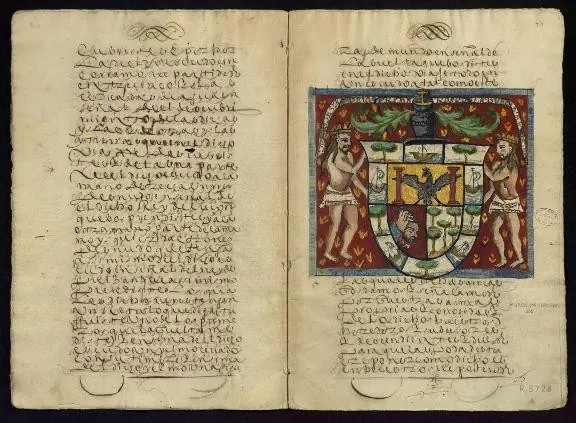
Arms granted by Charles I by royal decree of 4 February 1528 to the chief constable of Magellan's fleet and last captain of the Trinidad. It is one of the few visual testimonies of the period directly linked to a participant in the first circumnavigation: each figure alludes to episodes and results of the expedition.
Reading its elements
- The motto: “You were one of the first who gave me the turn (around the world)”
The world speaks symbolically to Gómez de Espinosa and acknowledges his part in the first circumnavigation. It is especially significant because, although he did not return with Elcano's Victoria, he ended up reaching Spain after crossing the Pacific and suffering captivity at Portuguese hands.
- The terrestrial globe on the helm
The royal grant explains that it represents the voyage around the world; it is one of the elements with explicit historical meaning. The cross that tops it can be read within the Christian iconography of the time, although the grant stresses the globe as the symbol of the voyage.
- The helm
It is the heraldic crest, placed above the shield. It represents his status as a man-at-arms and forms part of the dignity elements that accompany arms granted by the monarch.
- The black eagle on a field of gold
It is related to the power and imperial authority of Charles I, as well as to valor and strength. It is accompanied by two columns that reinforce the relation to the monarchy, although their documented interpretation is another.
- The two red columns
The grant indicates that they symbolize the effort shown during the voyage: the dangers, privations and difficulties of the expedition. They should not be reduced to the Pillars of Hercules, although they recall that iconography.
- The hand holding a severed head
Probably the most singular figure. The decree links it with an enemy captain killed by Gómez de Espinosa. Some interpretations identify him with Luis de Mendoza, captain of the Victoria killed in the suppression of the San Julián mutiny in April 1520; others relate it to an Indigenous adversary in Asia. The specific identification is not settled. Espinosa's own account, collected by Fernández de Oviedo, supports this second reading: in Brunei he killed a nephew of the king who commanded the force sent against the Spaniards, cut off his head and sent it to his uncle.
- The five islands and the trees
The islands represent the expedition's discoveries, especially in the Pacific. The trees are described as clove trees: a reference to the spices and to the economic aim of the enterprise, reaching the Spice Islands.
- The five ships and the waves
They evoke the fleet with which Magellan set out: Trinidad, San Antonio, Concepción, Victoria and Santiago. They are distributed around the border among islands surrounded by water, and the grant relates them to the discovery of lands and islands. The blue and white waves represent the ocean.
- The two crowned figures holding the shield
They are the supporters. The grant identifies them as the king of Luzon and the king of Pulam or Puluán, whom it presents as captured by Gómez de Espinosa. Oviedo, who saw the original privilege, summarizes that Espinosa “defeated the king of Luzon and seized the king of Puluán” (Palawan). They appear half-naked and crowned, according to the European iconography of the time.
- The mantling and the colors
The leaves surrounding the helm are mantling, traditional heraldic ornaments. Gold, red, green and blue may be conventionally associated with nobility, valor, hope and loyalty, but it is not recorded that the grant gave any particular meaning to each color.
Work identification
- Colored drawing on paper
- 14.6 × 17.5 cm
- General Archive of the Indies, MP-ESCUDOS,231 (from folio 79r of PATRONATO,87,N.1,R.3, merits of his descendant Rui Gómez de Espinosa)
- Muy alta para el documento; algunas identificaciones de sus figuras son discutidas
Credits and image provenance
General Archive of the Indies, MP-ESCUDOS,231 · Ministry of Culture
Reproduction record · Reproduction from the General Archive of the Indies; consult the PARES conditions of use
Related expeditions
Related protagonists
Maps
- Miller Atlas: world map
- Universal chart of Diego Ribero: reproduction
- Nautical planisphere of Lopo Homem
- Universale descrittione di tutta la terra conosciuta fin qui
- Nova et aucta orbis terrae descriptio
- Africae tabula nova
- Asiae nova descriptio
- Maris Pacifici
Show all links (11)
Art
- Americae sive quartae orbis partis nova et exactissima descriptio
- Description of the West Indies and title pages of the Décadas
- Portrait of Ferdinand Magellan
- Imaginary portrait of Juan Sebastián Elcano
Related milestones
- Magellan begins the first circumnavigation
- Encounters in Patagonia during the winter stay
- Mutiny at San Julián
- Magellan finds the strait
- Magellan’s fleet reaches Guam
- The expedition lands at Homonhon
- Magellan and Rajah Humabon at Cebu
- Battle of Mactan and death of Magellan
Show all links (11)
Sources of the related expeditions
- [B3] The Spanish Lake
- [B4] España y el Pacífico: un breve repaso a las expediciones españolas de los siglos XVI al XVIII
- [B6] Spanish discoveries in the South Sea
- [B7] Los hallazgos españoles en el Pacífico
- [B13] Relatos de viaje del siglo XVI
- [B21] Documentation of Magellan's fleet
- [B23] The First Voyage Round the World, by Magellan
- [B28] Colección de los viages y descubrimientos: Expediciones al Maluco. Viage de Magallanes y de Elcano
Show all links (21)
- [B30] First Voyage Around the World
- [B35] First Voyage Around the World: critical edition
- [B38] La Relación del primer viaje alrededor del mundo de Antonio Pigafetta y sus traducciones al español
- [B39] Reconstruction of the Trinidad’s route: the Navy’s KMZ file
- [B40] Primer viaje alrededor del mundo: edición de Leoncio Cabrero
- [B41] Punzorol’s letter from Tidore: critical edition and Spanish translation
- [B42] Gonzalo Gómez de Espinosa’s letter to Charles I about the Trinidad
- [B44] Elcano’s letter to the emperor (1522): copy and AGI transcription
- [B45] Pedro Gómez: servant aboard the Trinidad
- [B46] The crews of the first circumnavigation
- [B47] Virtual navigation of Gonzalo Gómez de Espinosa: attempted eastward return in 1522
- [B48] Gonzalo Gómez de Espinosa, Diccionario Biográfico Español
- [B49] Historia general y natural de las Indias, tomo II: primera parte de la segunda parte
Send comments to the author
Found an error or have information to contribute? Write privately to the author.