

Hernán Cortés
In this entry · 20 sections
- Medellín, Salamanca and the passage to the Indies
- The expedition of 1519
- From the Noche Triste to the fall of Tenochtitlan
- Governor of New Spain
- Pacific explorations and last years
- Assessment
- Compare Bernal’s testimony
- A surviving letter and an absent account
- The allies pursued policies of their own
- Offices
- Disputed dates and open questions
- Participation
- Related protagonists
- Maps
- Related milestones
- People and entries mentioned
- Mentioned in other entries
- Sources
- Linked sources
- Sources of the related expeditions
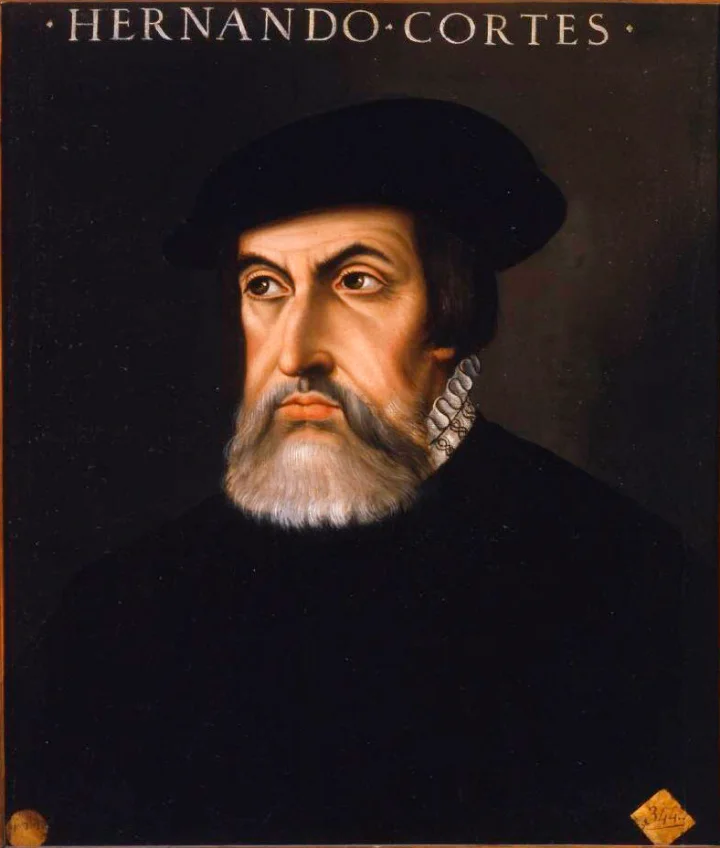
Unidentified artist · Eighteenth century.
He reached Hispaniola in 1504 and joined Diego Velázquez’s Cuban enterprise in 1511. This Caribbean career preceded the expedition he led to Mexico. [B94] [B94]
Birth: Medellín (Badajoz), 1485 [B94]. Death: Castilleja de la Cuesta (Seville), 2 December 1547 [B94].
Medellín, Salamanca and the passage to the Indies
He was born into a hidalgo family of small means: his father was Martín Cortés de Monroy and his mother Catalina Pizarro Altamirano. A frail child, at fourteen he went to Salamanca, where he learned Latin and law without graduating, and then worked with a notary in Valladolid. [B94]
He wanted to sail with Ovando in 1502, but a fall prevented him. He went to Hispaniola in 1504, was a notary at Azua and in 1511 accompanied Diego Velázquez in the conquest of Cuba as the treasurer's secretary. There he prospered with encomiendas, livestock and mines and married Catalina Xuárez. [B94]
The expedition of 1519
Velázquez chose him to lead the new expedition to the mainland and, when he wished to replace him, Cortés sailed first, in February 1519. He took some 508 soldiers, a hundred sailors, 16 horses and light artillery, paid for by Velázquez, Lares, Duero and Cortés himself. [B94]
The interpreters were decisive: Jerónimo de Aguilar, who spoke Maya, and Malintzin, who commanded Nahuatl and Maya and was much more than an interpreter. At Cempoala he obtained the first Indigenous alliance; after hard fighting, Tlaxcala became his faithful ally. At Cholula, on 18 October, he carried out a massacre of some three thousand people. On 8 November 1519 he entered Tenochtitlan. [B94]
From the Noche Triste to the fall of Tenochtitlan
He held Moctezuma and seized the treasure of Axayácatl. In May 1520 he defeated and incorporated into his force the fleet of Pánfilo de Narváez, sent against him, but in his absence Alvarado had killed the leading Mexica at the Templo Mayor. After Moctezuma's death, the flight of 30 June cost hundreds of Spaniards and thousands of allies; the victory at Otumba allowed him to take refuge in Tlaxcala. [B94]
With reinforcements, thirteen brigantines and some 25,000 allies, he laid siege to the city from 30 May 1521. With the Chapultepec aqueduct cut and the population decimated by smallpox, Cuauhtémoc surrendered on 13 August 1521. [B94] [B93]
Governor of New Spain
Named governor and captain general in 1522, he distributed encomiendas, exempted Tlaxcala, rebuilt Mexico on the old city, founded the Hospital de Jesús and asked for Franciscan missionaries, who arrived in 1524. On the expedition to Las Hibueras (1524–1526) he ordered Cuauhtémoc executed, and in his absence the royal officials fought over power. [B94]
He travelled to Spain in 1528. Charles V granted him in 1529 the marquisate of the Valley of Oaxaca with 23,000 vassals, but not the government. He married Juana de Zúñiga. He rebuilt his fortune with sugar, livestock, mines and shipyards, in which he also used enslaved labour. [B94]
Pacific explorations and last years
He financed four expeditions to Baja California and the gulf that bears his name between 1533 and 1540 and took part in that of 1535. In 1541 he returned to Spain with his sons, took part in the disastrous Algiers expedition and wrote memorials to the emperor without reply. He died at Castilleja de la Cuesta on 2 December 1547. [B94]
Assessment
Bennassar interprets Cortés’s success through his political skill and divisions within the Mesoamerican world. The study describes the alliance with Tlaxcala, the Cholula massacre and execution of Cuauhtémoc. His assessment of the commander and his motives is distinguished from a directly observed documentary fact. [B94] [B94] [B94]
Compare Bernal’s testimony
Bernal Díaz describes the decision to leave Mexico at night as an agreement by Cortés, the captains and the soldiers. This is a participant’s retrospective account, rather than minutes of that deliberation. The passage in chapter CXXVIII, f. 105v, can be read alongside the 1632 printing. [B10]
Two claims at the end of the siege should be distinguished: Bernal credits García Holguín with overtaking Cuauhtémoc’s canoe, and dates the capture to 13 August 1521. Both appear in chapter CLVI, ff. 155r–155v; saying that Cortés “conquered” the city does not identify the participants in each episode. [B10]
A surviving letter and an absent account
The letter preserved at AGI, PATRONATO,16,N.1,R.1 is dated at Cuyuacán on 15 May 1522. [B388]
In the letter, Cortés announces that he is sending an account of New Spain. [B388]
PARES states that the announced account is not part of this file. The letter is therefore not presented as a transcription of the Third Letter: these documentary pieces must be distinguished. [B388]
The allies pursued policies of their own
Coastal communities did not provide constant obedience: García Márquez describes interruptions and neutrality in relations with the totonaque. Contributions of people, food and materials must be studied alongside the conflicts discussed by the same author, without reducing these actors to passive auxiliaries. [B84]
Pastrana also examines Mexica diplomatic initiative: retaining allies, offering tribute exemptions and seeking agreements with rivals. His reading of the Tlaxcalan decision after the retreat of 1520 proposes renegotiation of the alliance; it is presented as a historical interpretation, not proof of unchanging loyalty to the Crown. [B90]
Offices
- Captain of the expedition of 1519 [B94]
- Governor and captain general of New Spain (1522) [B94]
- Marquis of the Valley of Oaxaca (1529) [B93]
Family tree
Lines connect only recorded parents. Probable relationships have dashed borders. Expand each person to consult details and sources.
Scroll horizontally to explore the tree.
- MCMartín Cortés de MonroyFatherCPCatalina Pizarro AltamiranoMother
- Hernán Cortés1st Marquis of the Valley of Oaxaca
Details and sources
Medellín, 1485 · Castilleja de la Cuesta, 1547
Documented · Bennassar; Ramos Medina [B94] [B94] [B93]
Parents: Martín Cortés de Monroy · Catalina Pizarro Altamirano
Portrait credits and provenanceCXCatalina XuárezFirst wife (Cuba, 1514–1515)JZJuana de ZúñigaSecond wife (Béjar, 1529)Details and sources
Daughter of the Count of Aguilar; six children
Marriage
Documented · Bennassar; Ramos Medina [B94]
TTecuichpoPartner; daughter of MoctezumaDetails and sources
Mother of Leonor Cortés Moctezuma, according to Bennassar
Union without marriage
Documented · Bennassar; Ramos Medina [B94]
- MCMartín CortésSon of MalintzinMCMartín Cortés y ZúñigaSon of Juana de Zúñiga
Details and sources
2nd Marquis of the Valley
Documented · Bennassar; Ramos Medina [B94]
Parents: Hernán Cortés · Juana de Zúñiga
LCLeonor Cortés MoctezumaDaughter of TecuichpoDetails and sources
Born in 1527
Documented · Bennassar; Ramos Medina [B94]
Parents: Hernán Cortés · Tecuichpo
Chronology
A life, step by step. Follow the dates and open each milestone or image to explore its sources.
- 1485
Eighteenth century About this image
Portrait of Hernán Cortés · Eighteenth century. Context portrait; it does not depict this event. Representation attributed to this person in the provenance record. It is not treated as evidence of physical appearance or as a record of their expeditions. The date of the work is distinguished from its digitisation date.Born in Medellín. [B94]
- 1504
Goes to Hispaniola. [B94]
Explore this year - 1511
Conquest of Cuba with Velázquez. [B94]
Explore this year - Feb. 1519
Leaves Cuba for Yucatán and Mexico. [B94]
Explore this year - 8 Nov. 1519
Second half of the 17th century About this image
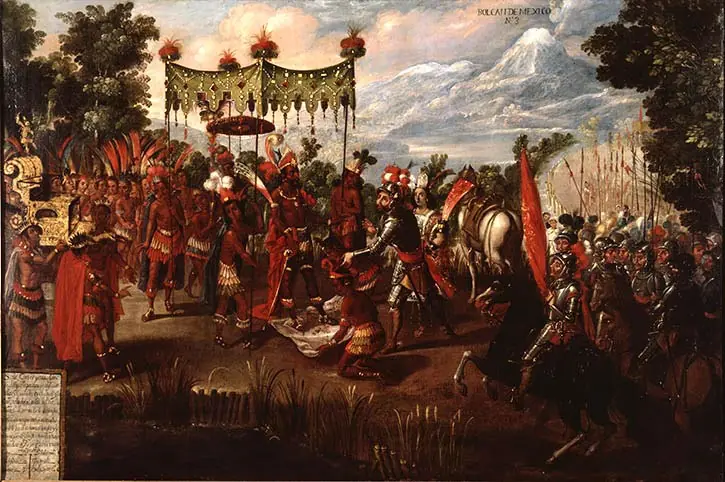
Meeting of Cortés and Moctezuma · Second half of the 17th century. Canvas 3 of the series of eight paintings on the conquest of Mexico (“The Meeting of Cortés and Moctezuma” in the Library of Congress catalog). Painted some 150 years after the events, it condenses several moments into one scene and follows the conventions of 17th-century battle painting; landscapes, costumes and gestures are idealized.Enters Tenochtitlan. [B94]
View the milestone: Cortés and Moctezuma meet in Tenochtitlan - 30 June 1520
Second half of the 17th century About this image
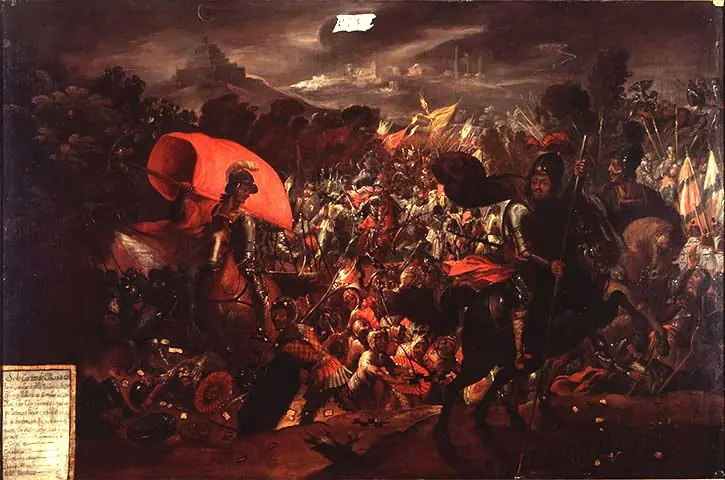
The Noche Triste (Sad Night) · Second half of the 17th century. Canvas 5 of the series of eight paintings on the conquest of Mexico (“The Sad Night” in the Library of Congress catalog). Painted some 150 years after the events, it condenses several moments into one scene and follows the conventions of 17th-century battle painting; landscapes, costumes and gestures are idealized.The Noche Triste. [B94]
View the milestone: Retreat from Tenochtitlan: the Noche Triste - 13 Aug. 1521
Second half of the 17th century About this image
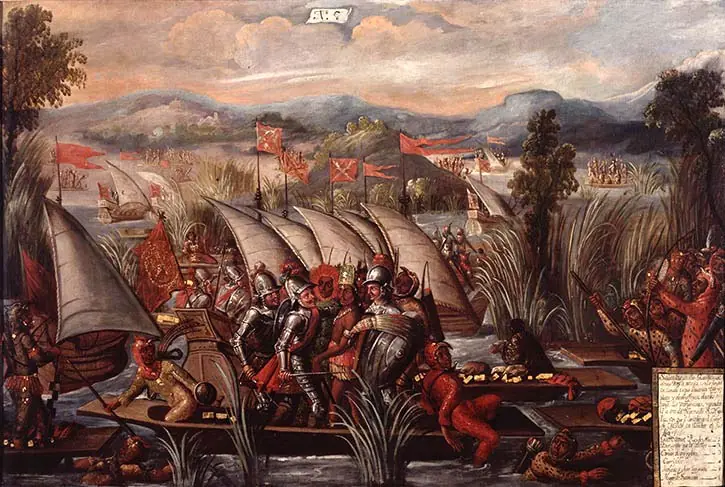
Capture of Cuauhtémoc · Second half of the 17th century. Canvas 8 of the series of eight paintings on the conquest of Mexico (“The Capture of Cuauhtémoc” in the Library of Congress catalog). Painted some 150 years after the events, it condenses several moments into one scene and follows the conventions of 17th-century battle painting; landscapes, costumes and gestures are idealized.Surrender of Cuauhtémoc. [B93]
View the milestone: The fall of Tenochtitlan - 15 Oct. 1522
Governor and captain general of New Spain. [B94]
Explore this year - 1524–1526
Expedition to Las Hibueras. [B94]
Explore this year - 6 July 1529
Marquis of the Valley of Oaxaca. [B93]
Explore this year - 1535
Expedition to California. [B94]
Explore this year - 2 Dec. 1547
Dies at Castilleja de la Cuesta. [B94]
Explore this year
Disputed dates and open questions
- Bennassar reports suspicions surrounding Catalina Xuárez’s death in 1522, without finding the evidence conclusive. [B94]
- Bennassar dates the marquisate to 6 June 1529; Ramos Medina’s chronology gives 6 July. [B94] [B93]
- Bennassar counts five ships; the Cozumel muster in Bernal–Lockhart counts eleven. The comparison is retained and the totals are not equated. [B94] [B22]
Participation
- Conquest of Mexico: fall of the Aztec Empire (1519): Head of the Spanish enterprise
Related protagonists
Maps
- Tenochtitlan and the Gulf of Mexico
- Americae sive quartae orbis partis nova et exactissima descriptio
- Americae sive novi orbis, nova descriptio
- Painting of Teozacoalco and documentation of its geographic report
- Descriptionis Ptolemaicae augmentum: set of plates
- Granata Nova et California
- Hispaniae Novae sive Magnae, recens et vera descriptio
Related milestones
People and entries mentioned
Mentioned in other entries
- Álvaro de Saavedra Cerón
- Antón de Alaminos
- Luis de Cárdenas
- Juan de Grijalva reaches San Juan de Ulúa
- Francisco de Ulloa’s reconnaissance of California
- Letters of Relation, edition by Ángel Delgado Gómez
- Hospital de Jesús collection
- La quarta relacion que Fernando Cortes embio al muy alto y muy potentissimo emperador (1525)
Show all links (11)
Una mención permite investigar una relación; no implica participación en la expedición ni acredita por sí sola el pasaje citado.
Sources
- Hernán Cortés, Diccionario Biográfico Español, Bartolomé Bennassar · Real Academia de la Historia
- True History of the Conquest of New Spain, Bernal Díaz del Castillo · Biblioteca Virtual Miguel de Cervantes
- Hernán Cortés portal, Biblioteca Virtual Miguel de Cervantes
- De Cozumel a Cempoala: cronología contrastada de 1519, Edición de Memórica; testimonios de Cortés y Bernal Díaz
- Las alianzas y las fuerzas militares antes del sitio de México-Tenochtitlan, Equipo y colaboradores de Noticonquista, UNAM
- Códice Florentino: edición digital, Bernardino de Sahagún y colaboradores nahuas
- Cronología de Hernán Cortés, Manuel Ramos Medina
- Memoirs of the Conquistador Bernal Diaz del Castillo, volumen 1, Bernal Díaz del Castillo; traducción de John Ingram Lockhart
- Historia verdadera de la conquista de la Nueva España, Bernal Díaz del Castillo; edición de Alonso Remón
- Carta de Hernán Cortés sobre Nueva España y documentos asociados, Hernán Cortés · Archivo General de Indias / PARES
- Alianza y conflicto con los totonaque, Agustín García Márquez · UNAM / Noticonquista
- Los mexicas y su política de alianzas durante la conquista [1], Miguel Pastrana Flores · UNAM / Noticonquista
Linked sources
- [B10] True History of the Conquest of New Spain
- [B22] Memoirs of the Conquistador Bernal Diaz del Castillo, volumen 1
- [B70] Florentine Codex: digital edition
- [B78] The alliances and military forces before the siege of México-Tenochtitlan
- [B79] From Cozumel to Cempoala: cross-checked chronology of 1519
- [B81] Hernán Cortés portal: works and documents
- [B84] Alliance and conflict with the totonaque
- [B90] The Mexica and their alliance policy during the conquest
Show all links (11)
Sources of the related expeditions
- [B11] Cronología General Iberoamericana: siglo XVI
- [B13] Relatos de viaje del siglo XVI
- [B15] La Era de la Exploración: navegantes y conquistadores del siglo XVI
- [B61] Lienzo de Tlaxcala
- [B77] Crónica de la Nueva España
- [B86] The Pleasant Historie of the Conquest of the Weast India, now called New Spayne
- [B89] History of the Indians of New Spain
- [B92] History of the Conquest of Mexico, volumen 1
Send comments to the author
Found an error or have information to contribute? Write privately to the author.