

Conquest of the Philippines
In this entry · 21 sections
- Context
- Stages
- Development
- Events of this expedition
- Route data
- Outcome
- Limits of the evidence
- Expedition facts
- Organisation
- Objectives
- Encounters and societies
- Ships and crew
- People and societies
- Related people
- Related cartography
- Art and memory
- Other expeditions with shared protagonists
- Sources and references
- Further reading and comparison
- Examine and compare documents
- Sources of the related expeditions
Episode · 1565. Miguel López de Legazpi.
Cabrero dates departure from Navidad to 21 November 1564. The IHCN list distinguishes San Pedro, San Pablo, San Juan de Letrán, San Lucas and an auxiliary vessel. Sierra identifies settlement, spices, preaching and the Pacific return as objectives. [B52] [B124] [B100]
Cabrero’s and Cuesta Domingo’s studies reconstruct Guam, Leyte, Samar, Bohol and Cebu. Morga links resistance at Cebu to Spanish seizure of provisions: attribution to the chronicler is preserved instead of reducing the encounter to a peaceful reception. [B52] [B105] [B27]
Cabrero dates San Pedro’s departure to 1 June 1565, with Salcedo in command and Urdaneta responsible for navigation. Legazpi remained in the islands. The move to Panay and establishment at Manila in 1571 are distinguished from the first Cebu settlement. [B52] [B52] [B52] [B52]
Context
The earlier attempts had shown both the interest in Asia and the difficulties of returning. Legazpi's enterprise aimed to maintain a stable presence and find a trans-Pacific connection, in territories with powers and trade networks of their own. [B105] [B100]
Stages
- November 21, 1564, Port of Navidad: Departure from the coast of New Spain. [B52]
- January 1565, Guam: Stopover in the western Pacific. [B52]
- February 1565, Philippines: Arrival at the eastern islands of the archipelago. [B105]
- 1565, Bohol: Contacts and agreements with local authorities. [B52]
- April 1565, Cebú: Installation of the colonial center after clashes. [B27]¶ [B52]
- June 1565, Cebú: The San Pedro set out for America; Legazpi stayed in the archipelago. [B52]
Development
The description of PATRONATO,23,R.16 brings together texts by several pilots. Its publication notes refer to the 1886 edition: Rodrigo’s outward account occupies pp. 217–351 and his return log pp. 427–456; Esteban Rodríguez’s outward account appears on pp. 373–426. These references locate distinct testimonies for comparison, not works by a single author. [B126]
Events of this expedition
Route data
- Two naos and two pataches, with about 380 men.
- Andrés de Urdaneta, by then an Augustinian friar, directed the navigation.
- In 1571 Legazpi moved the capital to Manila.
Outcome
A colonial base was created that shifted and expanded in later years. [B52]
The return route connected the possibilities of settlement with American supply, without resolving all the navigational risks. [B105]
Limits of the evidence
The departure of 1564 is distinguished from the establishment of 1565. [B52]
Manila became a colonial center in 1571: its founding is not attributed to the landing at Cebu. [B52]
Expedition facts
| Date | 1565 |
|---|---|
| Leader | Miguel López de Legazpi |
| Departure | Not specified in this entry |
| Destination | — |
| Period | 1564–1565; later expansion and moves |
Organisation
The fleet left the port of Navidad on 21 November 1564. Sources may count four main ships and an auxiliary brigantine, which explains some differing counts of the fleet. [B52] [B124]
Objectives
- To establish a colonial base in the archipelago [B100]
- To survey islands and negotiate or impose relations of dominion [B27]
- To test a return route to New Spain [B100]
Encounters and societies
Pacts and violence varied from island to island. The establishment at Cebu did not mean the complete conquest of the archipelago; local societies continued to negotiate, trade and resist. [B27]¶ [B52]
Ships and crew
| Ship | Captain | Master | Pilot | Reference |
|---|---|---|---|---|
| San Pedro | Miguel López de Legazpi (general embarked on the flagship) | Martín de Ibarra | Esteban Rodríguez; second pilot Pierre Plin | Institute of Naval History and Culture: composition of the fleet of 1564 [B124] [B52] |
| San Pablo | Not documented here | Juan Macías | Jaime Martínez Fortún and Diego Martín de Triana | Institute of Naval History and Culture: composition of the fleet of 1564 [B124] |
| San Juan de Letrán | Juan de la Isla | Juan Felipa de Triana | Rodrigo de Espinosa or de Isla | Institute of Naval History and Culture: composition of the fleet of 1564 [B124] |
| San Lucas | Alonso de Arellano | Nicolás the Greek | Lope Martín | Institute of Naval History and Culture: composition of the fleet of 1564 [B124] |
| Auxiliary brigantine | Not documented here | Not documented here | Not documented here | Institute of Naval History and Culture: composition of the fleet of 1564 [B124] |
Auxiliary brigantine: Auxiliary vessel cited in the organization of the fleet; its name and commanders are not completed without cross-checking.
People and societies
- Miguel López de Legazpi: Commander and governor [B52]
- Andrés de Urdaneta: Nautical adviser and head of the return project [B105]
- Guido de Lavezaris: Officer of the expedition and later governor [B115] [B115]
- Authorities of Bohol, Cebu and other islands: Interlocutors with different interests and positions [B52]
Related people
Related cartography
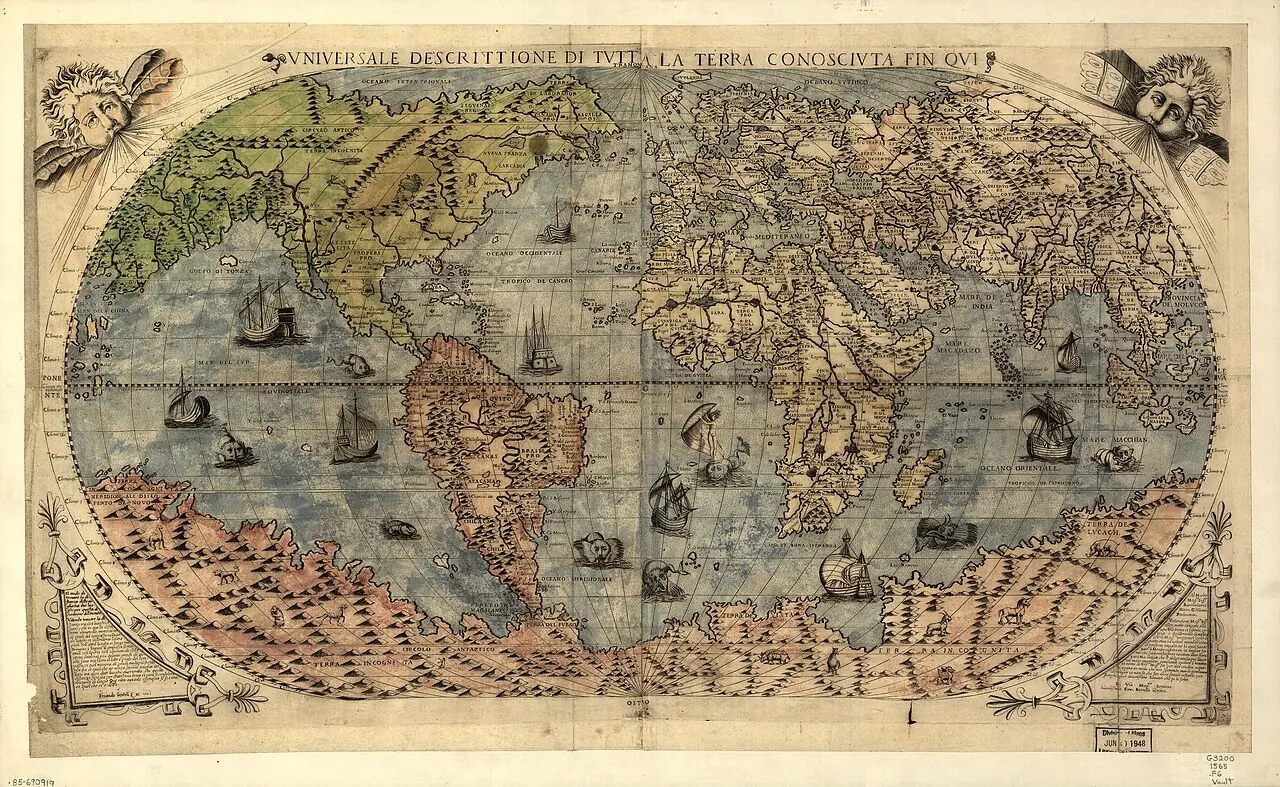
Universale descrittione di tutta la terra conosciuta fin qui · 1565. The continental shapes and the hypothetical southern land belong to the cartography of the time. The presence of a place does not prove a visit by the selected expedition.
Asiae nova descriptio · Copy of 1579, based on the author's earlier cartography. The record dates the copy to 1579. Luzon does not appear and several geographic shapes are distorted: its usefulness is to compare the knowledge of the period.
Maris Pacifici · 1589. The ship Victoria recalls the circumnavigation, but does not make the map a layout of the route of 1519–1522. The date of the map must be distinguished from that of the voyage.
Indiae Orientalis, insularumque adiacentium typus · Copy of the Latin edition of 1603; plate first published in 1570. The image is of 1603, not of the first edition of 1570. It does not describe Urdaneta's tornaviaje nor Mendaña's complete routes.
Art and memory
- Portrait of Andrés de Urdaneta · Date not established
- Portrait of Guido de Lavezaris · Date not established
Other expeditions with shared protagonists
Sources and references
- [B27] History of the Philippine Islands. Antonio de Morga. Work of 1609; English translation. Original record
- [B32] Caminos sobre la mar. Las expediciones a las islas de la especiería después de Magallanes, 1525–1564. Luis Alonso Álvarez. 2022. Original record
- [B54] Events in the Philippine Islands. Antonio de Morga. Mexico: Jerónimo Balli and Cornelio Adriano César, 1609. Original record
- [B83] Christian Doctrine in Spanish and Tagalog. Friars of the orders in Manila. Manila, 1593. Original record
- [B26] The Discovery and Conquest of the Molucco and Philippine Islands. Bartolomé Leonardo de Argensola. Work of 1609; English translation of 1708. Original record
- [B126] Sailing accounts and reports by the pilots of Legazpi’s fleet. Pilots of Miguel López de Legazpi’s fleet. File dated 1564; includes the 1565 eastward return. Original record
- [B128] Collection of unpublished overseas documents, second series, volume II: The Philippine Islands, I. Royal Academy of History (editor). 1886. Original record
- [B52] Miguel López de Legazpi. Leoncio Cabrero Fernández. Undated electronic edition; consulted on 2 November 2026. Original record
- [B124] Virtual navigation of Alonso de Arellano: the 1564–1565 fleet. Institute of Naval History and Culture. Institutional resource accessed 10 November 2026. Original record
- [B100] The expedition of Legazpi and Urdaneta: the tornaviaje. Blas Sierra de la Calle. Study published in 2009 on the tornaviaje of 1565. Original record
- [B105] Andrés de Urdaneta y Ceraín, Diccionario Biográfico Español. Mariano Cuesta Domingo · Real Academia de la Historia. n.d.; edition date not established. Original record
- [B115] Guido de Lavezaris. Javier Barrientos Grandon. Undated electronic edition; consulted on 2 November 2026. Original record
- Legazpi and Urdaneta: organization of the expedition and tornaviaje. Institute of Naval History and Culture, Notebook 58. Studies on naval organization and navigation. The outbound voyage began in November 1564 and Urdaneta's return was made in 1565.
Documents and call numbers
- FILIPINAS,34,N.1 · Letter from Mirandaola to Philip II
General bibliography guides further reading; it is not a pinpoint reference for every claim. Page, chapter and archival references are identified at the relevant passages.
Further reading and comparison
- Pedro Menéndez de Avilés's Expedition to Florida · 1565
- Urdaneta's discovery of the return route (tornaviaje) · 1565
- Founding of Manila · 1571
Examine and compare documents
- Pacification: legislation and non-compliance — Does changing a name establish that violence ceased? ·
- New Guinea and the San Jerónimo: accounts and service records — What does each account contribute, and how does it differ from the study interpreting it? ·
- The eastward return: failed attempts and two returns in 1565 — Why are reaching Asia from America and finding a return route different problems? ·
- Legazpi, Urdaneta and Arellano: expedition and return voyages — Are the settlement at Cebu and the return voyage the same episode? ·
Documentary supplements with their own review scope; they do not certify a complete collation of this entry.
Sources of the related expeditions
- [B3] The Spanish Lake
- [B4] España y el Pacífico: un breve repaso a las expediciones españolas de los siglos XVI al XVIII
- [B51] La gran isla de Nueva Guinea: descubrimiento y navegación por los españoles (1528–1607)
- [B58] Legazpi and Urdaneta: organization of the expedition and tornaviaje
- [B101] Andrés de Urdaneta virtual voyage: sailing journals of 1565
- [B108] El galeón del diablo: la desventura del San Jerónimo en aguas del océano Pacífico (1566)
Send comments to the author
Found an error or have information to contribute? Write privately to the author.